Gustave Doré · Micah 6:7-8
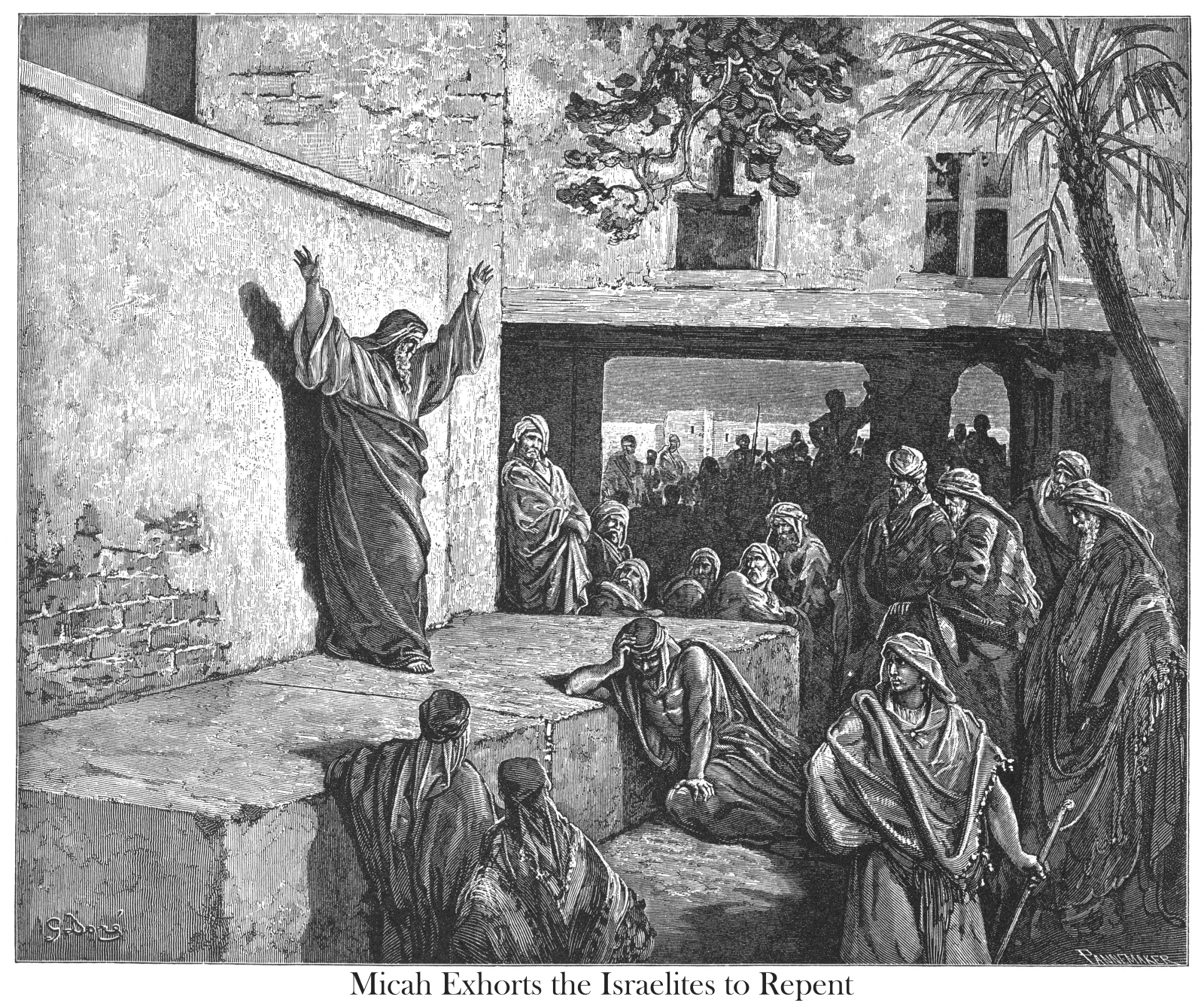
Micah Exhorts the Israelites to Repent
Micah 6:7-8 · World English Bible (Catholic)
7Will the LORD be pleased with thousands of rams? With tens of thousands of rivers of oil? Shall I give my firstborn for my disobedience? The fruit of my body for the sin of my soul?
8He has shown you, O man, what is good. What does the LORD require of you, but to act justly, to love mercy, and to walk humbly with your God?
With both hands raised, Micah stands on a broad stone terrace. His dark figure stands out against the pale wall; his shadow extends his silhouette across it. At his feet, the nearly empty surface stretches towards a crowd gathered below. The prophet towers over the assembly, yet a space separates him from those he addresses.
At the edge of the terrace, a seated man rests his head on his hand. His posture holds the eye: very close to the prophet, he offers no visible gesture in reply. Around him, some faces turn towards Micah, while other figures remain grouped on the right or press together beneath the dark opening at the back. The words reach an assembly whose members’ attitudes are not all alike. The title speaks of repentance; the engraving nevertheless leaves open each person’s response.
In Micah, a question precedes the divine demand: what should one bring before God? The offerings contemplated grow immense in scale, reaching the terrible question of giving one’s firstborn for one’s transgression. Then comes an answer of a different order: to practise justice, love mercy, and walk humbly with God. No ram, no flood of oil occupies the terrace. In place of these offered or imagined gifts, it is people who fill the scene.
The passage describes neither this gathering nor the seated man’s posture. The engraving thus gives a place and bodies to words that, in the verses, move from questioning sacrifice to a demand addressed to humanity. Micah’s raised arm and the bowed head beside him do not, by themselves, say what justice is. They make palpable the distance between words proclaimed in public and the manner in which they may be received.