Gustave Doré · 2 Maccabees 9:7, 9
The Punishment of Antiochus
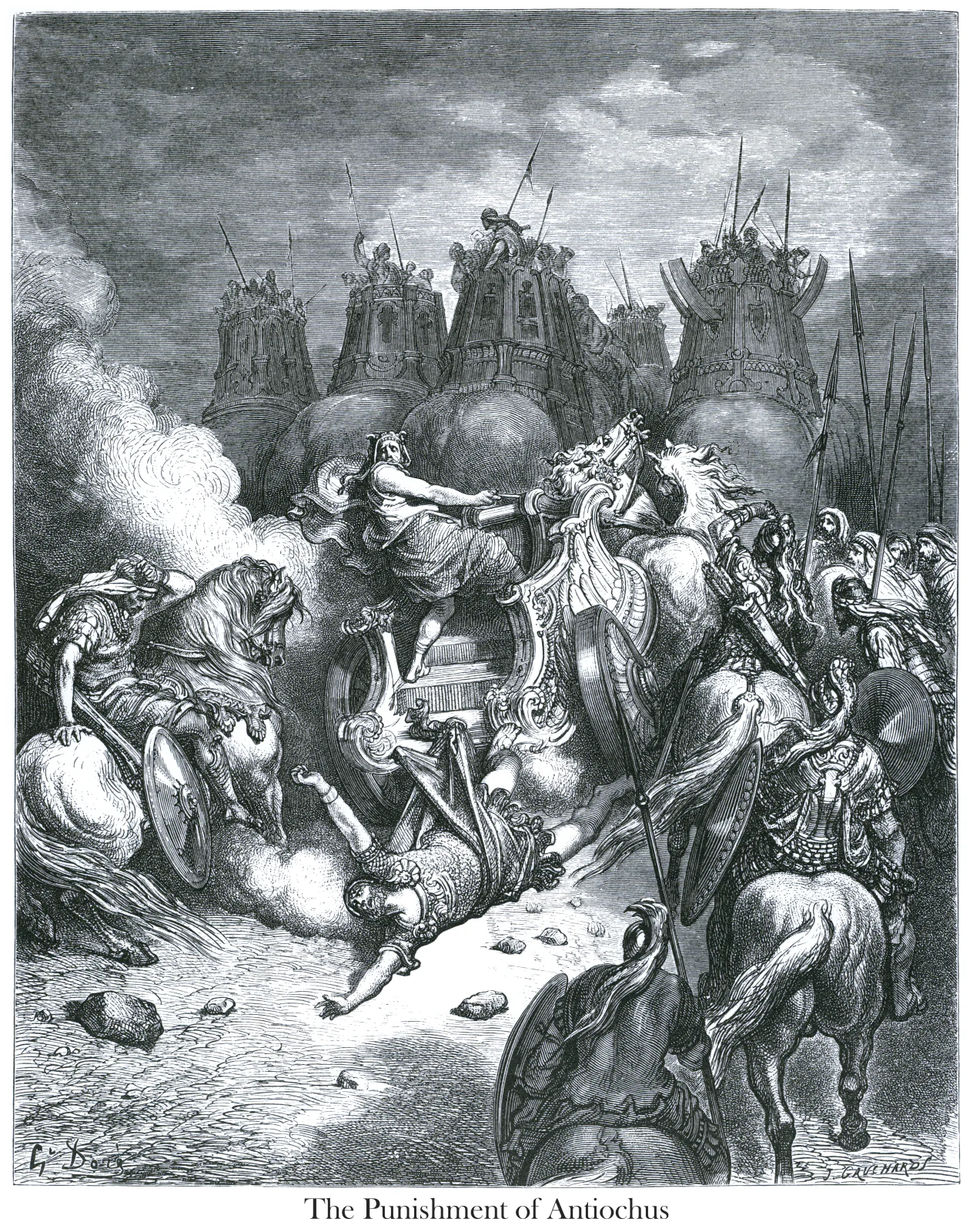
2 Maccabees 9:7, 9 · World English Bible (Catholic)
7But he in no way ceased from his rude insolence. No, he was filled with even more arrogance, breathing fire in his passion against the Jews, and giving orders to hasten the journey. But it came to pass moreover that he fell from his chariot as it rushed along, and having a grievous fall was tortured in all of the members of his body.
8He who had just supposed himself to have the waves of the sea at his bidding because he was so superhumanly arrogant, and who thought to weigh the heights of the mountains in a balance, was now brought to the ground and carried in a litter, showing to all that the power was obviously God’s,
9so that worms swarmed out of the impious man’s body, and while he was still living in anguish and pain, his flesh fell off, and by reason of the stench all the army turned with loathing from his decay.
A hand reaches out onto the road, a few stones from the chariot wheel. Antiochus has just fallen: his body crosses the foreground diagonally, while his legs remain close to the vehicle. The driver, still standing, turns towards him without releasing the reins. In the same movement, his gaze turns back and his arms remain stretched towards the horses. The chariot has not yet moved away from the fallen man.
Around the body, the riders and mounts close in, tightening the space. Higher up, behind the chariot, the mass of elephants topped with towers and soldiers extends the army’s advance. Their height makes the space occupied by Antiochus seem lower still. Amid this moving force, the fallen figure no longer controls the direction of his own body.
The Second Book of Maccabees gives the accident a precise significance. Antiochus, still full of anger against the Jews, was ordering the pace to be quickened when the crash of the chariot was interrupted by his fall. The text adds that all his limbs were bruised. Doré captures this moment, before the king is carried away on a litter. The worms and flesh falling away, mentioned later, cannot be discerned on the clothed body; the stench that sickens the army also eludes the engraving. The prolonged degradation of the text takes the form here of a sudden reversal.
The contrast between the lofty towers and the hand resting on the ground echoes another measure in the passage: he who imagined himself as high as the mountains is now hurled to the ground. Scripture sees in this fall the manifestation of God’s power. The engraving, for its part, leaves this power without a visible figure; it presents a man rendered vulnerable among the forces he once commanded.