Gustave Doré · 1 Maccabees 2:23-24
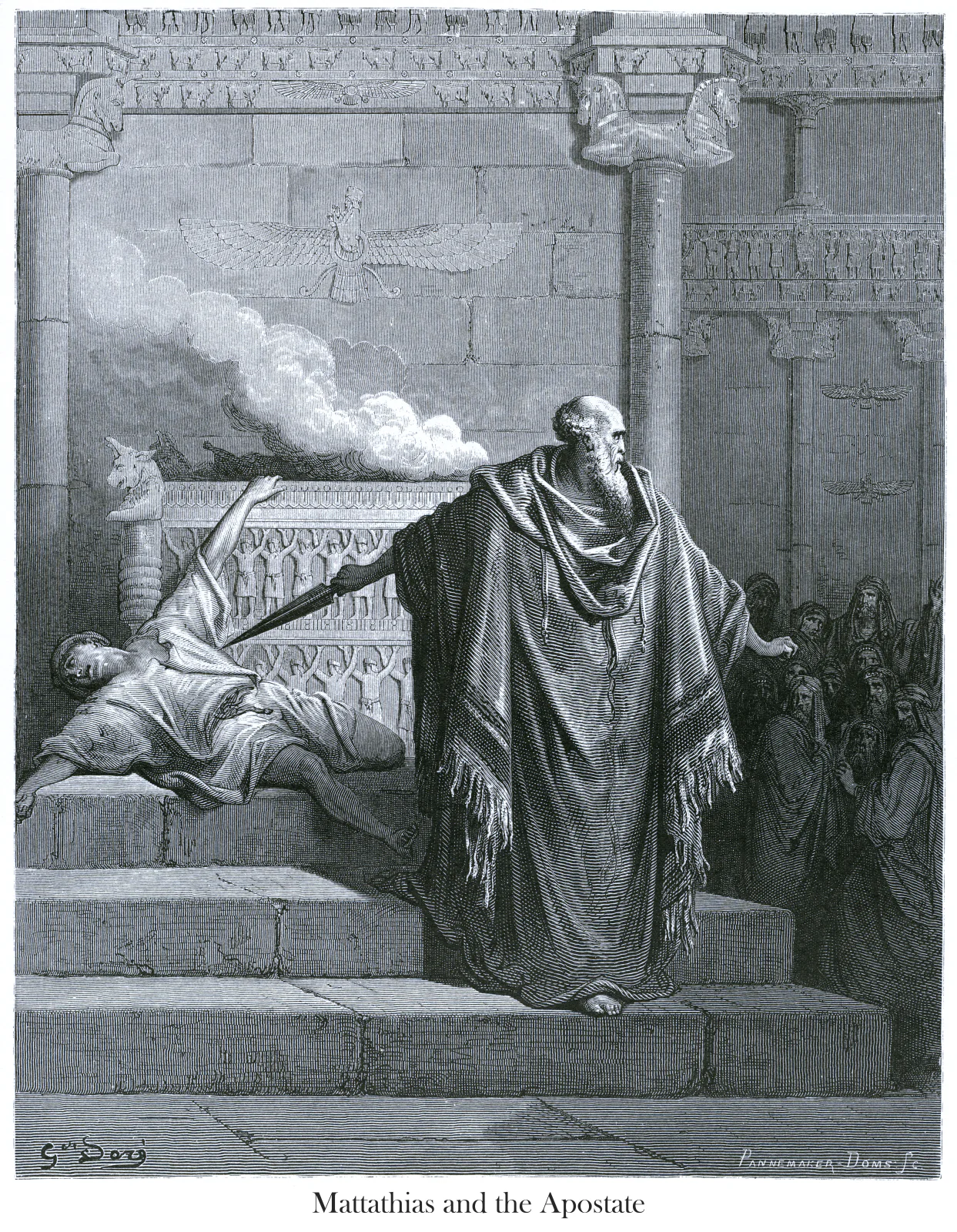
Mattathias and the Apostate
1 Maccabees 2:23-24 · World English Bible (Catholic)
23When he had finished speaking these words, a Jew came in the sight of all to sacrifice on the altar which was at Modin, according to the king’s commandment.
24Mattathias saw it, so his zeal was kindled, and his guts trembled, and he vented his wrath according to judgment, and ran and killed him upon the altar.
Mattathias’s blade remains extended toward the man lying behind him, while his face turns toward the group gathered on the right. His body occupies the center of the steps; his outstretched arms connect the victim with those witnessing the scene. The murderous gesture does not vanish when his gaze turns away: the weapon’s point remains close to the fallen body.
The fallen man, dressed in light-colored clothing, has one arm raised toward the altar and the other left hanging on the step. Behind him, thick smoke still rises from the sacrificial table. The altar stands, covered with carved figures, beneath a large winged image depicted on the wall. The interrupted ceremony remains present in this smoke and in the arm raised before it. In the foreground, Mattathias partly blocks the passage between the altar and the crowd; the faces packed together on the right look toward him or toward the place of sacrifice.
The First Book of Maccabees places this act immediately after Mattathias refuses to obey the king’s orders. A Jew comes forward publicly to sacrifice at the altar in Modein; Mattathias, seized with indignation, rushes upon him and kills him. The text describes an anger “according to the law.” The engraving gives this reaction a face already turned toward the witnesses and an almost motionless body, though his armed arm still extends the violence.
The immediate sequel also recounts the death of the royal officer and the overthrow of the altar. Here, no second victim can be distinguished, and the altar is still smoking. What remains in view is the sacrifice thwarted by a murder: devotion to worship and the violence committed in its name are brought together before the assembly. The contrast between the narrative’s swift action and this upright figure leaves time to consider their proximity.