Gustave Doré · Esther 15:6-7
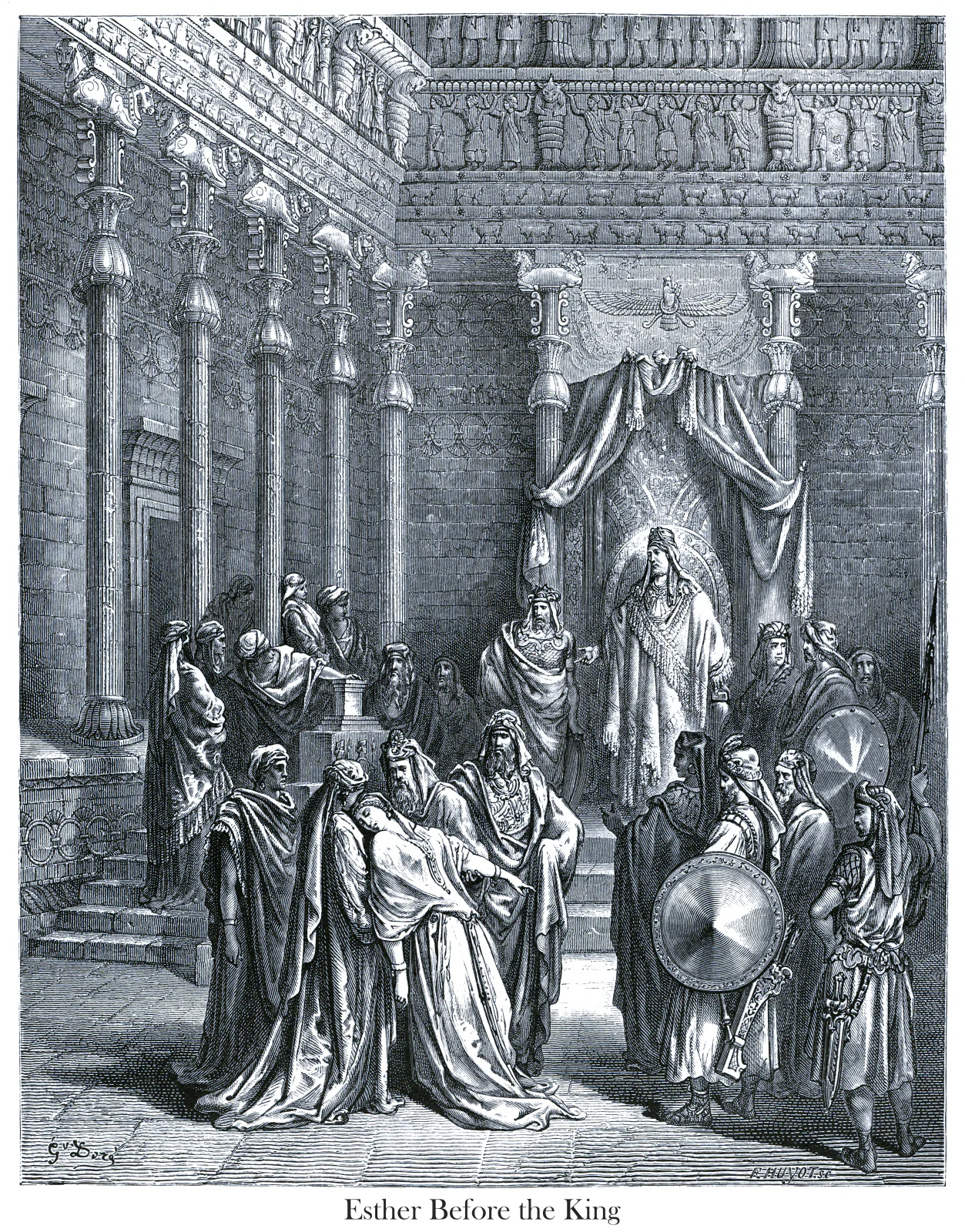
Esther Before the King
The Scripture passage associated with this engraving is available in the reading view.
Open the passageEsther’s head rests against a woman’s shoulder; her arm hangs down, while her light-colored dress spreads across the floor. At the foot of the steps, her leaning body disrupts the court’s solemn composure. Around her, several figures draw closer or turn toward her. Higher up, before the throne, a figure stands beneath a vast canopy.
The distance between the two groups gives the scene its measure. Esther is in the foreground, but the columns and steps lead the eye toward the elevated seat. The guards and their large shields occupy the right side; on the left, the row of columns seems to extend the depth of the hall. In this space ordered around power, the queen’s body can no longer remain upright.
The verses of Esther 15 also emphasize support: the queen walks with two attendants, one supporting her, the other lifting her long robe. Doré preserves the closeness of a woman beside Esther, but makes her weakness far more evident. Instead of remaining a garment worn and lifted, the robe forms a broad train spread across the ground. The precise role of the second attendant is less discernible in the closely gathered crowd.
The surrounding text gives this fragility a secret: beneath an amiable face, fear grips Esther’s heart. In the engraving, her bowed face and limp limbs instead lay bare a distress the court can see. The same passage recalls that before appearing in this way, she invoked God. This prayer has no distinct sign in the hall; yet it accompanies the reading of this body supported by others. The queen presents herself before power in the splendor of her adornment, but she does not cross the space that separates her from it alone.