Gustave Doré · Esther 7:5-6
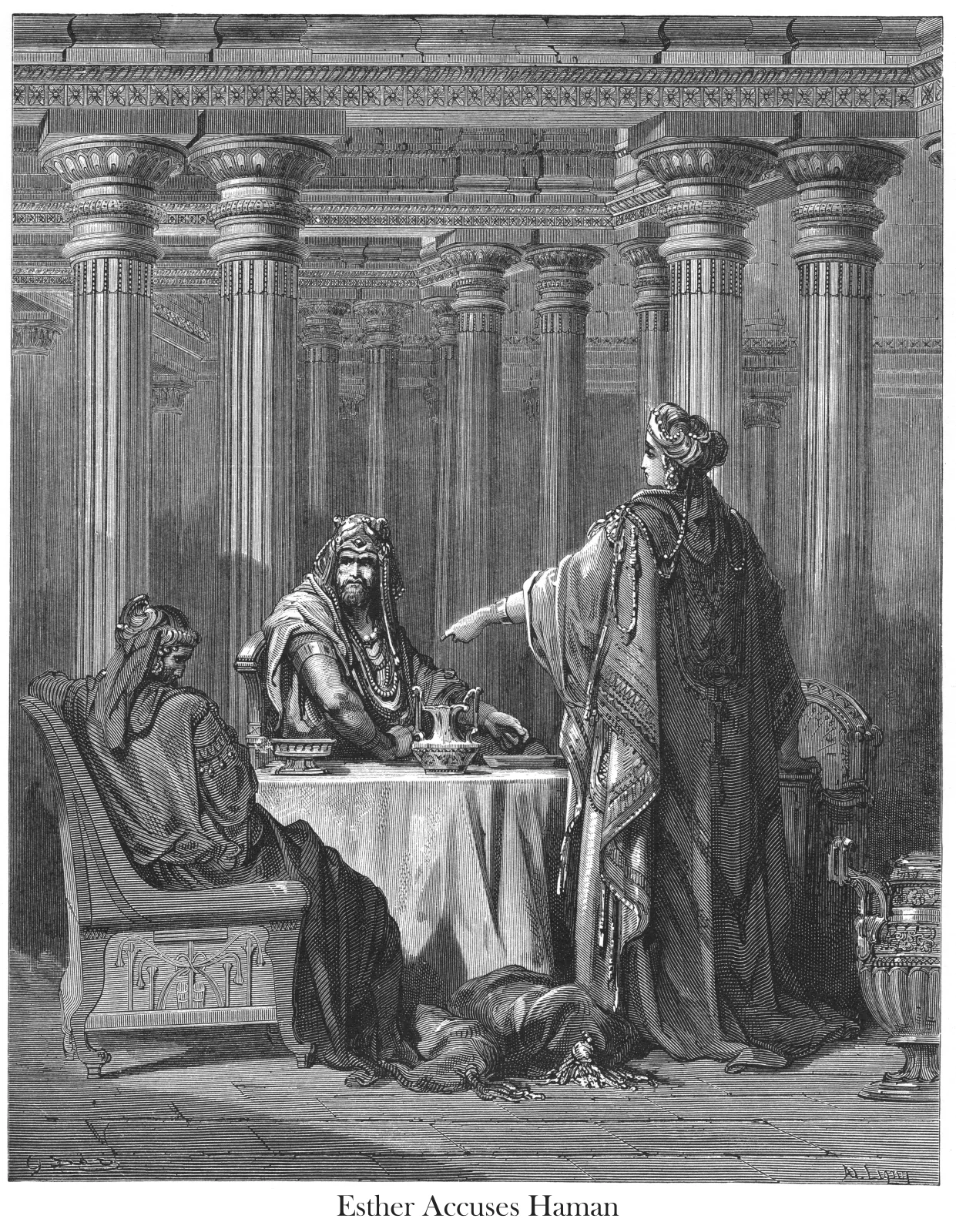
Esther Accuses Haman
Esther 7:5-6 · World English Bible (Catholic)
5The king said, “Who has dared to do this thing?”
6Esther said, “The enemy is Haman, this wicked man!” Then Haman was terrified in the presence of the king and the queen.
Esther’s arm reaches across the space above the table. Her finger points to the man seated on the left, whose face remains partly hidden. Between them, the king turns his head toward the man the queen accuses. A single gesture is enough to link the three figures and break the stillness of the feast.
Esther is standing. Her mantle falls to the floor, while her outstretched arm emerges from the abundance of the drapery. Haman, by contrast, remains seated at an angle, his back largely turned toward the viewer. His bowed head reveals little of his expression. Yet the text tells of his terror: Doré does not convey it through an uncovered face or spectacular agitation. Haman’s position, apart from the queen’s gesture and beneath the king’s gaze, gives this fear a more restrained form.
Ahasuerus has just asked who threatens Esther and her people. The queen’s answer names Haman as oppressor and enemy. In the engraving, this speech takes the form of a pointing gesture: the man who was a guest becomes the accused. The table remains set, and the cup and vessels are still there; nothing has changed among the objects of the meal, but the position of the seated man has changed.
The palace’s lofty columns tower over the encounter. They give Esther’s gesture a public significance, although the people of whom she speaks are absent. The preceding verse links her own fate to that of her people; here, this solidarity takes shape in the words of a single woman before the king. The gap raises a question of justice: how can the threatened lives of an entire people be made heard within the closed space where their fate is decided? The outstretched finger first leads the eye to a name.