Gustave Doré · Esther 1:11-12
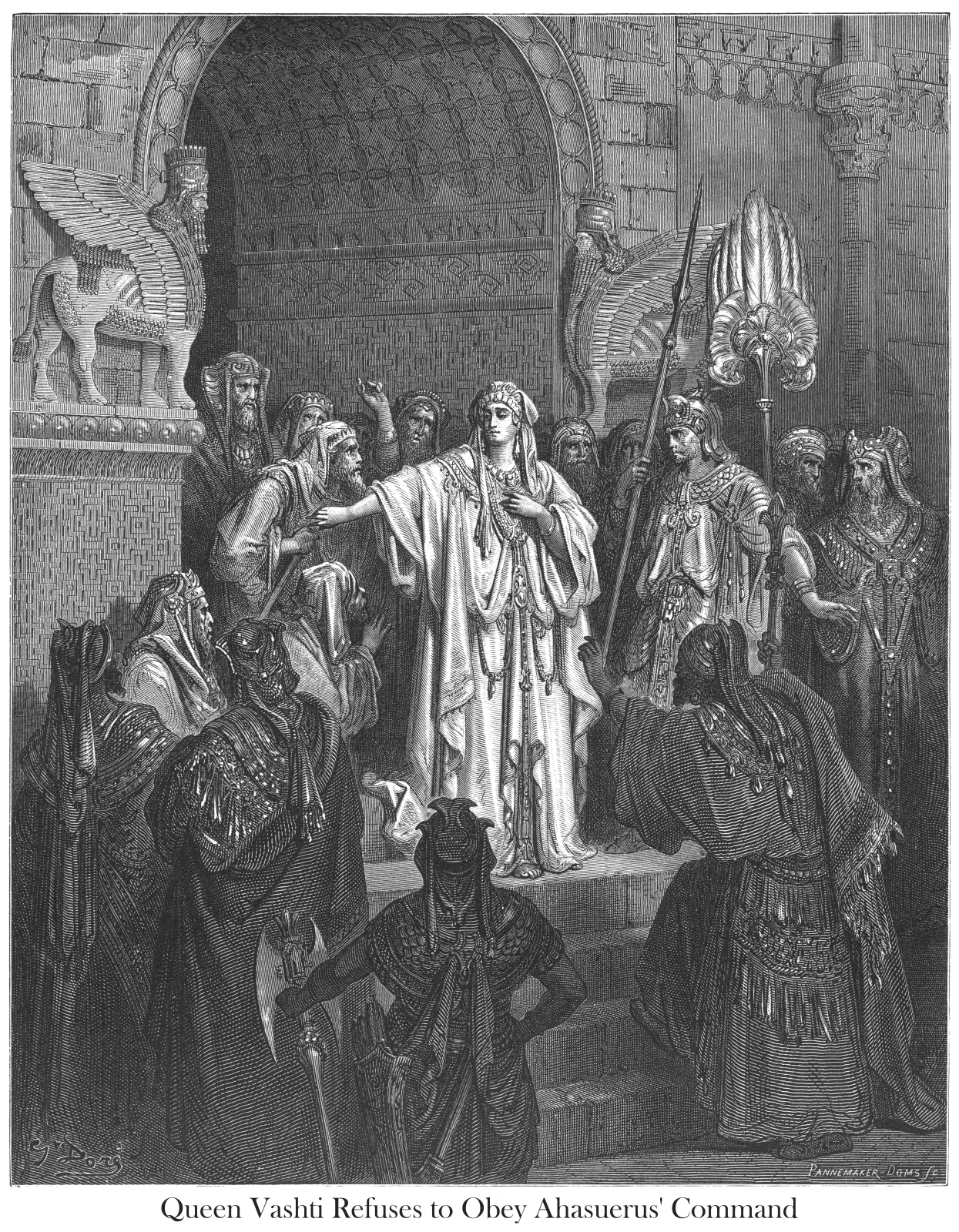
Queen Vashti Refuses to Obey Ahasuerus' Command
Esther 1:11-12 · World English Bible (Catholic)
11to bring in the queen to him, to enthrone her, and crown her with the diadem, and to show her to the princes, and her beauty to the nations, for she was beautiful.
12But queen Vashti refused to come with the chamberlains; so the king was grieved and angered.
Vashti extends her arm toward the man bowing before her. Her other hand rests on her chest. Between these two gestures, one directed toward the man approaching her, the other turned back toward herself, her refusal takes visible form. The queen stands on a dais, surrounded by figures, several of whom raise their hands or turn toward her. Her light-colored dress sets her figure apart from the dark group.
This gathering gives the refusal a paradoxical publicness. Ahasuerus wanted Vashti brought before the peoples and nobles to show them her beauty. Yet here she is already exposed to view in the engraving, placed at the center of a circle of men. But her presence among them does not mean that she has yielded: her outstretched arm interrupts the approach rather than leading her body forward. The clothing and jewels that mark her rank themselves attract the eye, while her gesture contests the direction imposed on her.
The text of Esther is briefer about the refusal. It reports neither the queen’s words nor the reasons for her decision; it specifies that the order was conveyed to her by the eunuchs. Doré gives this response a setting and gestures that the passage does not describe. Ahasuerus’ anger, mentioned immediately afterward in the Bible, is not here the identifiable center of the scene: attention remains fixed on Vashti and those surrounding her.
The distance between the royal command and its execution thus becomes a distance between bodies. A power seeks to command a person’s presence; a gesture resists it. Without attributing to Vashti motives on which the text is silent, this resistance raises a question about the dignity of the woman whom they ask to display: her beauty may be admired, but is that enough to make her available?