Gustave Doré · Ezra 7:13
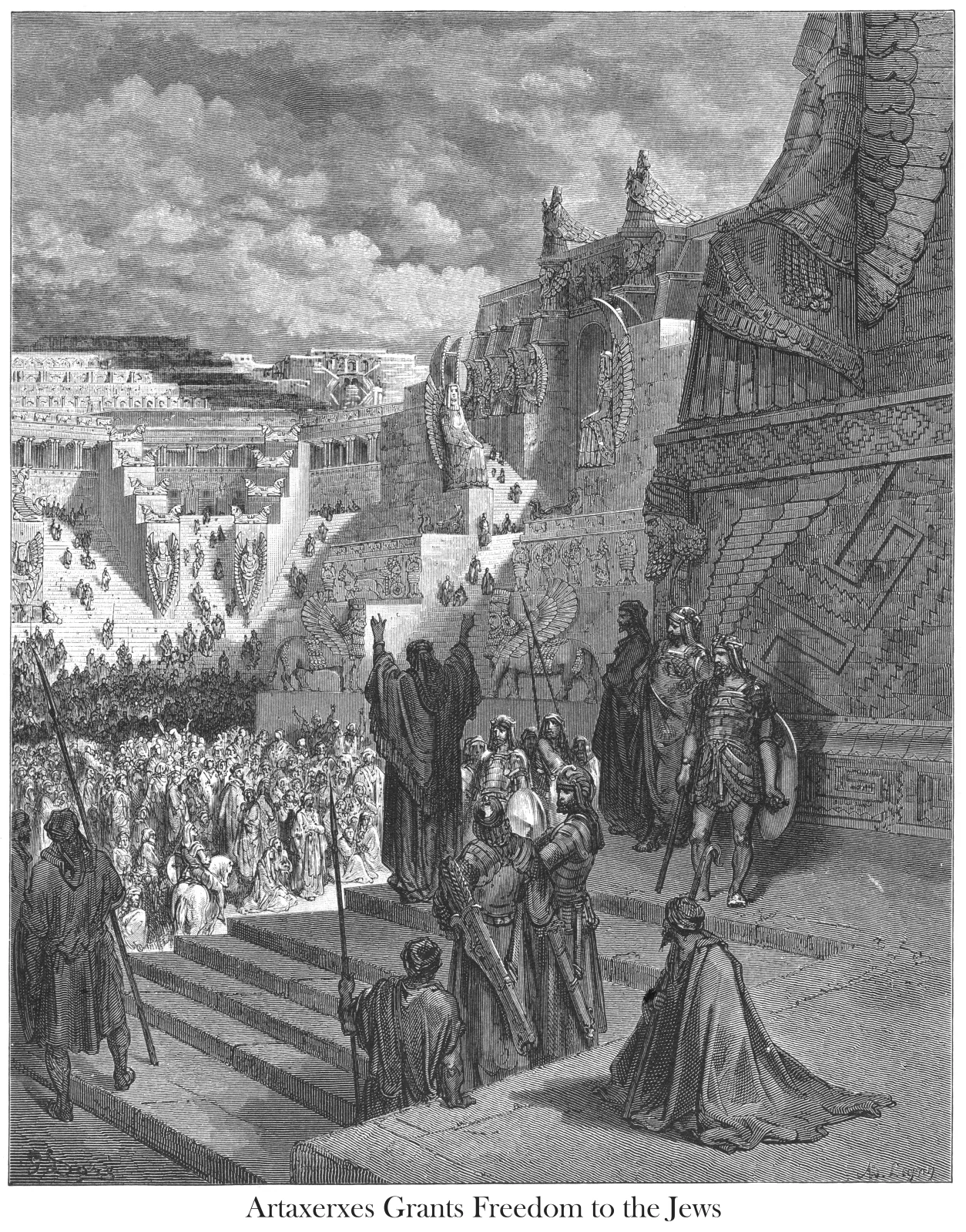
Artaxerxes Grants Freedom to the Jews
Ezra 7:13 · World English Bible (Catholic)
13I make a decree that all those of the people of Israel and their priests and the Levites in my realm, who intend of their own free will to go to Jerusalem, go with you.
At the edge of the staircase, a man seen from behind raises both arms toward the crowd. His dark silhouette separates the armed figures occupying the terrace from the tightly gathered assembly below. The gesture spans this distance: it presents a public address, though it is impossible to determine with certainty who is speaking.
Behind him, the steps multiply, leading the eye toward the palace doors and terraces. The figures moving along them grow tiny as the architecture rises. In the foreground, an immense winged relief towers over the men standing near its base. Royal power is thus measured less by a clearly isolated sovereign figure than by the space it occupies and the guards who hold its approaches.
The catalogue title identifies Artaxerxes and the freedom granted to the Jews. The biblical passage specifies the nature of this permission: in a letter addressed to Ezra, priest and scribe, the king authorizes members of the people of Israel, priests, and Levites who wish to do so to leave with him for Jerusalem. The text does not describe the proclamation before a crowd that the engraving invites us to imagine. Here, the royal writing becomes a collective event, unfolding on the steps of a palace.
This shift matters. The letter names a destination and leaves room for the desire to depart; the crowd, by contrast, is still gathered at the foot of the power that permits this departure. No road to Jerusalem is visible. Rather, the broad staircases offer the image of a threshold, where a royal decision can reach those whom it concerns. In the text, this decision also accompanies Ezra’s mission, to inspect Judah and Jerusalem according to the law of his God. Political authorization thus opens a journey whose religious horizon remains outside the frame.