Gustave Doré · Ezra 9:6
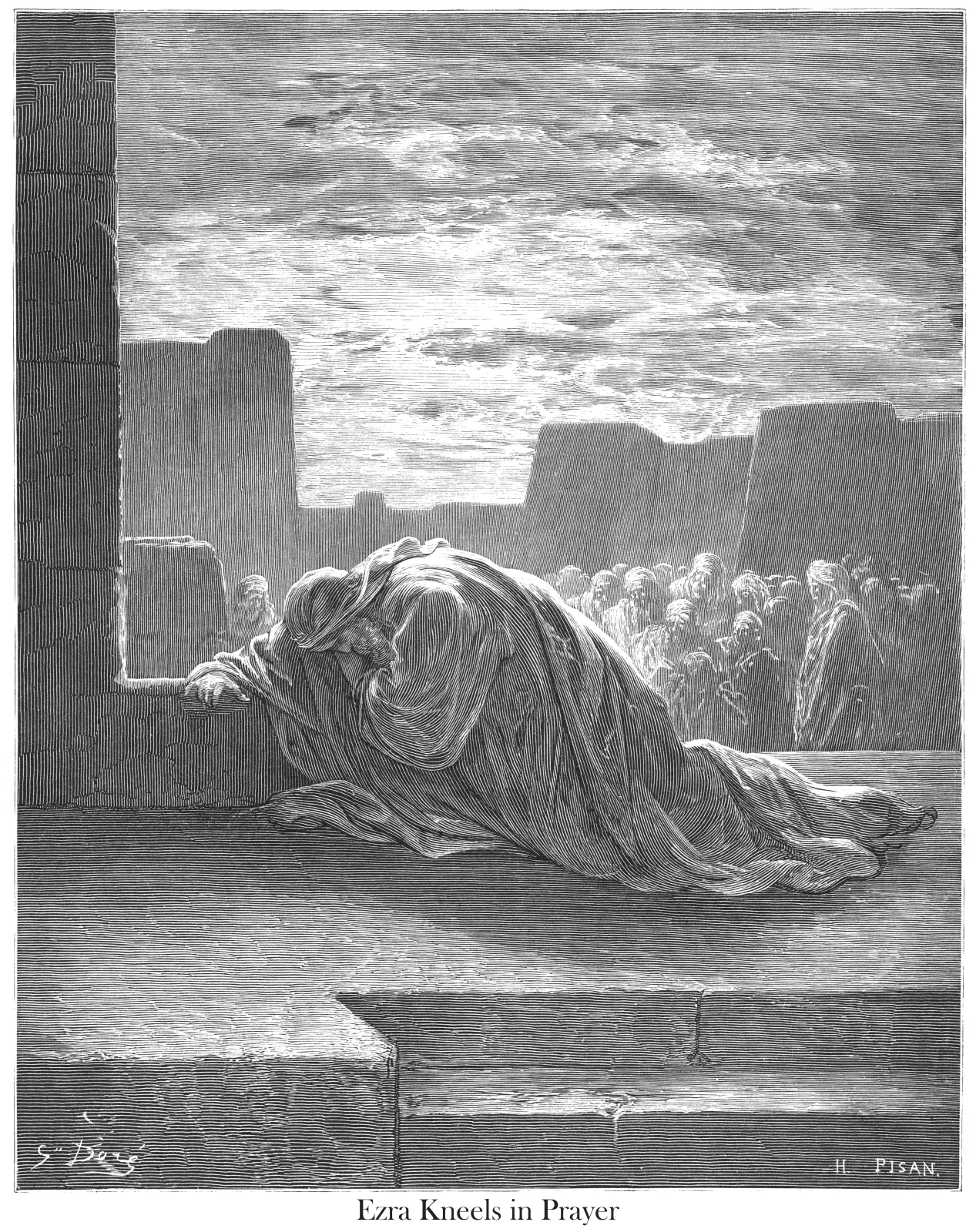
Ezra Kneels in Prayer
Ezra 9:6 · World English Bible (Catholic)
6and I said, “My God, I am ashamed and blush to lift up my face to you, my God, for our iniquities have increased over our head, and our guiltiness has grown up to the heavens.
Ezra’s head sinks down to his folded arm; his other hand rests on the stone. Kneeling, his body almost prone, he fills the foreground along the full length of his cloak. The folds draw the eye to the right, while his face remains buried near the wall. His eyes are nowhere to be seen.
Behind him, a group stands at a distance. Several faces are turned toward the kneeling figure, but none shares his place at the front of the terrace. This separation gives particular significance to his posture: Ezra is alone in his gesture, without being cut off from those gathered near him. His prayer uses the first person precisely to speak of a shared fault. He confesses his shame before God, then speaks of “our iniquities” and “our guilt.”
The text specifies that, at the time of the evening offering, Ezra falls to his knees, his hands outstretched toward God. The engraving retains the kneeling posture, but his hands are not raised: one is braced against the stone, the other drawn back near his face. This change makes palpable a statement in the following verse: Ezra says he is too ashamed to lift his face. Here the movement of prayer passes through the inclination of the body rather than the extension of the arms.
Above the dark walls, a broad expanse of sky opens up. In the confession, guilt has grown until it rises above the heads and reaches the heavens; in the engraving, this space looms over the group and the prostrate figure. Yet it gives no visible form to the guilt. It leaves open the distance toward which Ezra speaks without being able to lift his eyes. Further on, his prayer will also acknowledge the mercy granted to the people: these words are not yet represented, but they belong to the same movement of supplication.