Gustave Doré · Nehemiah 2:13
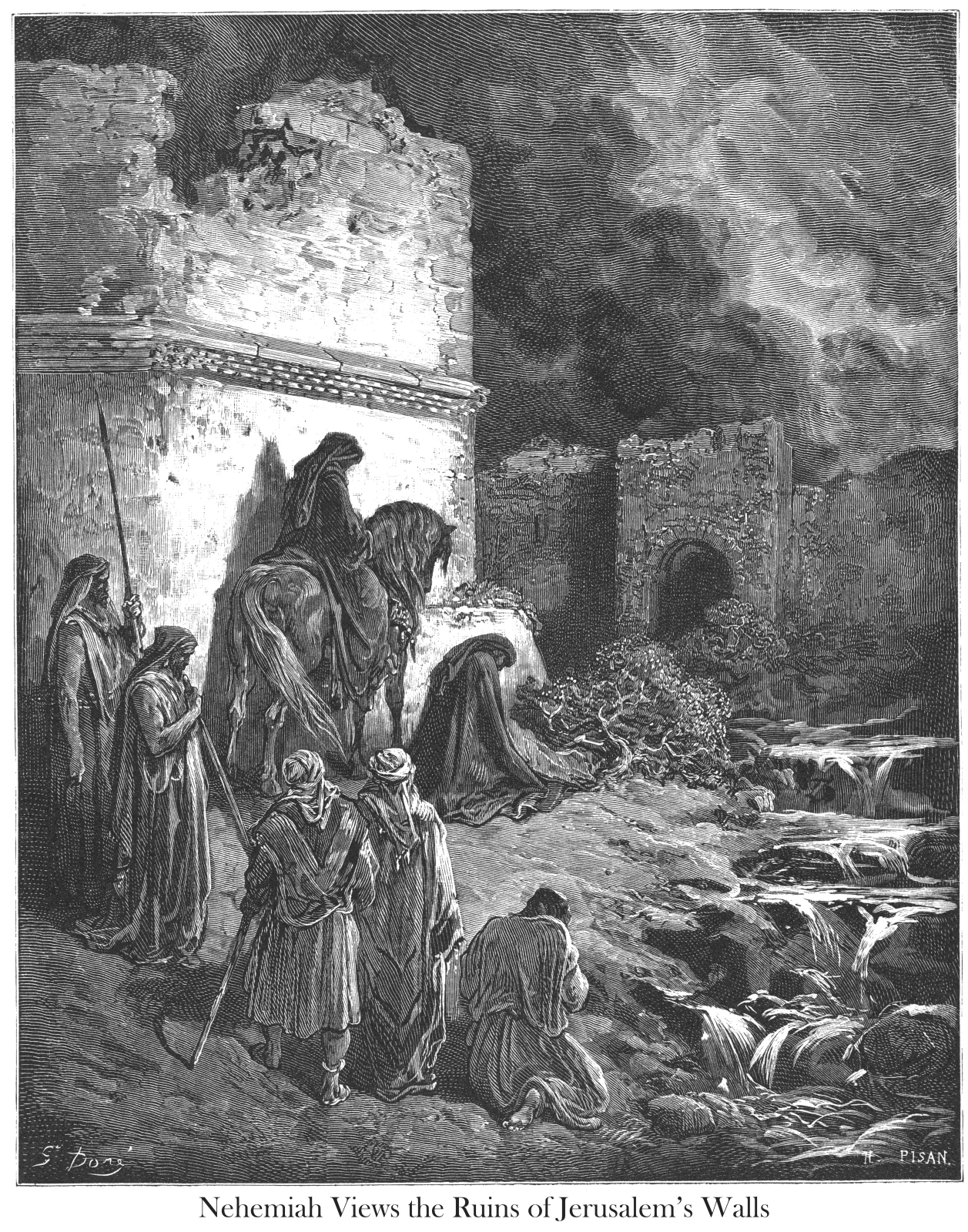
Nehemiah Views the Ruins of Jerusalem's Walls
Nehemiah 2:13 · World English Bible (Catholic)
13I went out by night by the valley gate toward the jackal’s well, then to the dung gate; and I inspected the walls of Jerusalem, which were broken down, and its gates were consumed with fire.
The mount has lowered its head. Its rider, Nehemiah, remains motionless before the broken stones; behind him, several companions look in the same direction. To the right, a stream crosses uneven ground. Beyond it, a dark gate opens in a wall whose crest is jagged. The group has stopped some distance from this opening: the eye must pass over cluttered ground and brush before reaching it.
The nearest wall, on the left, is brightly lit. Its mass looms over the men, but its upper section is broken. The light does not reveal a protective enclosure: it exposes the break. Farther away, the gate still stands, while the darkness of its passage conceals whatever lies beyond it. These two fragments convey the extent of the ruin without offering a general view of Jerusalem.
Nehemiah recounts that he went out at night to inspect the demolished walls and the gates consumed by fire. He specifies that only a few men accompanied him and that he had only his own mount. The engraving preserves this gathering and this single horse. It also gives space to the figures: a kneeling man in the foreground and a stooped figure near the rider introduce postures that the text does not describe. Their presence lends the inspection a gravity shared by all, without specifying what each person thinks or does.
The account says that a little farther on the way becomes too narrow for the mount. Here, the halt comes before that detail: the rough terrain before the group conveys the difficulty of moving forward. Nehemiah has not revealed what God has put into his heart for Jerusalem. Before any public words, his nighttime inspection takes the form of close attention to the breaches; the engraving makes it a silent vigil before the wounded city.