Gustave Doré · Ezra 1:7-8
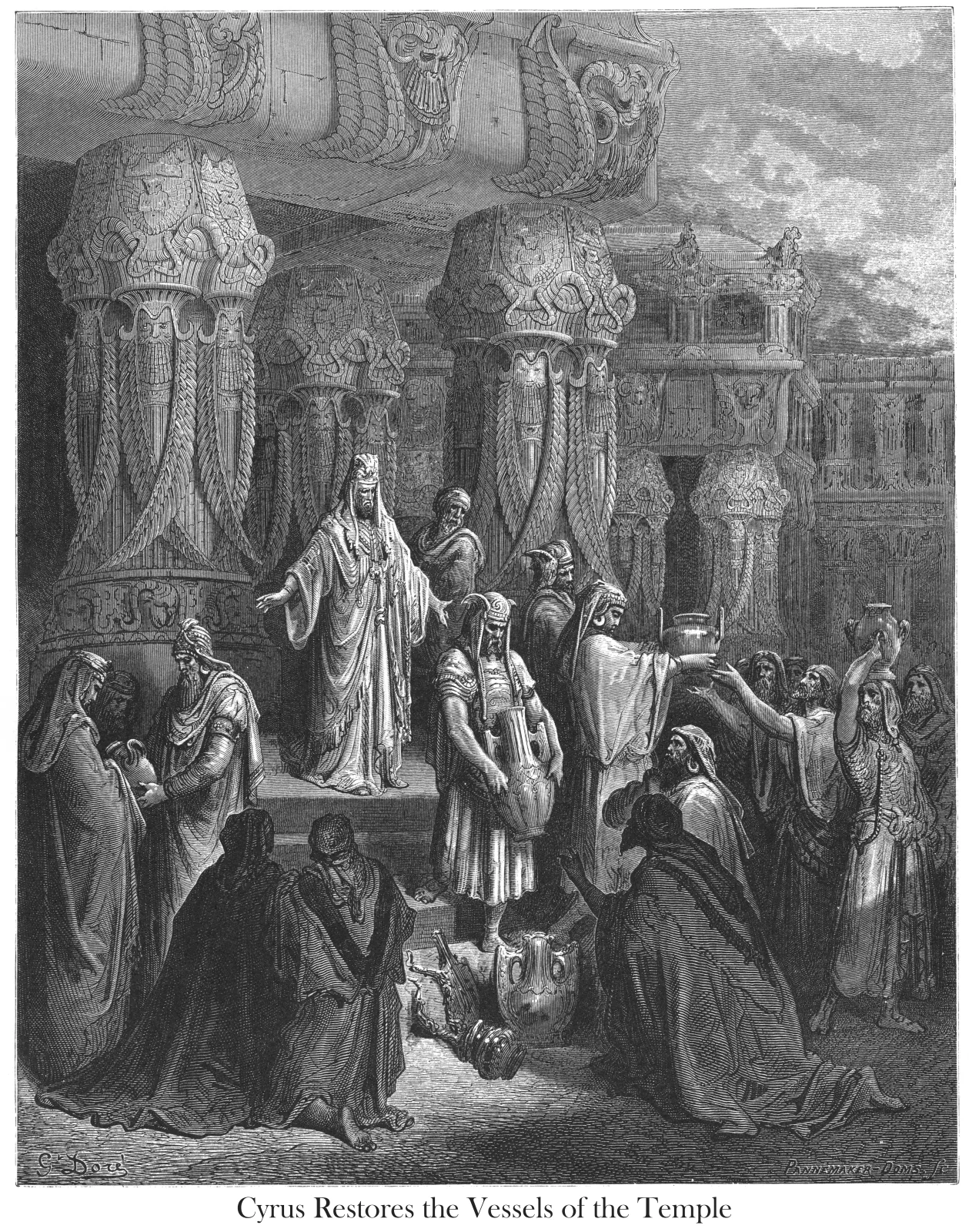
Cyrus Restores the Vessels of the Temple
Ezra 1:7-8 · World English Bible (Catholic)
7Also Cyrus the king brought out the vessels of the LORD’s house, which Nebuchadnezzar had brought out of Jerusalem, and had put in the house of his gods;
8even those, Cyrus king of Persia brought out by the hand of Mithredath the treasurer, and counted them out to Sheshbazzar the prince of Judah.
On the right, a vessel passes from hand to hand. Two men are still supporting it as their arms meet: the transfer is contained in this contact. Below, other vessels await on the ground, while at the center a bearer holds a large, ornamented object close to himself. The objects do not form an immobile treasure; they are moving before the eyes of an assembly.
On the platform, Cyrus stretches out his arms. His position towers over the bearers, but his gesture also accompanies the movement that runs through the scene. To his left and to his right, figures draw together around the vessels. The kneeling men in the foreground turn their backs or their profiles toward us: their posture lends the handover a solemnity that goes beyond the mere handling of precious objects.
The Book of Ezra names the stages of this restitution. Cyrus entrusts the vessels to Mithredath, his treasurer; Mithredath hands them over, counting them, to Sheshbazzar, prince of Judah. Before this, Nebuchadnezzar had taken them from Jerusalem and placed them in the house of his god. The passage that follows begins to specify their number. Each object thus belongs to a history of dispossession before it figures in an accounting of restitution.
Doré gives this operation ceremonial breadth. The massive columns, covered with winged figures and carved motifs, loom over the men and the vessels. Their decoration occupies almost as much of the viewer’s attention as the participants: the restitution takes place in a setting of foreign royal power, not in the house of Yahweh from which the objects were removed. The text describes neither this place nor these precise gestures.
The vessel held between two pairs of hands makes visible a moment that the account alone cannot preserve. The vessels from the house of Yahweh are changing hands once more; this time, their transfer opens up the possibility of their return to their destination.