Gustave Doré · 2 Chronicles 23:13-15
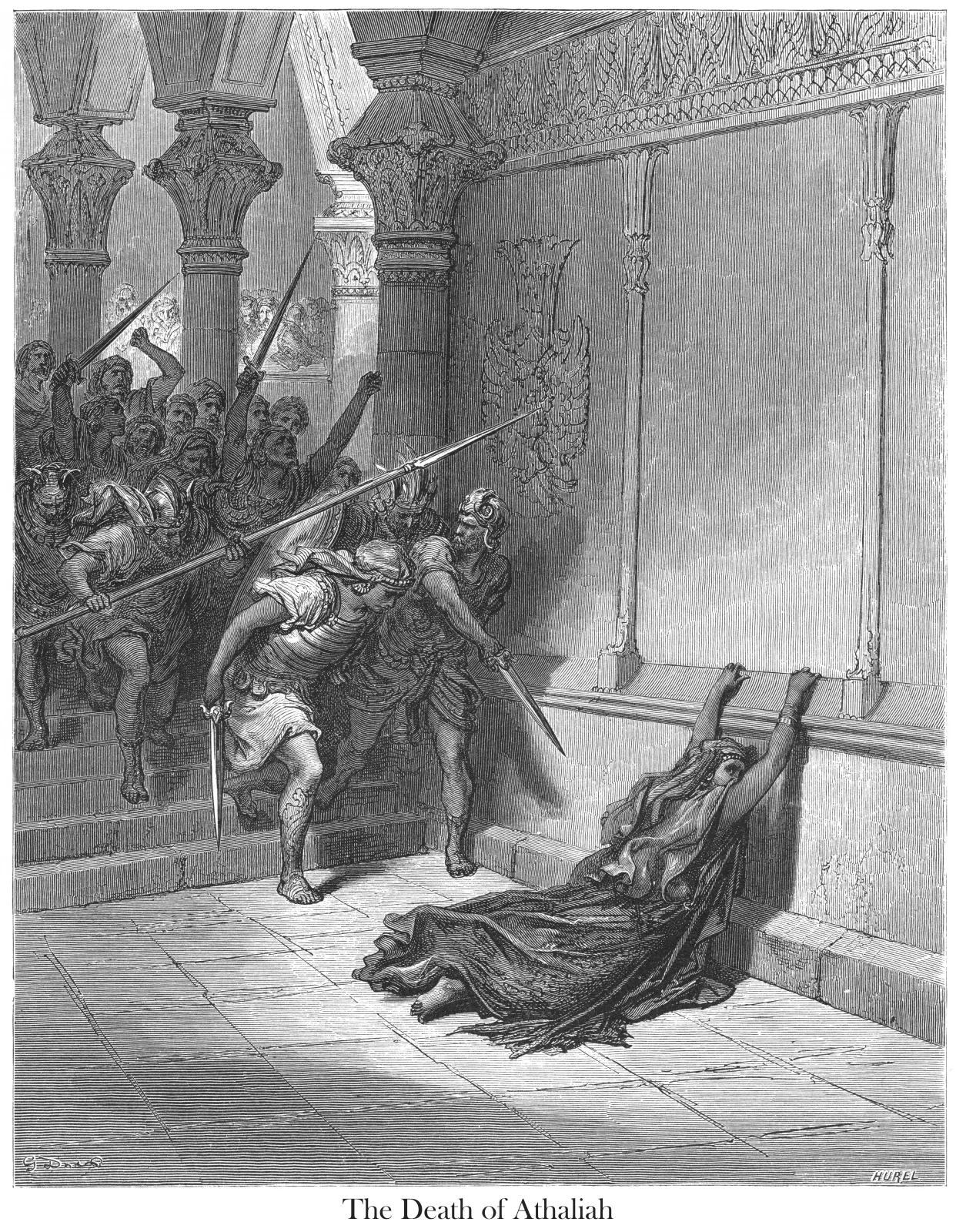
The Death of Athaliah
2 Chronicles 23:13-15 · World English Bible (Catholic)
13Then she looked, and behold, the king stood by his pillar at the entrance, with the captains and the trumpeters by the king. All the people of the land rejoiced and blew trumpets. The singers also played musical instruments, and led the singing of praise. Then Athaliah tore her clothes, and said, “Treason! treason!”
14Jehoiada the priest brought out the captains of hundreds who were set over the army, and said to them, “Bring her out between the ranks; and whoever follows her, let him be slain with the sword.” For the priest said, “Don’t kill her in the LORD’s house.”
15So they made way for her. She went to the entrance of the horse gate to the king’s house; and they killed her there.
Both of Athaliah’s hands clutch the projection of a wall. Her body has slid to the ground; her garments spread across the flagstones, while her arms remain stretched above her head. On the left, armed men descend the steps. A sword is pointed at her, but no blow has yet struck her.
The distance separating the woman from the soldiers is narrow. Yet it is enough to suspend the killing announced by the title. Behind the first men, a crowd presses beneath the columns, raising its arms and weapons. Athaliah, by contrast, has no one at her side. The broad expanse of wall, almost bare above her figure, heightens this isolation: her hands find a hold there, but no visible way out.
The Book of Chronicles first gives voice to a very different tumult. Drawn by the people’s acclamations, Athaliah comes to the house of Yahweh; she sees the king surrounded by the leaders and trumpeters. She then tears her clothes and cries out that there is a conspiracy. In the engraving, neither the king nor the ceremony can be recognized. The gathering still fills the space, but now it accompanies the men marching against her.
Jehoiada orders that Athaliah be led out of the house of Yahweh, where he forbids her to be killed. The text places her death at the entrance to the Horse Gate, toward the king’s house. The architecture in the engraving does not allow this precise location to be identified with certainty. It focuses above all on the moment when collective resolve closes in on a body trapped with nowhere to turn.
The passage goes on to recount the covenant Jehoiada makes between himself, the people, and the king. Set before it, Athaliah’s death remains bound up with a separation: the sacred place must be kept from the execution. The engraving leaves this boundary difficult to locate and shows instead the tiny space that remains before the blow.