Gustave Doré · 1 Chronicles 21:16
The Plague of Jerusalem
1 Chronicles 21:16 · World English Bible (Catholic)
16David lifted up his eyes, and saw the LORD’s angel standing between earth and the sky, having a drawn sword in his hand stretched out over Jerusalem. Then David and the elders, clothed in sackcloth, fell on their faces.
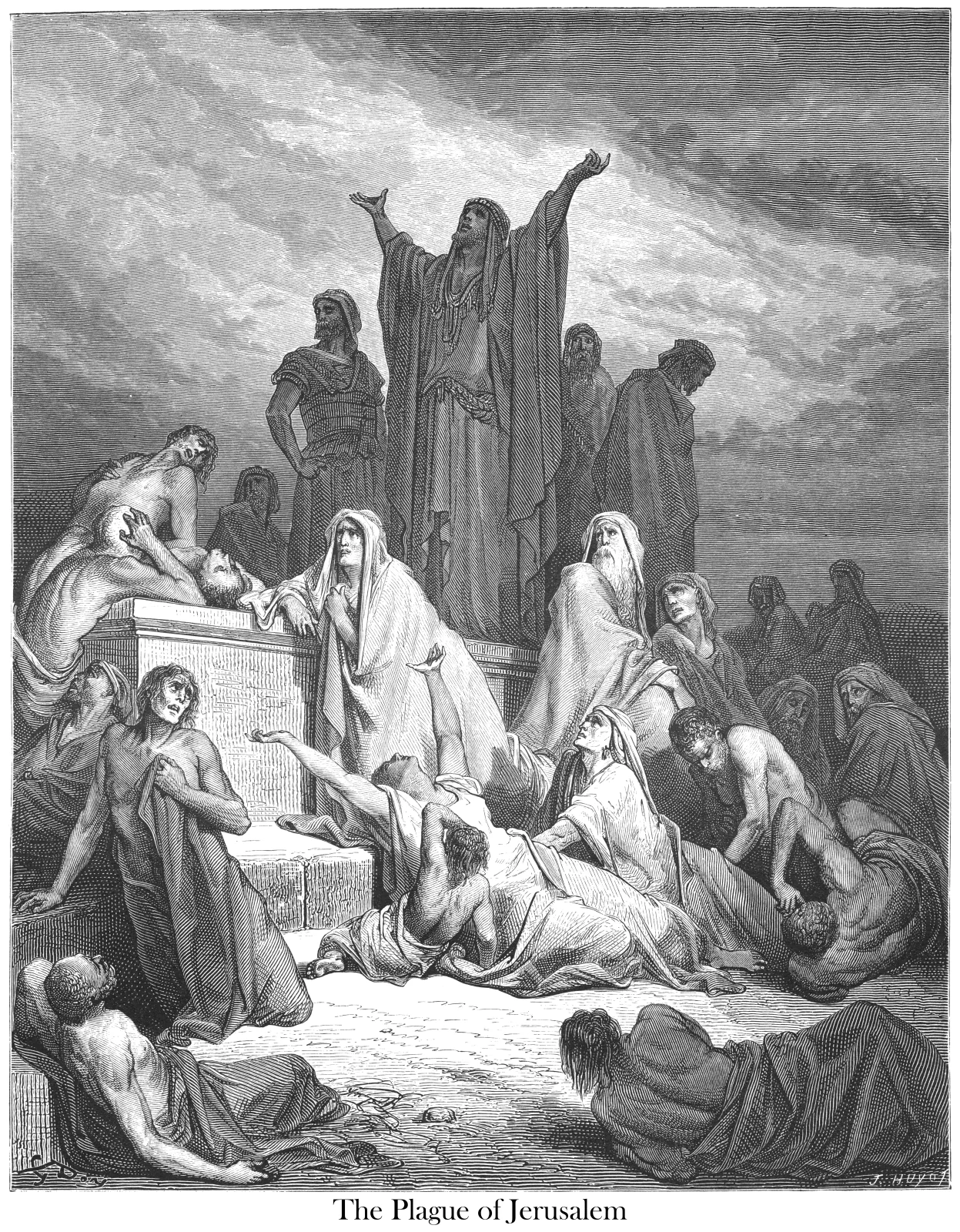
Above the outstretched bodies, a standing man raises both arms toward the sky. His figure rises above the crowd, but his open hands hold nothing. Around him, gazes scatter: some turn upward, others lower toward those on the ground. The sky occupies a large part of the engraving; no angel appears there.
This absence shifts the scene announced by the biblical reference. In the First Book of Chronicles, David looks up and sees the angel of Yahweh between earth and heaven, with a drawn sword turned against Jerusalem. Then the king and the elders, clothed in sackcloth, fall facedown. Here the central figure remains standing. His gesture may suggest supplication, though the image alone does not allow him to be identified with certainty as David. The sword and the angel are missing; yet the hands are still directed toward the sky where the text locates the threat.
Lower down, another pair of arms reaches up from the ground. This gesture echoes that of the standing man, but belongs to someone overturned among the others. Between them, a woman leaning against a ledge looks upward. The catastrophe does not take the form of a battle: it immobilizes the bodies and leaves the survivors beside them. The title names the plague; the passage recounts that it has already caused seventy thousand deaths in Israel.
The text then gives David a precise utterance: he acknowledges that he ordered the census and asks that the punishment fall on him, rather than on the people. The engraving does not make these words audible. Yet by bringing the raised gesture close to the bodies lying on the ground, it gives a place to David’s question: how can one answer before God for a calamity that strikes others?