Gustave Doré · 2 Kings 2:23-24
Children Mauled by Bears
2 Kings 2:23-24 · World English Bible (Catholic)
23He went up from there to Bethel. As he was going up by the way, some youths came out of the city and mocked him, and said to him, “Go up, you baldy! Go up, you baldy!”
24He looked behind him and saw them, and cursed them in the LORD’s name. Then two female bears came out of the woods and mauled forty-two of those youths.
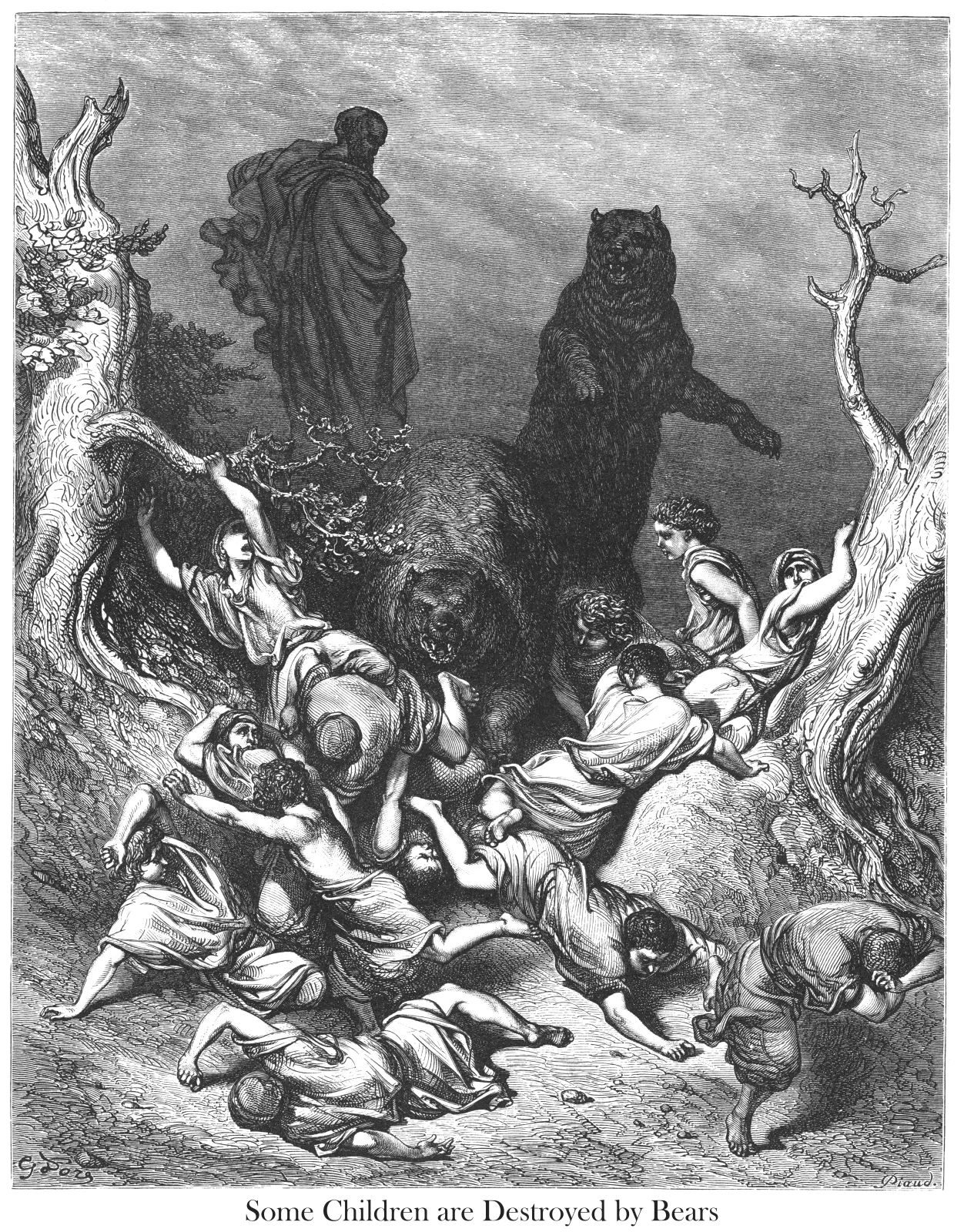
In the foreground, a child lies stretched out on the path, arms spread wide. Behind him, bodies press together and cross one another: one tries to flee to the right, another clings to a branch. A bear advances at the center of this confusion, its jaws open. A second rears up higher, one paw outstretched above the group.
Elisha stands apart, on high ground to the left. His dark figure looms over the children without joining their movement. He turns his head toward them, while his body remains oriented toward the path. This slight turn holds the eye: the prophet seems still intent on his journey, yet he sees what is happening behind him. Between him and the children, the two beasts occupy almost all the space.
The Second Book of Kings places the encounter on the road to Bethel. The young boys who have come out of the city mock Elisha for his baldness; he turns, looks at them, and curses them in the name of Yahweh. Two bears then come out of the forest and maul forty-two children. The text recounts the events with extreme brevity. Doré gives the final event the largest share of the engraving: the mockery can no longer be heard, and the number of victims cannot be determined from this heap of bodies.
The prophet’s gaze nonetheless remains part of the scene. It recalls the words that preceded the attack, without making the curse itself visible. The distance separating Elisha from the children leaves a difficult question unresolved: how are we to understand the authority of a word spoken in God’s name when the narrative associates it with such terrible violence? The engraving does not resolve this question; it gives it the weight of bodies fallen on the road.