Gustave Doré · 2 Kings 6:25-26
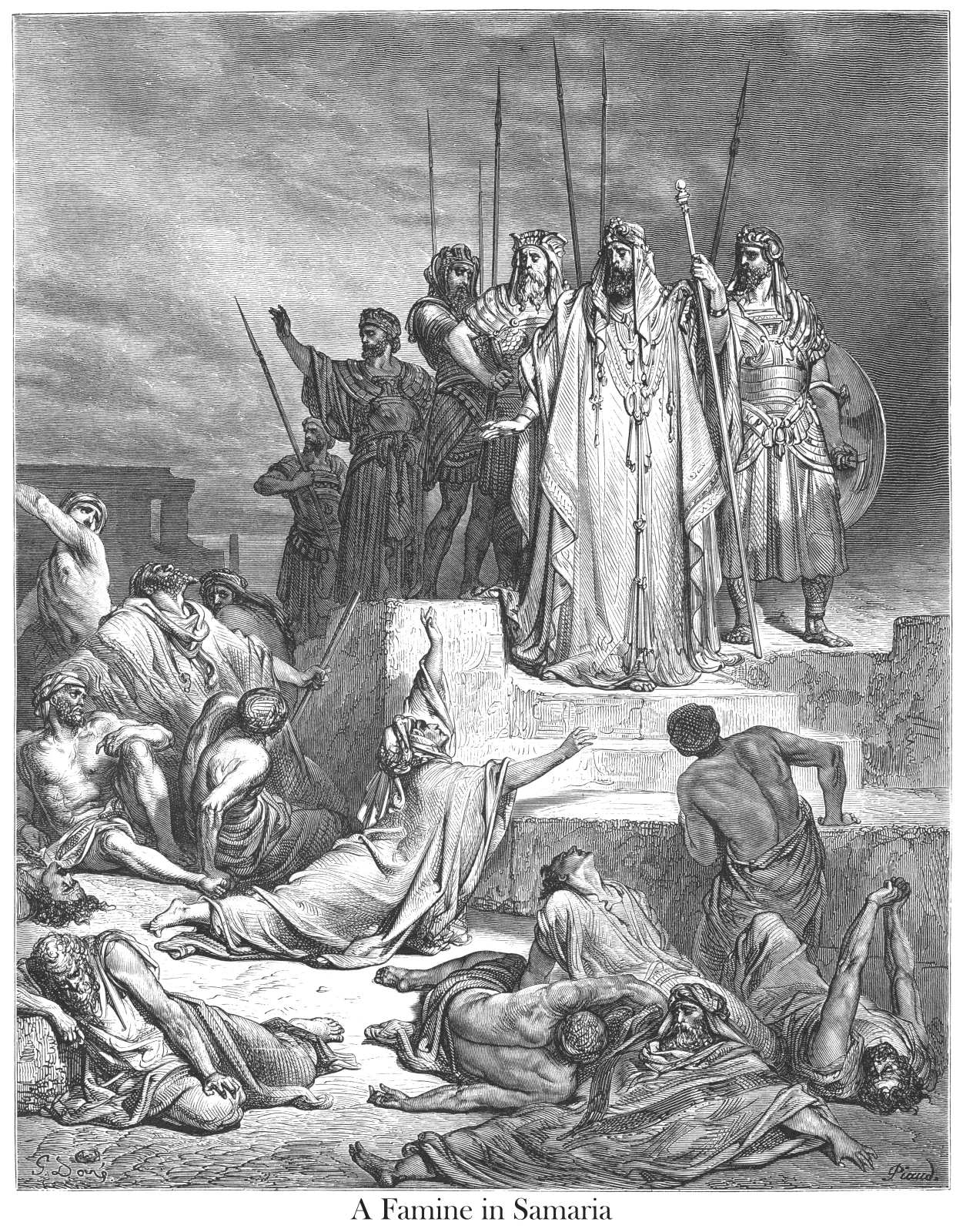
A Famine in Samaria
2 Kings 6:25-26 · World English Bible (Catholic)
25There was a great famine in Samaria. Behold, they besieged it until a donkey’s head was sold for eighty pieces of silver, and the fourth part of a kab of dove’s dung for five pieces of silver.
26As the king of Israel was passing by on the wall, a woman cried to him, saying, “Help, my lord, O king!”
At the foot of the steps, a woman stretches both arms toward the king. Her body remains on the ground; her open hands reach out, seeking to bridge the distance between her and him. The king stands above her, surrounded by armed men. His free hand is open too, but it does not meet the hands of the woman pleading with him.
This suspended gesture shapes the encounter. The steps and the low wall draw a clear boundary between the standing ruler and the inhabitants crowded below. Around the woman, bodies lie stretched out or slumped; some struggle to rise, while others have their heads thrown back. The distress is no longer confined to a single voice. It fills almost the entire foreground, right up to the edge of the engraving.
The Second Book of Kings first gives the famine the form of a measure: during the siege, a donkey’s head and a small quantity of pigeon dung fetch exorbitant prices. Then a woman calls out to the king as he passes along the wall. Doré retains this cry, but leaves the provisions and their prices outside the frame. The high cost, a sign of scarcity in the text, gives way to its effects on the bodies. The spears raised behind the king make an armed force present, without showing the Syrian army besieging the city.
The following verse gives the king a helpless reply: if Yahweh does not save this woman, where can he find the means to help her? The ruler’s outstretched hand may be read in the light of these words, though no gesture alone can settle its meaning. The staff he holds and the escort around him signal his authority; yet nothing in his hands answers the hunger. The appeal addressed to the king thus encounters the question of a help that exceeds his resources.