Gustave Doré · 1 Kings 17:22-23
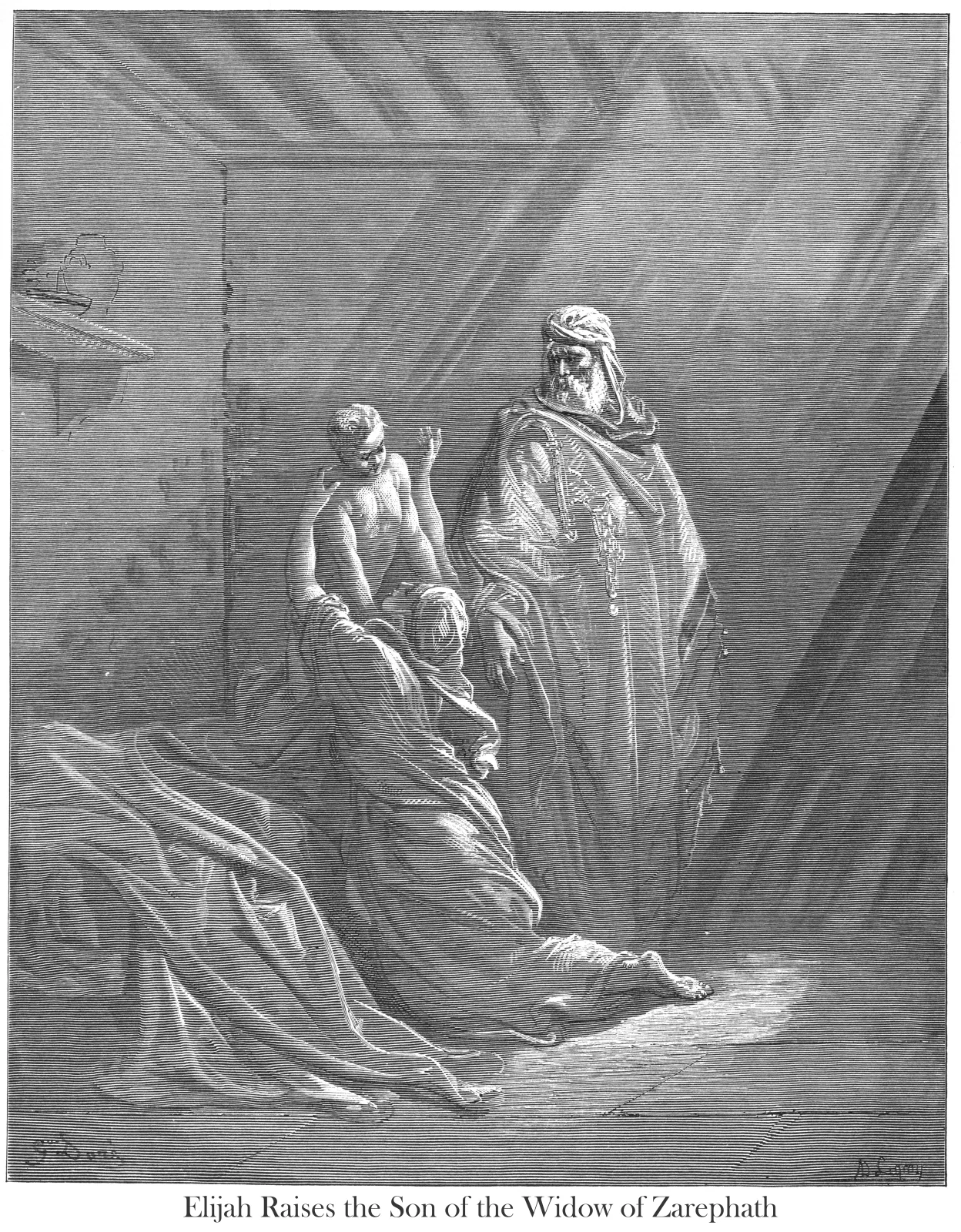
Elijah Raises the Son of the Widow of Zarephath
1 Kings 17:22-23 · World English Bible (Catholic)
22The LORD listened to the voice of Elijah; and the soul of the child came into him again, and he revived.
23Elijah took the child and brought him down out of the room into the house, and delivered him to his mother; and Elijah said, “Behold, your son lives.”
The woman’s raised arm is silhouetted between the child and Elijah. Kneeling at the foot of the bed, she turns her almost entirely veiled face toward them. The child, bare-chested, is upright on the bed; his head inclines toward her. On the right, the prophet stands with his hands lowered, watching the encounter.
The sheet covering the bed extends in broad folds to the foreground. It leads the eye toward the mother, whose body bends over her son. The child no longer lies stretched out like a lifeless body: his torso is supported, and his arms are braced beside him. Yet the engraving does not seek to isolate the instant when life returns. It makes this return visible in the closeness of the three figures and in the woman’s gesture, before any words can be read on her lips.
The Book of Kings recounts that Elijah prayed, and then that God heard him: the child’s soul returned to him. The prophet then brought him down from the upper room and gave him back to his mother. In the engraving, the bed remains immediately behind the child, and no descent is depicted. The place and precise moment of the encounter thus remain less clearly defined than in the text.
This shift focuses attention on the living child and on the now very short distance separating him from his mother. Elijah is beside them, but his gesture no longer occupies the center. The account attributes the life restored to God’s response to the prayer; the engraving lets us perceive its human consequence: a son can once again face the woman who had lost him.