Gustave Doré · 1 Kings 18:38-40
The Prophets of Baal Are Slaughtered
1 Kings 18:38-40 · World English Bible (Catholic)
38Then the LORD’s fire fell and consumed the burnt offering, the wood, the stones, and the dust; and it licked up the water that was in the trench.
39When all the people saw it, they fell on their faces. They said, “The LORD, he is God! The LORD, he is God!”
40Elijah said to them, “Seize the prophets of Baal! Don’t let one of them escape!” They seized them; and Elijah brought them down to the brook Kishon, and killed them there.
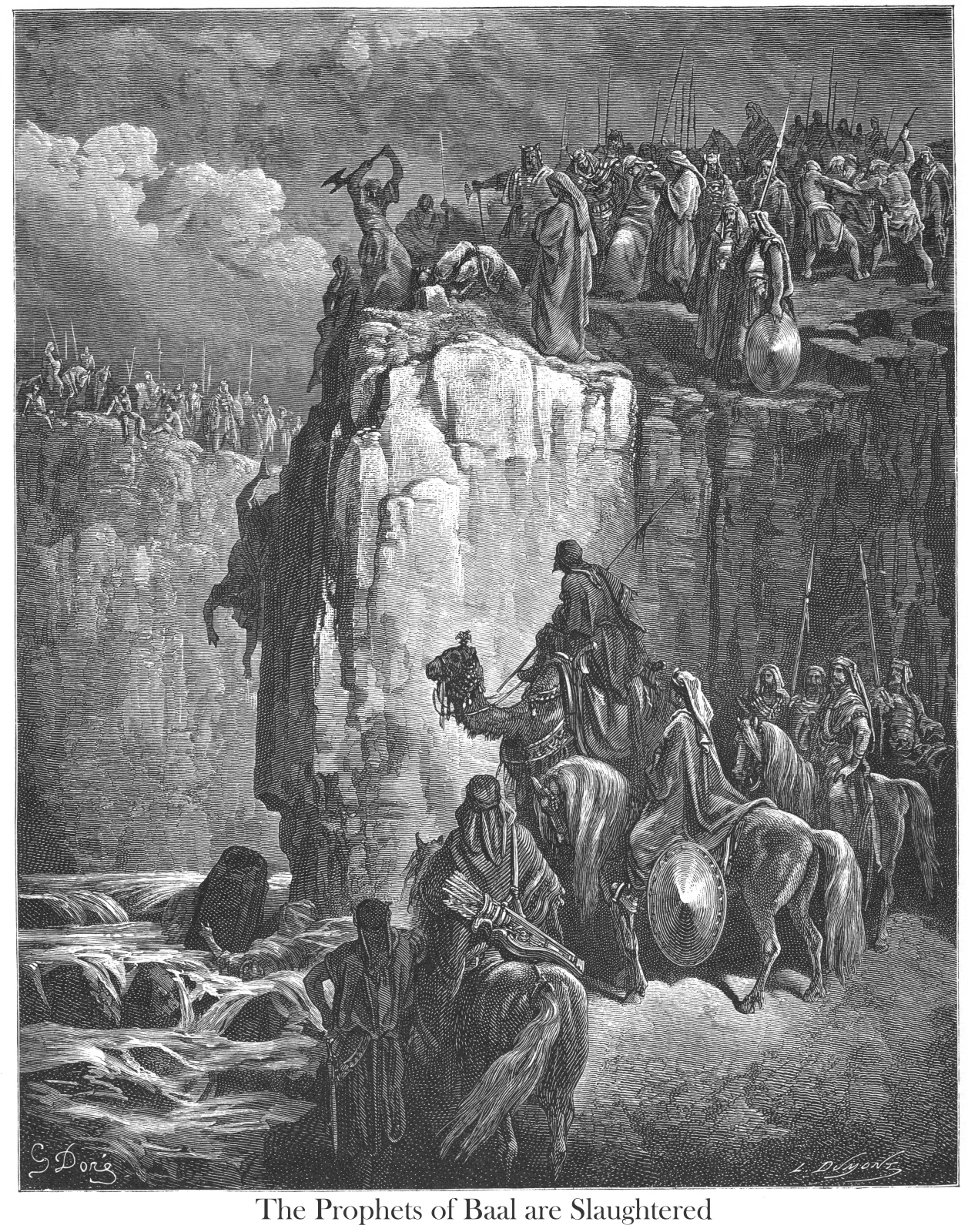
At the top of the rock, a man raises his weapon above a bent body. The blow has not yet fallen. Behind him, a tightly packed crowd fills the plateau; to the right, other men struggle. The slaughter has several centers, but this raised arm concentrates its violence in a suspended gesture.
Beneath the scene, the pale cliff descends almost to the water. A body plunges down along its left edge, while in the foreground horsemen and armed men stand near the torrent. The height of the rock separates these witnesses from the execution while also connecting the two levels: the falling body crosses the distance the eye must travel. The water at the bottom of the engraving is not mere scenery; it gives this fall an end point.
The Book of Kings places the killing at the torrent of Kishon. It is followed by two events that the engraving leaves out of view: the fire of Yahweh consumed the burnt offering, down to the stones and the earth, and then the people prostrated themselves, acknowledging their God. Elijah then orders the capture of the prophets of Baal and kills them. Here, no fire descends from heaven. Attention is focused on the bodies, the weapons, and the crowd gathered around the deed.
The text thus brings the people’s confession close to the violence inflicted on the prophets; the engraving chiefly shows that violence and those gathered around it. The torrent preserves the connection with the place named in Scripture, but the great escarpment and the fall give death a presence that the narrative states briefly. The people’s acknowledgment of Yahweh remains in the background of the reading: it does not remove the difficulty of looking at what follows.