Gustave Doré · 1 Kings 13:24-25
The Disobedient Prophet Is Slain by a Lion
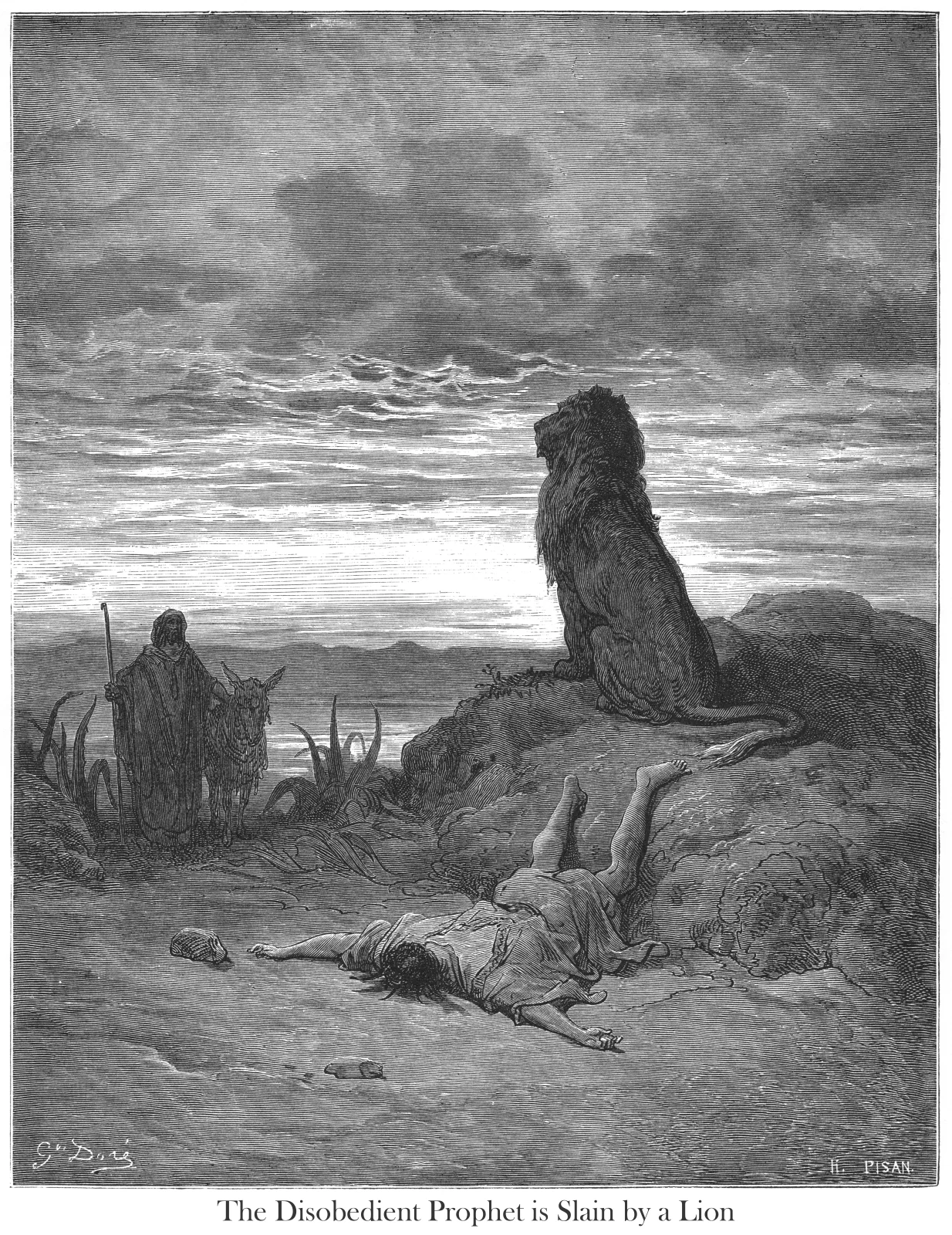
1 Kings 13:24-25 · World English Bible (Catholic)
24When he had gone, a lion met him by the way and killed him. His body was thrown on the path, and the donkey stood by it. The lion also stood by the body.
25Behold, men passed by and saw the body thrown on the path, and the lion standing by the body; and they came and told it in the city where the old prophet lived.
The lion sits above the dead man. Its head stands out against the bright band of the horizon; its long tail reaches down toward the feet of the outstretched body. It does not bend over its victim. This stillness gives the animal an unexpected place: after the violence, it remains there, dominating the path as though guarding access to it.
In the foreground, the man of God lies with his arms outstretched, his face turned toward the ground. His headdress has fallen some distance away. The diagonal of his body leads the eye toward the rock and the lion, while on the left a man with a staff stands beside a donkey. The distance between this group and the corpse leaves the path open, but the seated animal occupies its way through. The vast sky, almost empty above these figures, prolongs their silent waiting.
The Book of Kings recounts that the lion met the man on the road and killed him. It then dwells on a strange arrangement: the donkey and the lion both remain beside the corpse. Passers-by see the body and the lion before carrying the news to the city. The engraving captures the moment when the death has become visible to others. It gives presence to a man standing near the donkey, without allowing him to be identified with certainty as one of the passers-by or as the old prophet.
The title names the disobedience; the passage provided interprets it through the words of the old prophet, who sees in the man’s death the fulfilment of a word from Yahweh. But on the engraved path, nothing directly reveals that word or the transgression. The abandoned body and the lion remaining beside it come before any explanation. Their unusual closeness makes visible a death which, in the text, must be read in the light of a divine word.