Gustave Doré · 1 Kings 5:5-6
Cedars Are Cut Down for the Jerusalem Temple
1 Kings 5:5-6 · World English Bible (Catholic)
5Behold, I intend to build a house for the name of the LORD my God, as the LORD spoke to David my father, saying, ‘Your son, whom I will set on your throne in your place shall build the house for my name.’
6Now therefore command that cedar trees be cut for me out of Lebanon. My servants will be with your servants; and I will give you wages for your servants according to all that you say. For you know that there is nobody among us who knows how to cut timber like the Sidonians.”
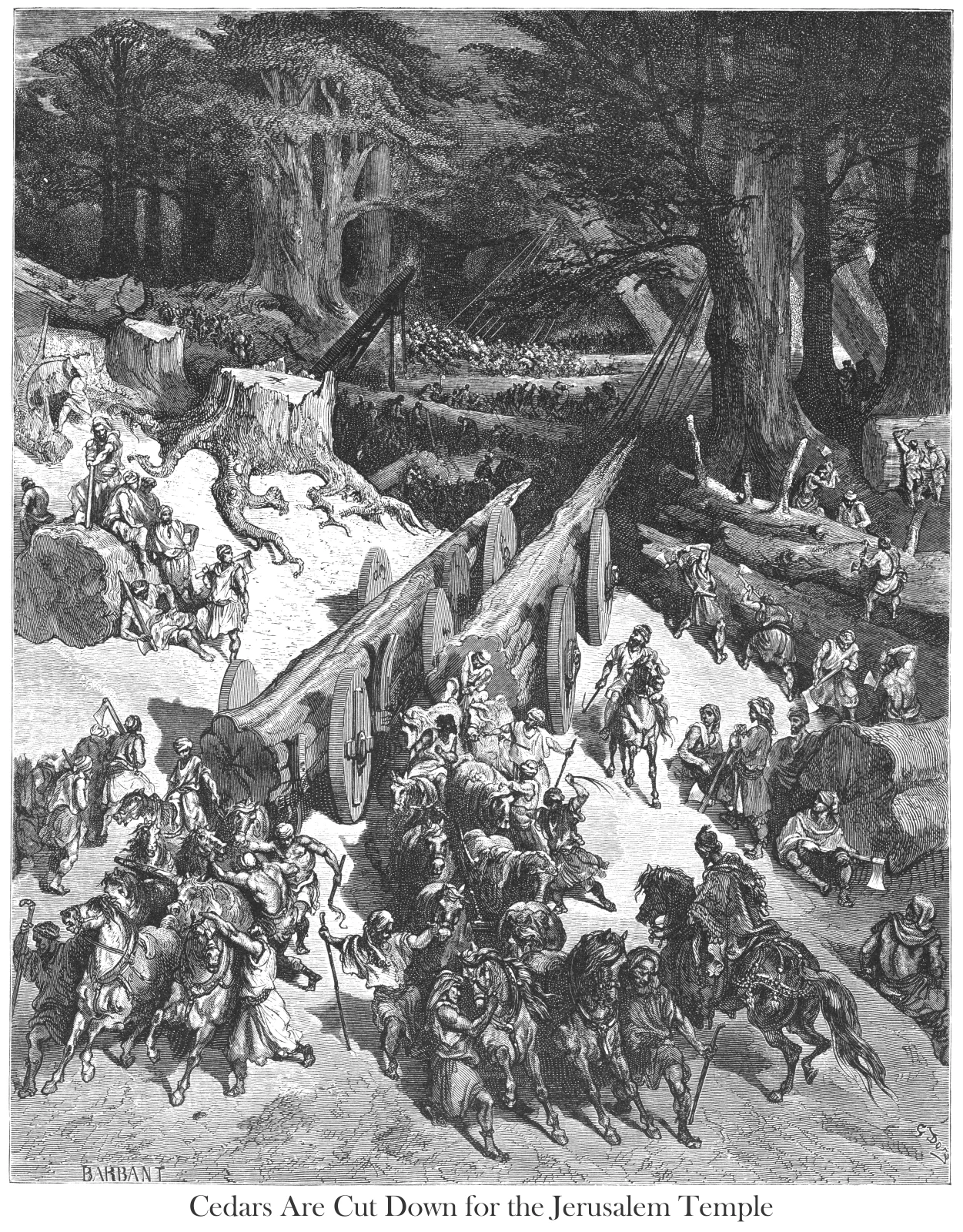
Two tree trunks loaded onto long wagons cross the clearing. Their wheels, almost as tall as the men around them, convey the scale of the timber to be moved. In the foreground, horses and their drivers crowd together; farther off, the trunks draw the eye toward the forest still standing. The road opened through the trees is also a worksite.
On the left, an immense stump retains the shape of the vanished tree. Its roots spread across the ground, while on the right workers swing their axes near other felled trunks. The forest is not merely a backdrop: we see together what remains standing, what has just been cut, and what is already being carried away on the wagons. The distance between the stump and the timber in transit conveys the scale of the collective labor.
The catalogue title gives these trees a destination: the Temple of Jerusalem. Yet the Temple remains outside the frame, and the passage supplied for this notice mentions neither its construction nor the felling of the cedars. It describes the security of Judah and Israel under Solomon, then numbers the king’s stalls and horses. The horses visible in the engraving echo this last detail, without the text allowing us to identify them as the king’s horses or explain the transport depicted.
The juxtaposition is nevertheless suggestive. The peace of each person beneath his vine and fig tree is answered here by a crowd occupied in transforming another landscape of trees. The title relates this work to a dwelling consecrated to God; the engraving itself stops along the way, among the stumps, the teams of horses, and the men. The holy place announced is still visible only through the materials being carried away.