Gustave Doré · 1 Kings 3:25-27
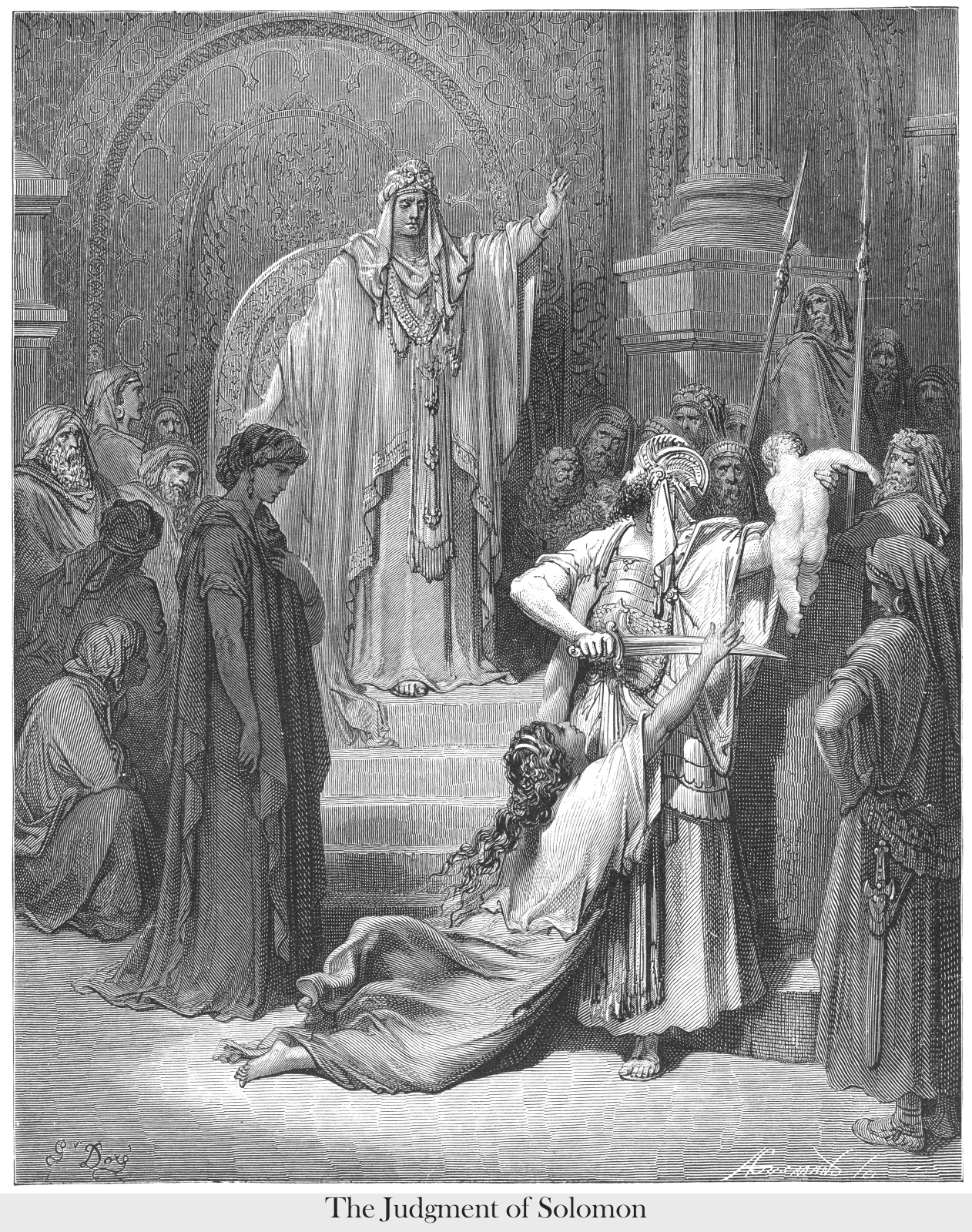
The Judgment of Solomon
1 Kings 3:25-27 · World English Bible (Catholic)
25The king said, “Divide the living child in two, and give half to the one, and half to the other.”
26Then the woman whose the living child was spoke to the king, for her heart yearned over her son, and she said, “Oh, my lord, give her the living child, and in no way kill him!” But the other said, “He shall be neither mine nor yours. Divide him.”
27Then the king answered, “Give the first woman the living child, and definitely do not kill him. She is his mother.”
A raised hand meets the sword’s blade. At the foot of the throne, a woman lying on the ground stretches out her arm toward the child held by the soldier. The little body is suspended above the weapon; the mother cannot reach him without crossing the line of the blade. Her gesture conveys the proximity of danger more surely than the blow itself would.
The soldier occupies the center of this encounter. He holds the child with one arm and, with the other, the almost horizontal sword. Behind him, Solomon stands on his dais, one hand raised. This gesture presides over the scene, but its meaning remains suspended: does it command the division, or stop the soldier? Below, another woman stands with her head bowed. Between her stillness and the surge of the woman on the ground, the distance is also that between two responses to the same threat.
In the Book of Kings, Solomon orders the living child to be divided. The mother then asks that he be given to the other woman rather than killed; the latter accepts the division. The king recognizes as the mother the woman who gives up her child to save his life. The text makes successive words heard; the engraving gathers them around a weapon still held and a child still separated from his mother. It gives physical form to the urgency revealed by the words, without depicting the child’s final return.
The open hand near the blade thus leads the eye from peril toward judgment. According to the passage, the wisdom recognized in Solomon discerns the mother by this painful consent: to let the child live with another. The king’s authority is measured here by the life he ultimately commands to be preserved.