Gustave Doré · 2 Samuel 12:31
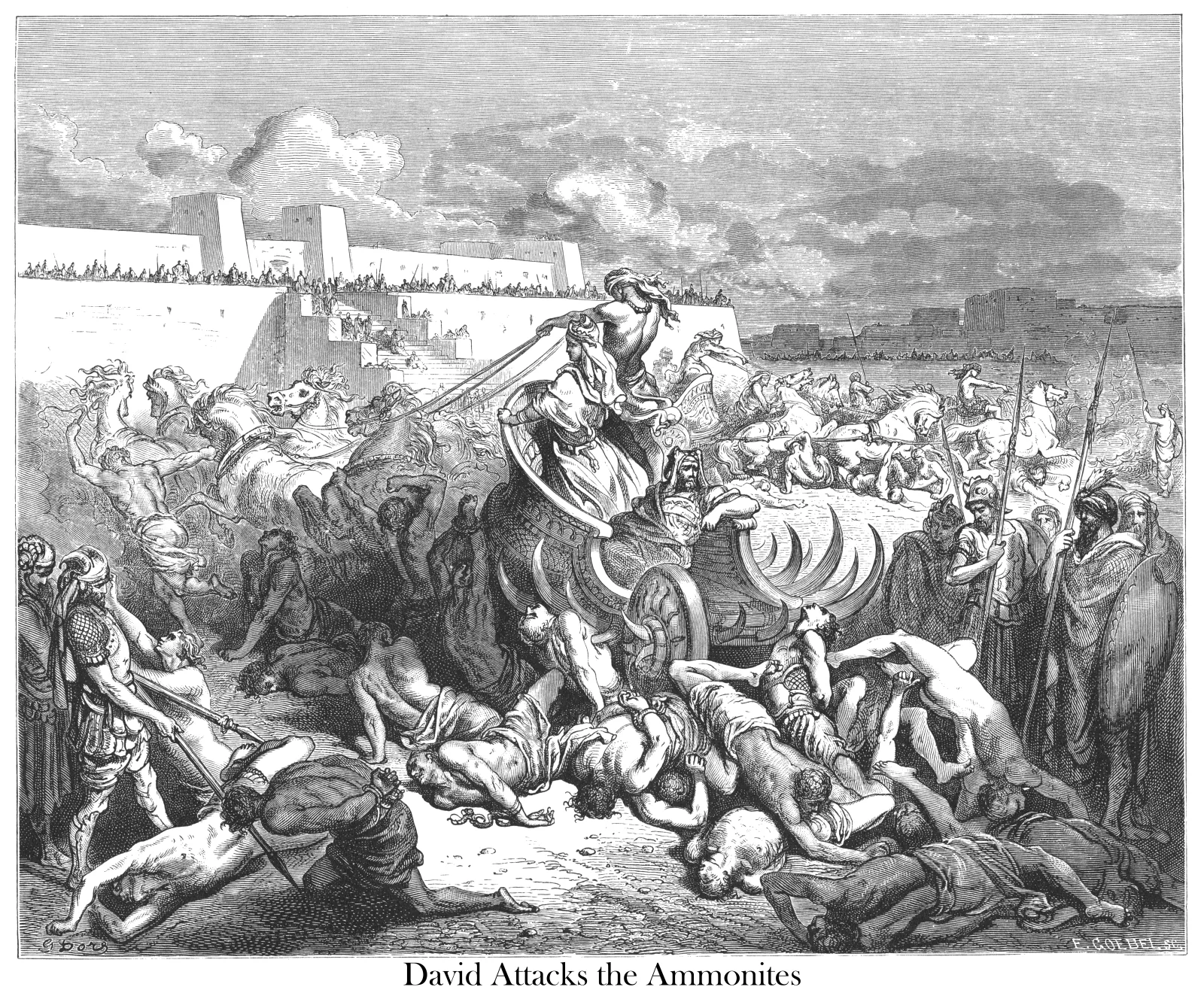
David Attacks the Ammonites
2 Samuel 12:31 · World English Bible (Catholic)
31He brought out the people who were in it, and put them to work under saws, under iron picks, under axes of iron, and made them go to the brick kiln; and he did so to all the cities of the children of Ammon. Then David and all the people returned to Jerusalem.
Curved blades bristle along the side of the chariot at the center of the engraving. They jut out at the level of the fallen bodies, so close that the wheel and limbs merge in a single tangle. Higher up, a driver holds his horses back by the reins; in front of him, a crowned figure sits in the chariot. His position sets him apart from the crowd on the ground without removing him from the violence around him.
The eye follows the horses to the left, then returns to the victims sprawled in the foreground. Some are still trying to shield themselves; others lie motionless. On the right, armed men standing with long spears line this field of bodies. In the distance, a file of small figures runs along the city walls and descends a staircase. This distance gives the scene a breadth that the foreground alone would not allow us to gauge: violence unfolds before an occupied city and in full view of a crowd.
The book of Samuel places what happens to the people after the capture of Rabbah. David has received the crown of the defeated king and carried off the spoils; he then brings out the inhabitants and puts them to the saws, picks, iron axes, and brick molds. The translation provided names these instruments without detailing the actions. The bladed chariot, by contrast, does not appear in the passage. Doré gives David’s dominion a visible and immediate form, amid the fallen bodies.
The crown, mentioned just before the fate of the inhabitants, reappears at the heart of this reading. It does not separate victory from what follows: placed above the chariot and its blades, it makes the question of violence bear upon the figure of the king himself. The biblical text leaves this troubling closeness between acquired glory and the treatment of the defeated unresolved.