Gustave Doré · 2 Samuel 2:15-17
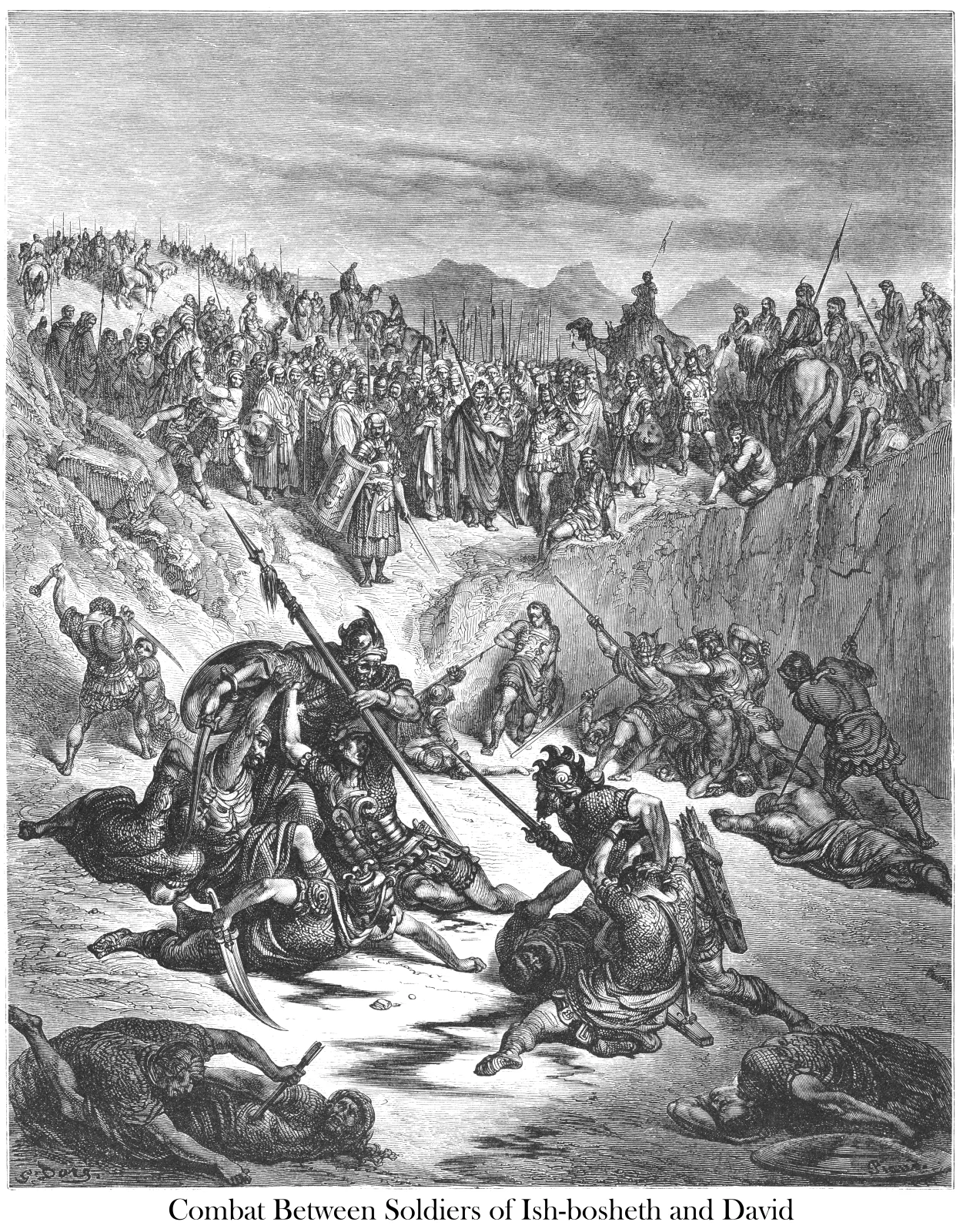
Combat between Soldiers of Ish-bosheth and David
2 Samuel 2:15-17 · World English Bible (Catholic)
15Then they arose and went over by number: twelve for Benjamin and for Ishbosheth the son of Saul, and twelve of David’s servants.
16They each caught his opponent by the head and thrust his sword in his fellow’s side; so they fell down together. Therefore that place in Gibeon was called Helkath Hazzurim.
17The battle was very severe that day; and Abner was beaten, and the men of Israel, before David’s servants.
In the foreground, two men have fallen one upon the other. The one still dominating his opponent holds a blade against his body; nearby, other combatants grapple, strike, or already lie on the ground. Armor and limbs merge in the melee. One must follow the arms to make out, sometimes, who is holding whom.
The fight occupies a hollow space, bordered on the right by a steep wall. Above and in the background, a crowd of soldiers gathers; horsemen rise above them. A man carrying a large shield stands apart, in the passage descending toward the bodies. His position creates a distance between the massed troops and the combatants engaged in the foreground. The violence unfolds before the eyes of those who have not yet taken part in it.
The Book of Samuel gives this confrontation a precise measure: twelve men for Ish-bosheth and twelve for David. Each seizes his opponent by the head and drives his sword into his side; they all fall together. In Doré’s work, the close holds and tangled bodies retain something of this reciprocity. But their shared fall becomes a duration: some are still struggling while others lie outstretched. The equal number in the two groups is not easy to verify amid the confusion of figures.
Abner had proposed to Joab that the young men should fight before them. The crowd overlooking the scene gives weight to this “before”: a contest accepted by the leaders exposes the bodies of their men. The text goes on to recount a very fierce battle and Abner’s defeat; the engraving instead leaves the gaze at the edge of the initial clash, without clearly identifying the victorious side.
The closeness of the adversaries makes visible a violence in which each blow strikes a fellow combatant. Even before the outcome of the battle, their shared fall weighs upon the victory foretold.