Gustave Doré · 1 Samuel 31:5-6
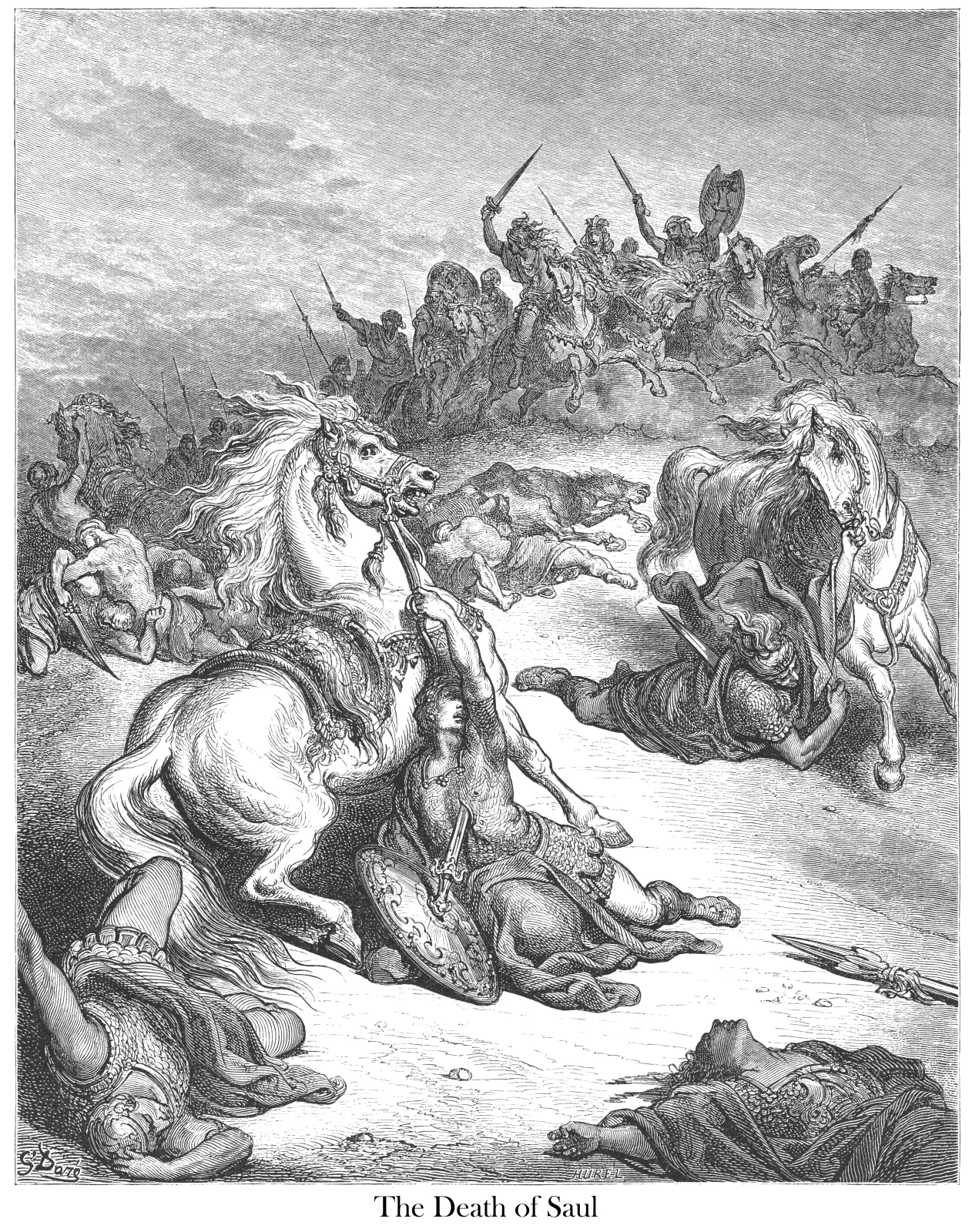
The Death of Saul
1 Samuel 31:5-6 · World English Bible (Catholic)
5When his armor bearer saw that Saul was dead, he likewise fell on his sword, and died with him.
6So Saul died with his three sons, his armor bearer, and all his men that same day together.
At the center, an armed man has fallen to his knees. His body is thrown back against the flank of a white horse, while a sword rises before him. The horse turns its head, eyes wide open and mouth pulled taut by the reins. Very close by, on the right, another man lies beneath a horse, holding its bridle. The two animals remain standing amid the bodies; their movements extend the disorder of the fall.
Higher up, riders cross the horizon, weapons raised. Their charge passes behind the central group without stopping. The distance separating them from the dead gives the defeat its breadth: the battle continues in the distance, while in the foreground the men are already scattered on the ground. The title leads us to look for Saul among them, but the multitude of bodies makes their identification uncertain. No gesture clearly distinguishes his sons from his other companions.
The Book of Samuel nevertheless focuses attention on a precise sequence. Saul, fearing that his enemies will abuse him, fell upon his sword after his armor-bearer refused to kill him. Seeing his master dead, the armor-bearer then took his own life. The text then gathers into a single day the deaths of the king, his three sons, his armor-bearer, and his men.
The engraving gives form to this “whole” without clearly restoring the order of the two deaths. The separate bodies occupy the same ground, beneath the horses and weapons still in motion. The text of Samuel adds a consequence that the landscape does not contain: the inhabitants abandon their towns, where the Philistines come to settle. The fall of the king and those close to him is therefore not an isolated end; it reaches an entire people, even in their homes.