Gustave Doré · Judges 5:7-9
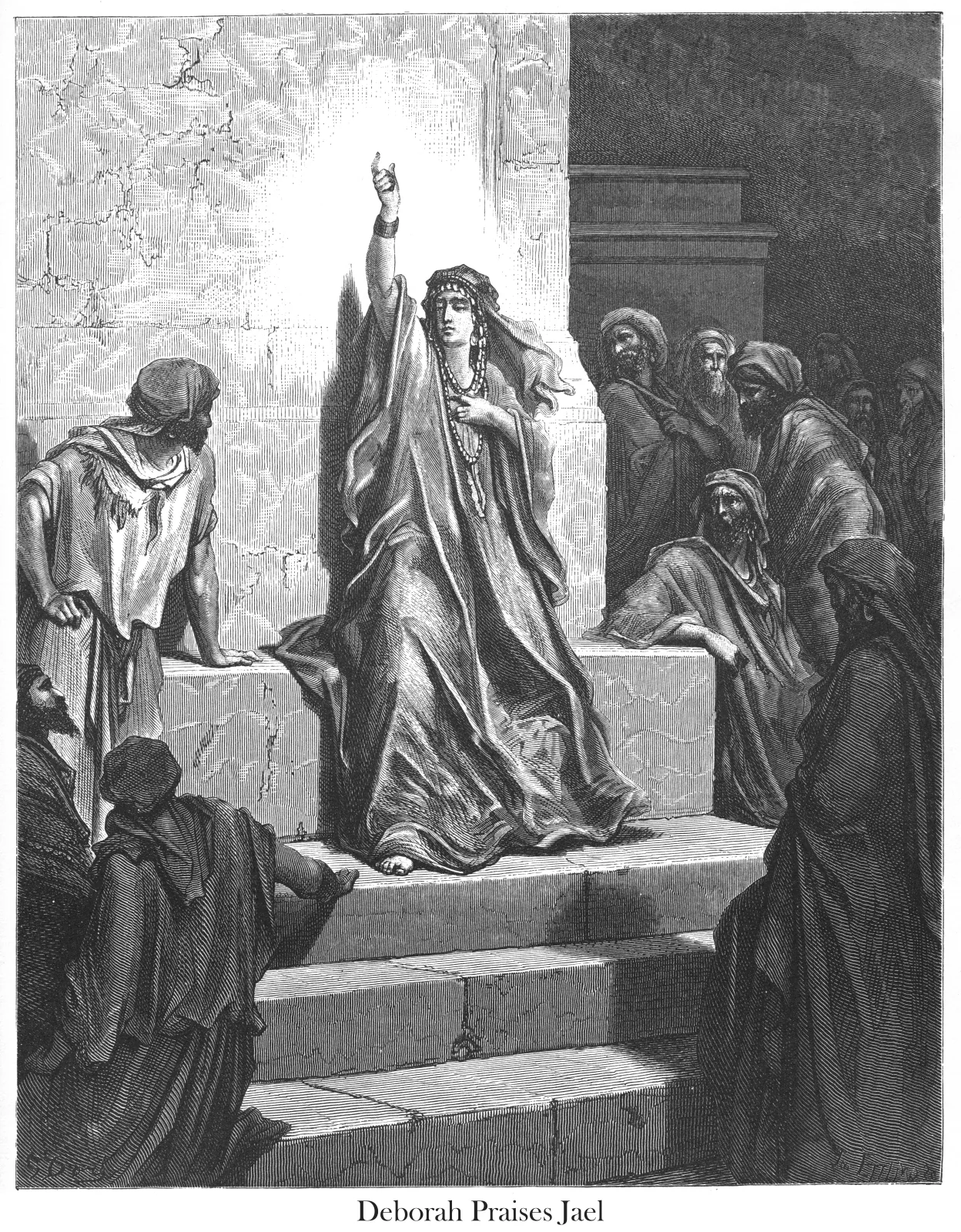
Deborah Praises Jael
Judges 5:7-9 · World English Bible (Catholic)
7The rulers ceased in Israel. They ceased until I, Deborah, arose; Until I arose a mother in Israel.
8They chose new gods. Then war was in the gates. Was there a shield or spear seen among forty thousand in Israel?
9My heart is toward the governors of Israel, who offered themselves willingly among the people. Bless the LORD!
One hand resting on her breast, Deborah raises the other above her head. Her index finger points to a place beyond the engraving, while the men gathered around her turn their faces toward her. The gesture thus links the words that come from the heart to a direction no one can see. Deborah stands at the top of the steps; her garments fall almost to the edge, as though her presence were supported by the full width of the threshold.
To her right, the listeners crowd into the dark opening of a building. One of them, leaning on the stone, looks up at her. On the left, a man also bends forward, his hand on the ledge. These repeated points of support hold the group around the standing woman: the assembly seems gathered in attentive listening, though not all of them occupy the same space. The light wall sets off Deborah’s figure, but her gesture reaches higher than this architectural frame.
The song in Judges gives her a first-person voice: she arose as a mother in Israel after the countryside had been abandoned. She speaks of war at the gates and the absence of weapons, then her heart goes out to the leaders and to those who volunteered among the people. The engraving gives a body to this voice and gathers figures before her whom the verses do not describe as an assembly standing on steps. Neither the deserted countryside nor the war is depicted; they remain in the words that the scene allows us to imagine.
The title announces a tribute to Jael, named in the immediate context of the passage, but the indicated verses address the leaders and the volunteers. No figure here allows us to identify Jael with certainty. The hand on the breast may recall Deborah’s heart; when read in light of the call to bless Yahweh, the raised hand takes on a significance that goes beyond a tribute to one person.