Gustave Doré · Genesis 29:1-20
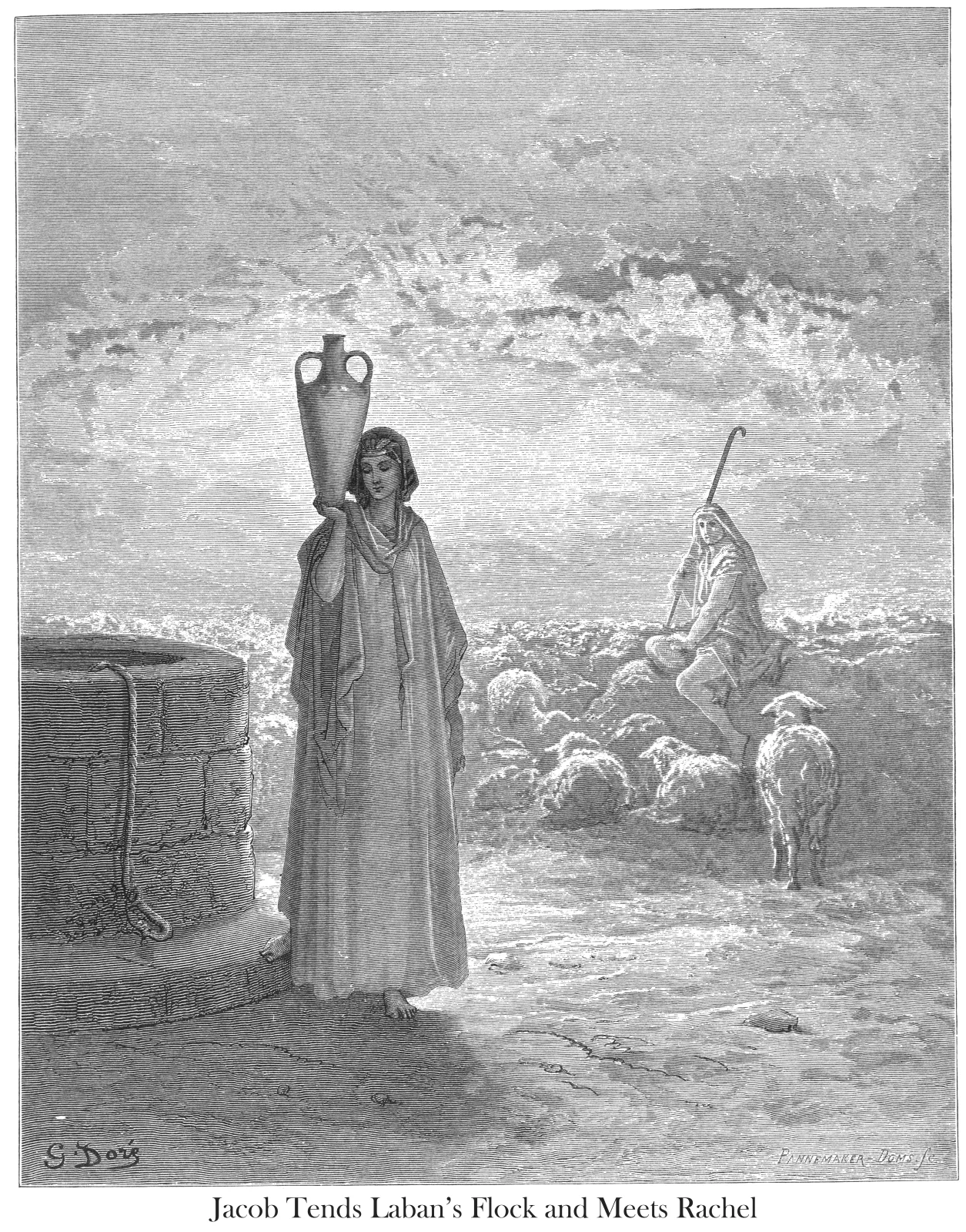
Jacob Tends Laban's Flocks and Meets Rachel
Genesis 29:1-20 · World English Bible (Catholic)
1Then Jacob went on his journey, and came to the land of the children of the east.
2He looked, and saw a well in the field, and saw three flocks of sheep lying there by it. For out of that well they watered the flocks. The stone on the well’s mouth was large.
3There all the flocks were gathered. They rolled the stone from the well’s mouth, and watered the sheep, and put the stone back on the well’s mouth in its place.
4Jacob said to them, “My relatives, where are you from?” They said, “We are from Haran.”
5He said to them, “Do you know Laban, the son of Nahor?” They said, “We know him.”
6He said to them, “Is it well with him?” They said, “It is well. See, Rachel, his daughter, is coming with the sheep.”
7He said, “Behold, it is still the middle of the day, not time to gather the livestock together. Water the sheep, and go and feed them.”
8They said, “We can’t, until all the flocks are gathered together, and they roll the stone from the well’s mouth. Then we will water the sheep.”
9While he was yet speaking with them, Rachel came with her father’s sheep, for she kept them.
10When Jacob saw Rachel the daughter of Laban, his mother’s brother, and the sheep of Laban, his mother’s brother, Jacob went near, and rolled the stone from the well’s mouth, and watered the flock of Laban his mother’s brother.
11Jacob kissed Rachel, and lifted up his voice, and wept.
12Jacob told Rachel that he was her father’s relative, and that he was Rebekah’s son. She ran and told her father.
13When Laban heard the news of Jacob, his sister’s son, he ran to meet Jacob, and embraced him, and kissed him, and brought him to his house. Jacob told Laban all these things.
14Laban said to him, “Surely you are my bone and my flesh.” Jacob stayed with him for a month.
15Laban said to Jacob, “Because you are my relative, should you therefore serve me for nothing? Tell me, what will your wages be?”
16Laban had two daughters. The name of the elder was Leah, and the name of the younger was Rachel.
17Leah’s eyes were weak, but Rachel was beautiful in form and attractive.
18Jacob loved Rachel. He said, “I will serve you seven years for Rachel, your younger daughter.”
19Laban said, “It is better that I give her to you, than that I should give her to another man. Stay with me.”
20Jacob served seven years for Rachel. They seemed to him but a few days, for the love he had for her.
A large jar rests on the shoulder of the woman standing near the well. Her hand supports its base; her gaze is lowered. A few paces behind her, a shepherd seated among the sheep turns his face toward her. The distance between them leaves a broad empty space on the ground. No gesture crosses it.
The title makes it possible to recognize Jacob beside the flock and Rachel near the well. Yet in Genesis, it is Rachel who arrives with her father's sheep: she is a shepherdess. Jacob, a traveler who has come to the land of the people of the East, first speaks with other herdsmen. As soon as he sees Rachel and Laban's animals, he rolls away the heavy stone that covers the well and waters the flock. Then he kisses Rachel and weeps aloud.
Here, the stone does not occupy the well's visible opening, and Jacob does not bend down to move it. The jar carried by Rachel introduces an object that this passage does not mention. The narrative immediately linked the meeting to an act performed for the sheep; the engraving distributes the tasks and presences differently. The curved staff identifies the shepherd, while the woman stands closest to the water. The animals lying around him lend this arrangement a tranquillity undisturbed by any exchange of words.
The text soon leads from the well to Laban's house, then to the seven years of service undertaken for love of Rachel. Under a single title, the engraving brings together the meeting and the tending of the flocks, without telling what follows. It leaves the distance between the two figures intact: where Genesis gives rise to an acknowledged kinship and a promise of life together, the shepherd's gaze remains suspended before any contact.