Gustave Doré · Genesis 18:9-10
Abraham and the Three Angels
Genesis 18:9-10 · World English Bible (Catholic)
9They asked him, “Where is Sarah, your wife?” He said, “There, in the tent.”
10He said, “I will certainly return to you at about this time next year; and behold, Sarah your wife will have a son.” Sarah heard in the tent door, which was behind him.
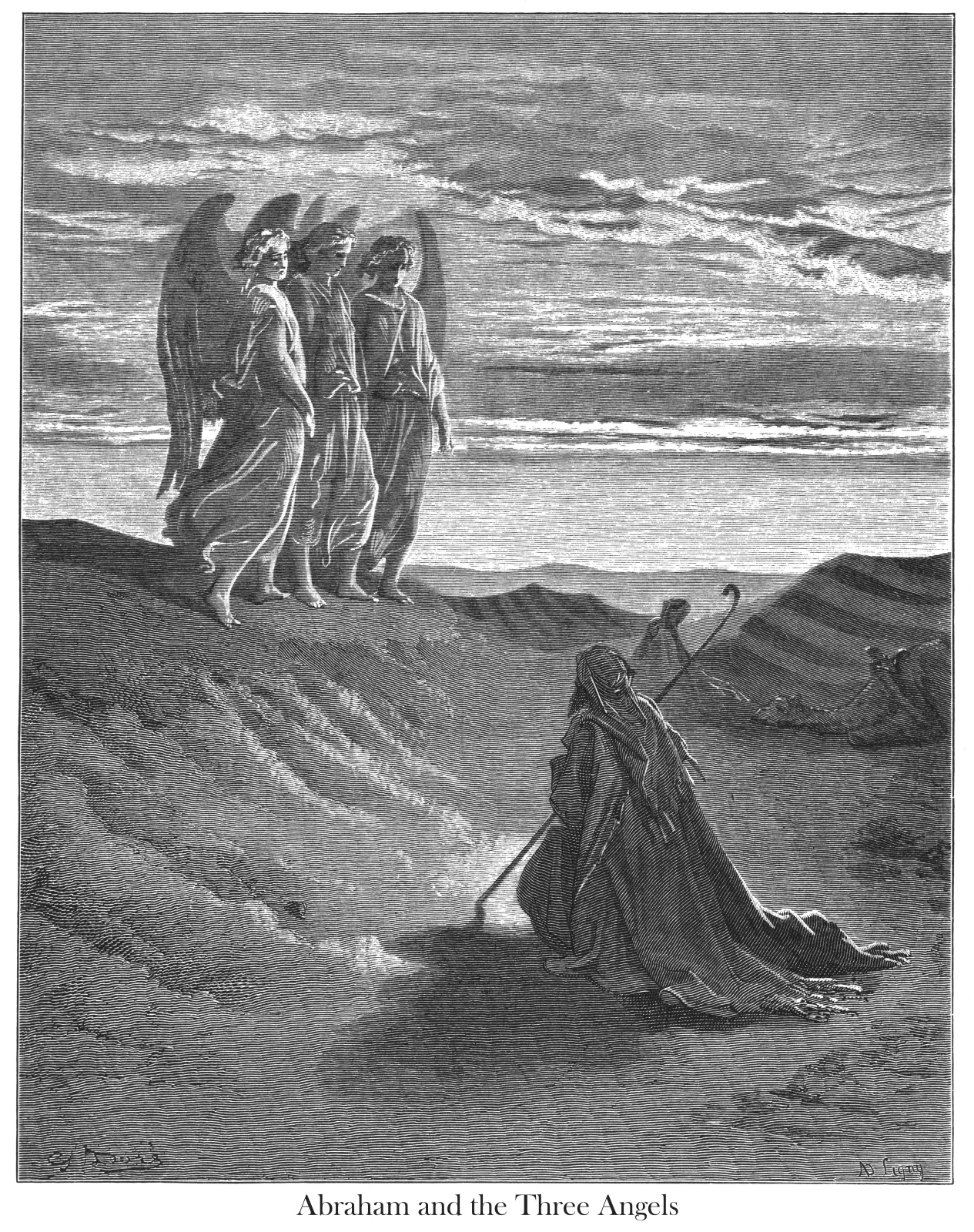
A slanting staff crosses the space between Abraham and the three visitors. Leaning on it, the patriarch is on his knees, his back turned toward us. His long robe spreads across the ground, while the three winged figures stand on the rise, close together. The hollowed ground that separates them gives their encounter an unexpected breadth.
The angels are not, however, isolated in the sky: their feet touch the slope. Their bodies form an almost continuous group, but their faces and gestures remain distinct. Opposite them, Abraham raises his head toward them. The staff, an extension of his inclined body, leads the eye toward the visitors without bridging the distance that separates him from them.
Genesis places the exchange in a more familiar setting. After serving food to the visitors under the tree, Abraham answers their question: Sarah is in the tent. One of them then announces that she will have a son; she hears the words from the entrance. The text thus moves from a question asked in the plural to a promise spoken in a single voice. In the engraving, the three beings remain grouped together, with no one interlocutor clearly singled out.
The tent, the meal, and Sarah cannot be discerned with certainty in this expanse, where the eye first moves from the patriarch to the angels. The setting of hospitality gives way to an encounter on open ground. The wings make manifest the visitors’ nature, which the supplied passage does not describe in this way. They lend visible weight to the announced words, while the one to whom they are addressed remains outside the center of the scene. The promise of a son, made to a couple whom the text describes as advanced in age, does not yet take the form of a birth: it lies in the distance between the messengers and the one who listens to them.