Gustave Doré · Genesis 19:24-26
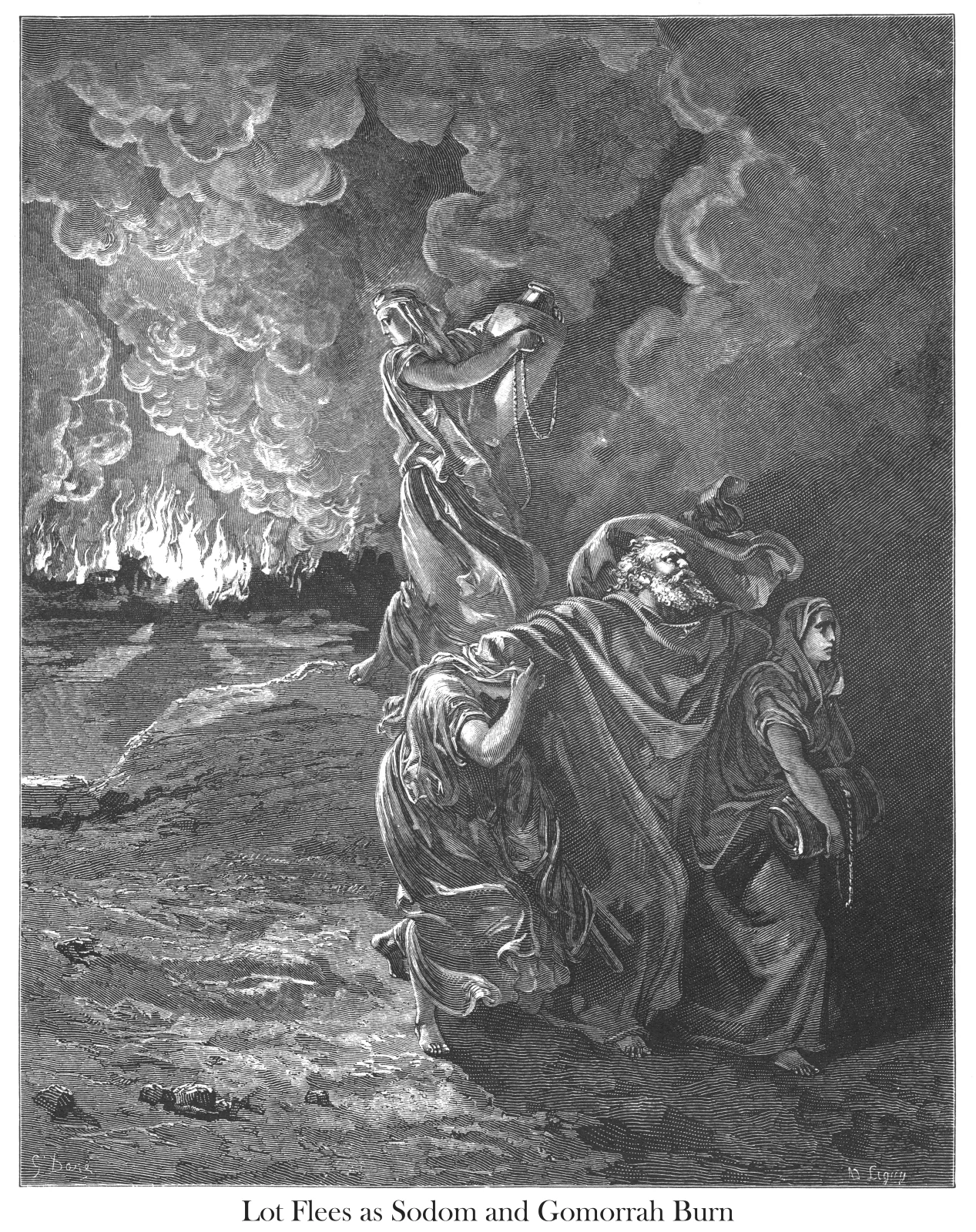
Lot Flees as Sodom and Gomorrah Burn
Genesis 19:24-26 · World English Bible (Catholic)
24Then the LORD rained on Sodom and on Gomorrah sulfur and fire from the LORD out of the sky.
25He overthrew those cities, all the plain, all the inhabitants of the cities, and that which grew on the ground.
26But Lot’s wife looked back from behind him, and she became a pillar of salt.
Set apart from the group, a woman carries a large vessel against her shoulder. Her body follows the flight to the right, but her face turns toward the conflagration. This contrary movement already separates her from the others. Ahead of her, Lot advances beneath the raised folds of his cloak; a woman bends near him, while another, carrying a scroll, walks at the far right.
In the distance, the flames silhouette the dark outlines of the buildings. Thick smoke rises and spreads above the fugitives. The bare ground separating them from the city gives a measure of the distance they have travelled, without dispelling the proximity of disaster: the sky is almost entirely filled with its clouds. The woman with the vessel stands precisely in this intermediate space, between the burning city and the three figures gathered in the foreground.
Genesis recounts that God rained sulfur and fire upon Sodom and Gomorrah, then destroyed the cities, the plain, their inhabitants, and the plants. It adds that Lot’s wife looked back and became a pillar of salt. Here, no pillar is clearly discernible. The woman turned toward the conflagration retains the features and posture of someone walking; her identification as Lot’s wife remains tied to this gesture and to the biblical passage, rather than to any visible transformation.
This figure gives duration to the brief account of the glance. The vessel she carries still belongs to the departure, while her face is turned toward what is lost. The divine judgment named in the text does not appear in the engraving in personal form: it is read in the expanse of fire and in the separation opening up within the group. The narrative leads to the pillar’s stillness; the image leaves the woman on the threshold of that halt.