Gustave Doré · Genesis 21:17-18
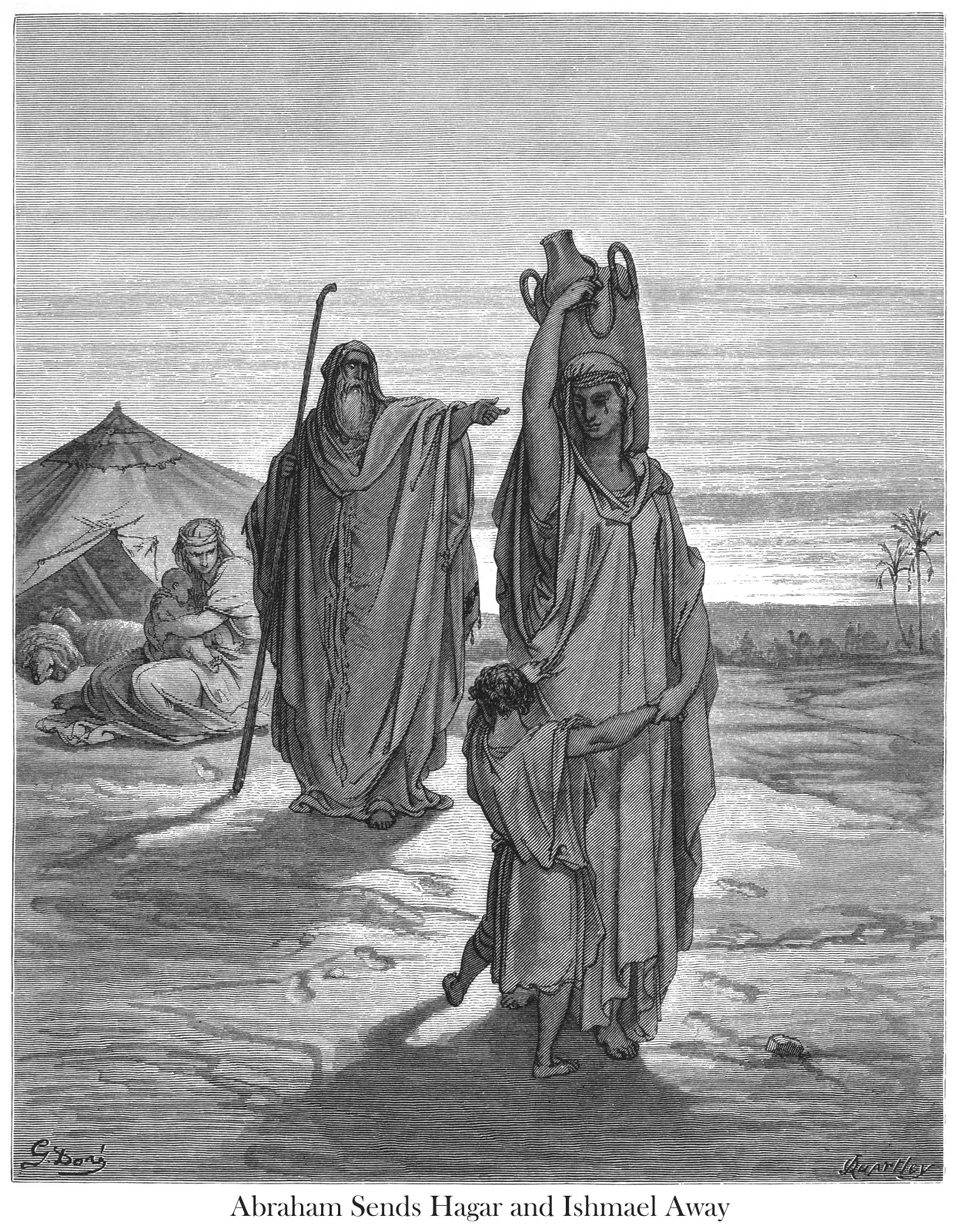
Abraham Sends Hagar and Ishmael Away
Genesis 21:17-18 · World English Bible (Catholic)
17God heard the voice of the boy. The angel of God called to Hagar out of the sky, and said to her, “What troubles you, Hagar? Don’t be afraid. For God has heard the voice of the boy where he is.
18Get up, lift up the boy, and hold him with your hand. For I will make him a great nation.”
Ishmael’s hand meets Hagar’s in the foreground. The child turns toward his mother and clings to her, while she carries a large vessel on her head, holding it in place with one raised arm. Both are still standing, closely bound together at the moment of departure.
Behind them, Abraham stretches his arm in their direction. His gesture crosses the space separating him from Hagar without touching her. Farther away, near the tent, a seated woman holds a young child against her. This second group remains beside the shelter; Hagar’s group is moving away from it. The closeness of the maternal figures on either side of Abraham makes the separation more palpable than his gesture alone would.
The title identifies the sending away of Hagar and Ishmael. Yet the cited verses take the story further: Hagar has sat down at a distance from her son, unwilling to see him die. God hears the child’s voice; his angel calls to Hagar and tells her to raise him and take him by the hand. He declares that he will make him into a great nation. No angel appears here, and the child is not lying down. The engraving comes before the distress and before the call from heaven.
The joined hands nevertheless give particular force to the connection with the text. In the engraving, the contact accompanies their departure; in the angel’s words, taking the child by the hand becomes the action asked of a mother separated from him by the fear of his death. This contact, visible from the outset, is not enough to tell what will follow. It allows us to measure the distance between the scene of the sending away and the promise addressed to Hagar in the wilderness.