Gustave Doré · Genesis 21:17-18
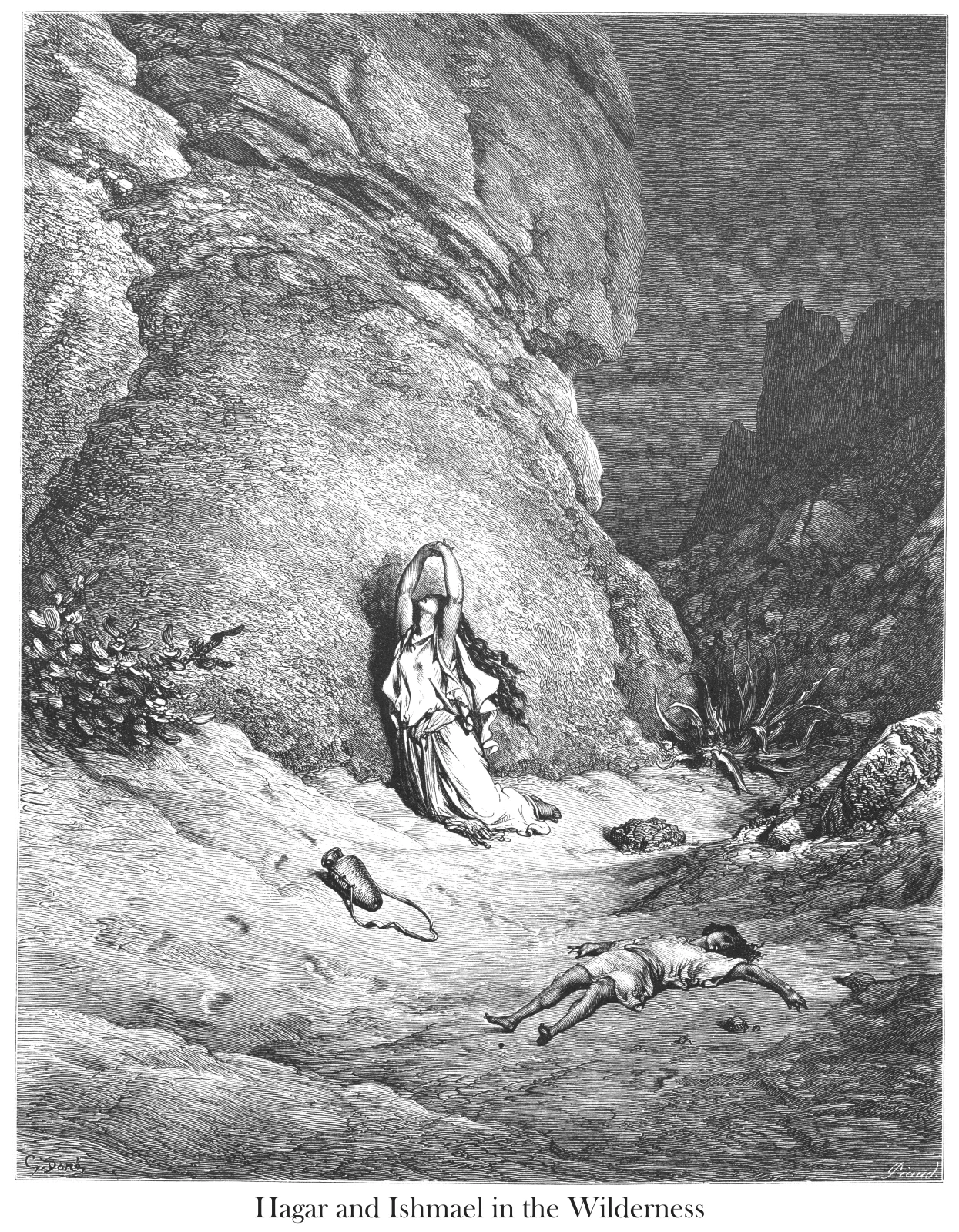
Hagar and Ishmael in the Wilderness
Genesis 21:17-18 · World English Bible (Catholic)
17God heard the voice of the boy. The angel of God called to Hagar out of the sky, and said to her, “What troubles you, Hagar? Don’t be afraid. For God has heard the voice of the boy where he is.
18Get up, lift up the boy, and hold him with your hand. For I will make him a great nation.”
Hagar’s hands meet above her head. Kneeling against an immense wall of rock, she does not touch the child lying lower down, in the foreground. Her gesture rises toward heaven, while Ishmael’s body remains apparently motionless on the bare earth. The ground between them remains open: no embrace yet crosses the distance.
This separation gives the landscape its scale. The rock looms over Hagar and seems almost to push her toward the bottom of the page; in the distance, other walls of rock close off the horizon. A waterskin lies on the ground, apart from the two figures. Its presence makes more palpable what is lacking: the water the child needs. Yet no well can be seen in this expanse.
Genesis first places Hagar at a distance from her son: she does not want to see him die and begins to weep. Then God hears the voice of the child. The angel calls to Hagar from heaven and tells her to get up, lift Ishmael, and take him by the hand; he announces that a great nation will come from him. The well will not be seen until afterward, when God opens Hagar’s eyes.
Doré leaves this speech without a visible figure. No angel, no contact between mother and child: the engraving holds on the moment of distress rather than the carrying out of the requested actions. The waterskin on the ground already belongs to the story of deliverance, but nothing in its appearance allows us to see that it can be filled. The gaze remains fixed on what precedes the discovery of water.
In the text, the voice that is heard is the child’s, while the call is addressed to his mother. The distance the engraving maintains between them gives particular weight to these words: the promised help comes through a hand to be extended toward the one who remains lying there.