Gustave Doré · Genesis 22:10-12
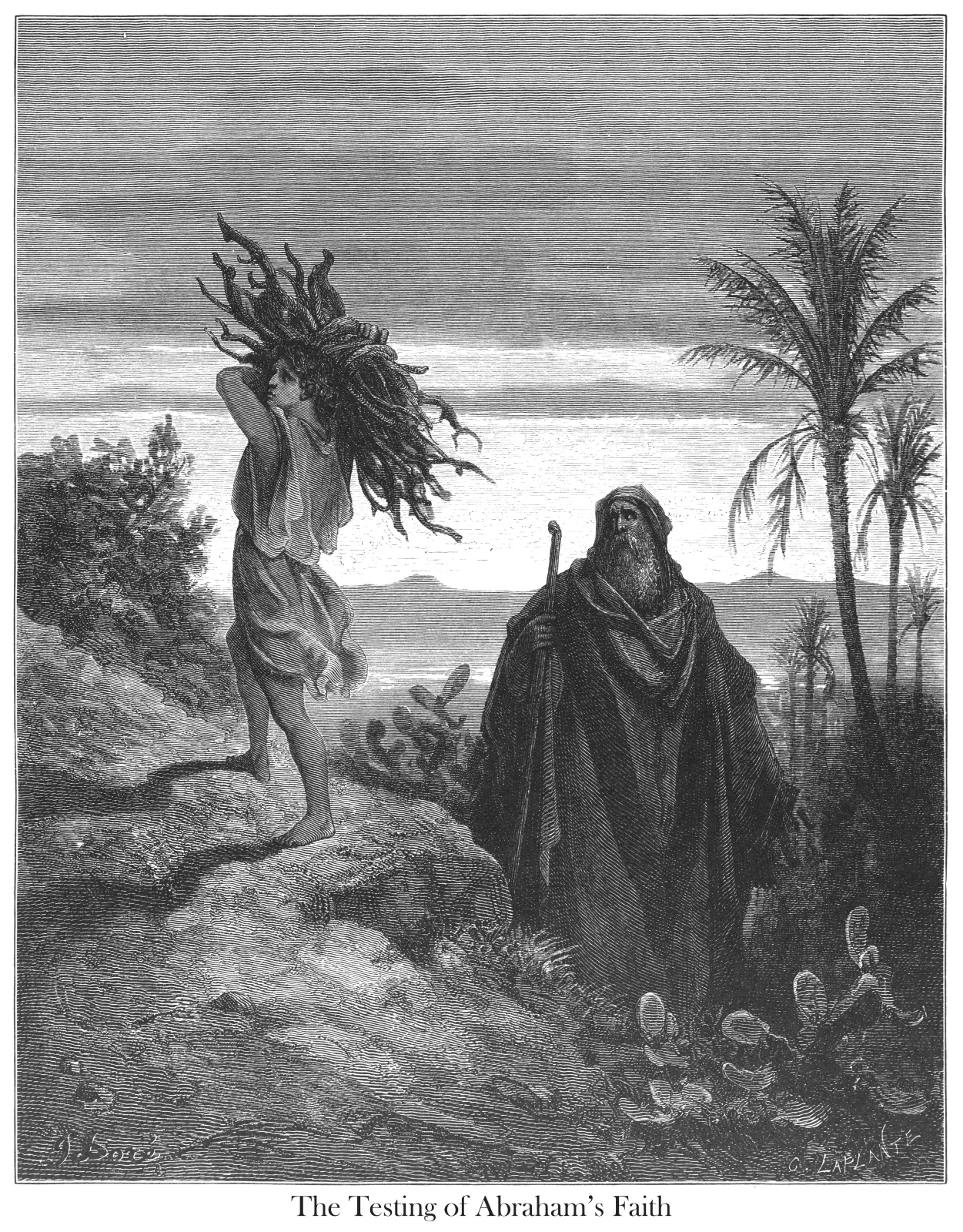
The Testing of Abraham's Faith
Genesis 22:10-12 · World English Bible (Catholic)
10Abraham stretched out his hand, and took the knife to kill his son.
11The LORD’s angel called to him out of the sky, and said, “Abraham, Abraham!” He said, “Here I am.”
12He said, “Don’t lay your hand on the boy or do anything to him. For now I know that you fear God, since you have not withheld your son, your only son, from me.”
The wood extends well beyond the young man's shoulders. Its gnarled branches rise above his head and fall behind his back; he supports them with both raised arms. To the right, lower down on the ground, an old bearded man holds a staff. The distance between the two figures reveals the stony path and, farther off, a bright expanse edged by heights.
The title leads us to recognize Abraham and Isaac. One advances under the burden, while the other stands behind him. Their gestures do not answer one another: the son's arms encircle the wood, while the father leans on his staff. The bundle draws the eye all the more because it stands out against the sky and obscures part of Isaac's silhouette. This wood, still being carried, is not the wood that the cited passage already describes as laid out on the altar.
The difference is decisive. In Genesis 22, Abraham has bound his son; he takes the knife, then the angel calls to him from heaven and forbids him to lay a hand on the boy. Here, Isaac is standing and free to move. No altar, no angel is visible. The engraving thus places the two figures before the moment indicated by the reference, without depicting the halting of the sacrificial act. The ram mentioned in the context is likewise absent.
In the light of what follows, the burden takes on a gravity that the walk alone could not give it. Yet the text as transmitted also makes us hear words that this silent image necessarily lacks: the call addressed to Abraham and his reply. The fear of God named by the angel cannot therefore be read directly in the father's face. In the passage, it remains bound to a word received and to the son's life being spared.