Gustave Doré · Genesis 23:19
The Burial of Sarah
Genesis 23:19 · World English Bible (Catholic)
19After this, Abraham buried Sarah his wife in the cave of the field of Machpelah before Mamre (that is, Hebron), in the land of Canaan.
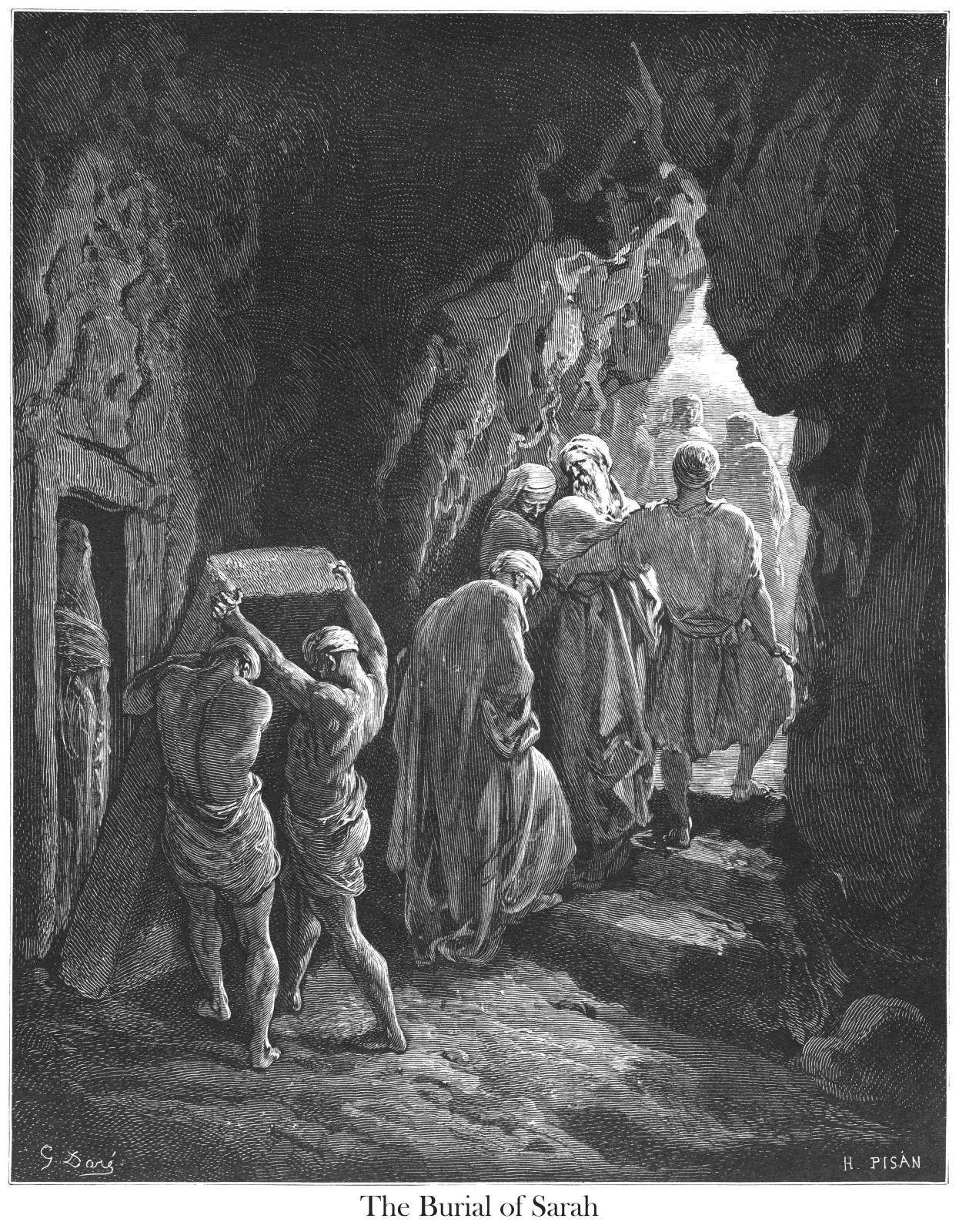
On the left, two men lift a heavy slab. Their outstretched arms and bent backs make its weight palpable, while at the centre a close-knit group accompanies a form wrapped in cloth. There is little free space between these gestures and the cave’s luminous threshold. The burial is a task carried out by several people, in a place that seems at once vast and crowded with human presence.
The slab holds the eye because, before us, it covers nothing yet: it is in motion. Nearby, a dark opening is cut into the wall. The work of moving the stone gives duration to the burial, whereas Genesis recounts it in a few words: Abraham buried Sarah in the cave of Machpelah. The engraving unfolds what this sentence leaves unspoken, without allowing each participant to be identified with certainty.
At the back, light from outside outlines the figures standing near the entrance. It also illuminates the central group, but scarcely reaches the upper part of the cavern, whose rocky mass looms over the figures. The eye thus moves from the open passage behind them to the stone being lifted in the foreground: entering the cave and closing the burial place belong to the same moment.
The text locates the tomb precisely, opposite Mamre, and places it within a field that became Abraham’s property before the sons of Heth. Nothing in the cavern makes these boundaries or witnesses recognizable. The legal permanence of the place is answered here by the fragility of the gestures needed to lay a dead woman there. The land Abraham owns appears first as a space where the living care for Sarah.