Gustave Doré · Genesis 9:24-25
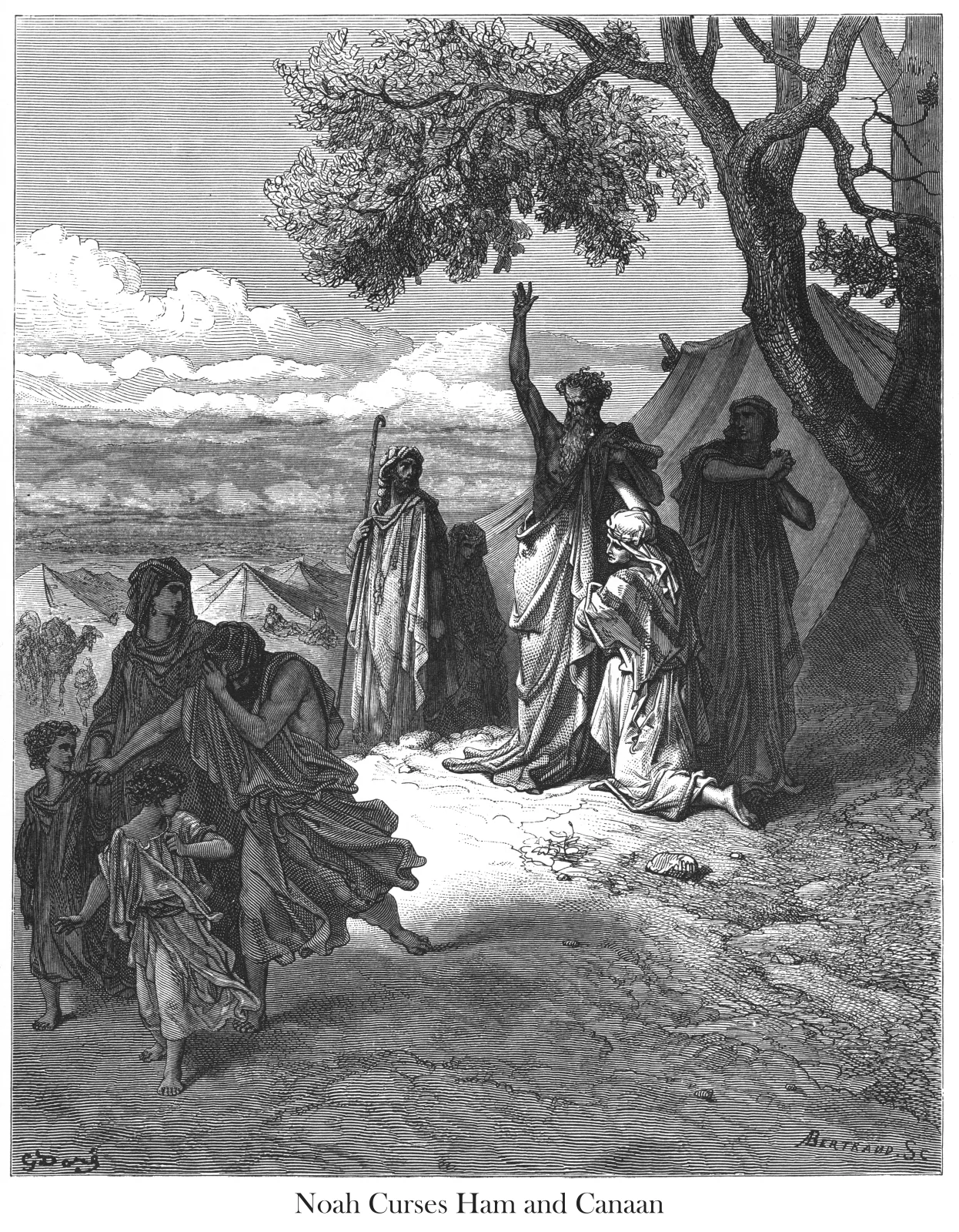
Noah Curses Ham and Canaan
Genesis 9:24-25 · World English Bible (Catholic)
24Noah awoke from his wine, and knew what his youngest son had done to him.
25He said, “Canaan is cursed. He will be a servant of servants to his brothers.”
Noah’s arm rises almost as high as the foliage. At his feet, a kneeling figure turns toward him; farther away, in the foreground, a man covers his face and walks off with children. Between the raised hand and this group moving toward the edge of the image, a distance opens across the bare ground. Noah’s words take shape in that interval.
The man who withdraws does not leave alone. His bent figure looms over the children, one of whom looks back. The catalogue title associates Ham and Canaan with the curse; yet nothing allows us to identify each figure in this group with certainty. Their closeness is enough to give the scene a familial dimension. While Noah remains standing near the tent, the movement of the figures in the foreground draws the eye beyond the circle gathered around him.
Genesis places these words after Noah wakes. Shem and Japheth covered their father without looking at his nakedness; Noah then learns what his youngest son had done to him. But the one he names in his curse is Canaan. He declares that Canaan will be a servant to his brothers. The passage provided describes neither the gathering before the tent nor the departure of a group: Doré gives bodies and space to words whose consequences for those who hear them are not reported in the text.
This shift makes a difficulty in the passage tangible. The offense Noah learns of and the curse he pronounces do not bear the same name. The group of adults and children does not resolve this discrepancy; on the contrary, it leaves it visible in the closeness of the generations. The father’s words, spoken from the threshold of the tent, reach beyond the confrontation between two men.