Gustave Doré · Genesis 8:11
A Dove Is Sent Forth from the Ark
Genesis 8:11 · World English Bible (Catholic)
11The dove came back to him at evening and, behold, in her mouth was a freshly plucked olive leaf. So Noah knew that the waters were abated from the earth.
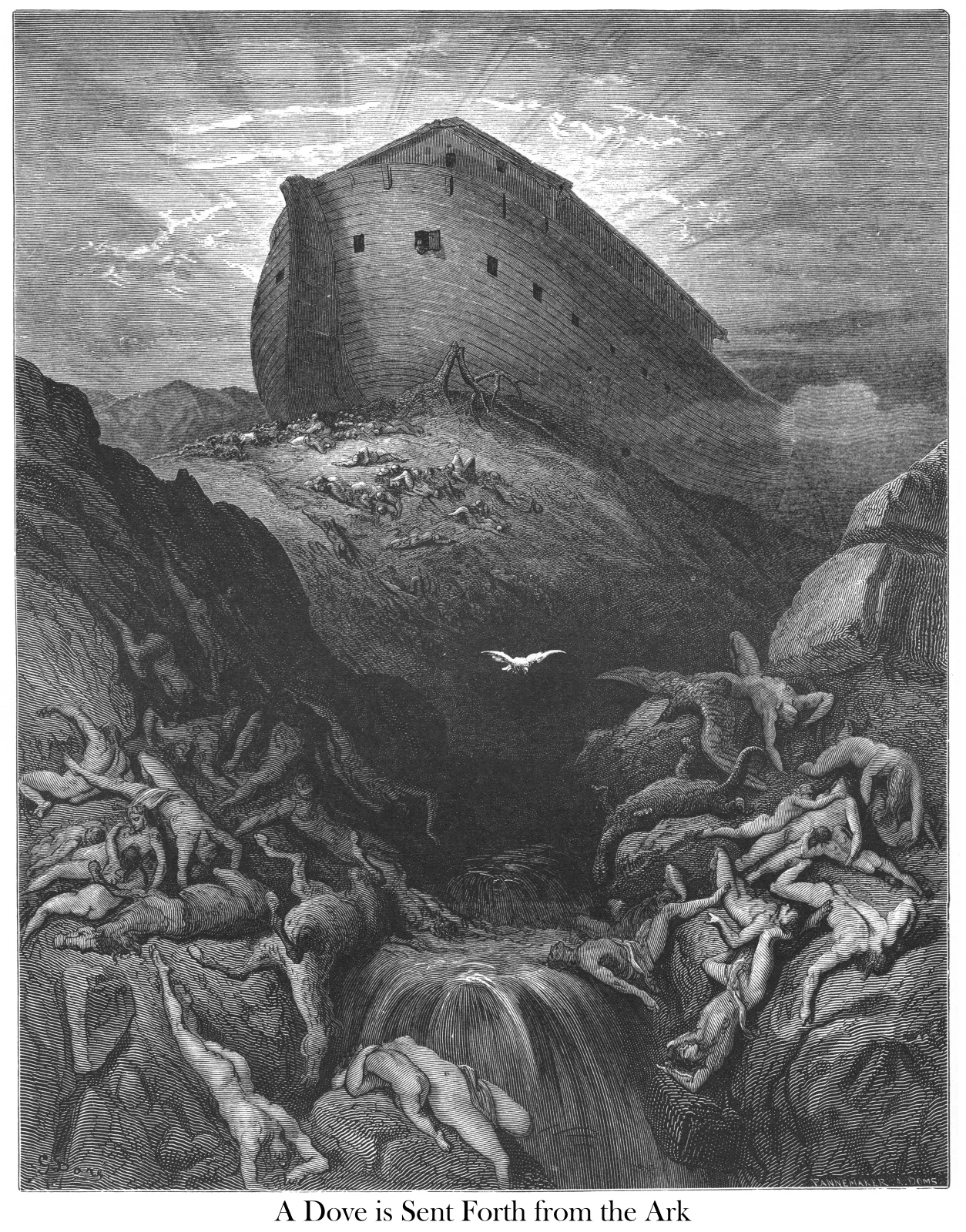
A small white shape crosses the dark hollow at the center of the engraving. The dove spreads its wings far below the ark, whose immense hull fills the heights. Between the two, a barren slope is strewn with bodies. The bird’s flight stands out clearly, but it does not dominate the landscape: it seems tiny against the expanse it traverses.
The foreground forces us to reckon with what this expanse covers. Human bodies and animals lie among the rocks, on either side of water that is still flowing. Higher up, the ark rests above this ravine laden with the dead. Its bulk shelters the beings within it, but hides nothing of the disaster around it. The dove passes precisely through the open space between these two crowded banks.
Genesis relates that, after an unsuccessful first flight, Noah waits seven days before sending the bird out again. It returns in the evening with a fresh olive leaf in its beak: Noah then understands that the waters have receded. The engraving’s title refers to the sending, while the verse cited recounts the return. In the image, no leaf is clearly discernible; the direction of the flight itself remains difficult to establish. The moment chosen thus retains something of the uncertainty that precedes the recognition of the sign.
The text conveys the news in a leaf. The engraving, by contrast, extends the gaze across a land where the receding waters also reveal the dead. The small bird links these two scales: the immensity of the catastrophe and the fragility of a sign of life. The promise of land regained does not make what the waters have left behind disappear.