Gustave Doré · Revelation 21:1-2
The New Jerusalem
Revelation 21:1-2 · World English Bible (Catholic)
1I saw a new heaven and a new earth, for the first heaven and the first earth have passed away, and the sea is no more.
2I saw the holy city, New Jerusalem, coming down out of heaven from God, prepared like a bride adorned for her husband.
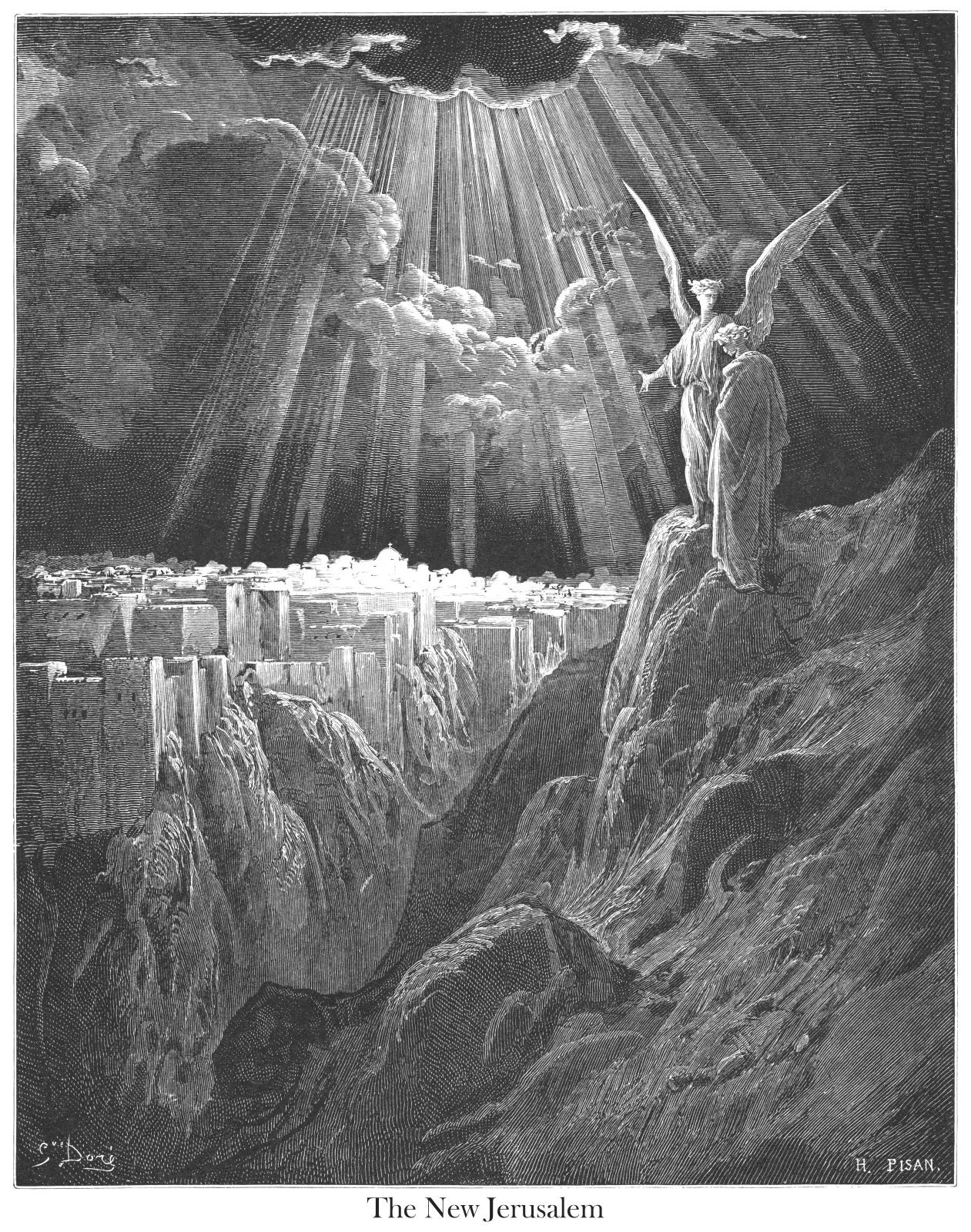
On a promontory to the right, an angel stretches out his hand toward the city. Beside him, a draped man stands at the edge of the rock, facing in the same direction. Their small stature gives a sense of the distance separating them from the walls. The New Jerusalem occupies the horizon, while a deep ravine cuts through the foreground.
This void matters as much as the city. The bright ramparts and closely packed roofs appear beyond a steep slope whose lines plunge toward the bottom of the engraving. No visible path connects the place where the two figures stand to the city. Only the angel’s gesture crosses this distance: he points to what the man can contemplate without yet entering it.
Above the buildings, long rays descend from an opening in the clouds. They draw the eye toward the city, whose whiteness stands out against the dark sky. Yet its walls seem already established on earthly ground. The downward movement announced by Revelation is not depicted as that of a city still suspended in the air; it remains perceptible in the light coming from above.
The passage also describes Jerusalem as a bride adorned for her husband. The engraving gives no human form to this image: her adornment becomes the radiance of distant architecture. It likewise leaves without direct representation the passing away of the first heaven and the first earth, as well as the absence of the sea.
In the following verse, a voice announces that God will dwell with humankind. Here, this promised nearness is first contemplated from a distance. The ravine does not negate the promise; it makes visible the time of looking, before an abode still situated on the opposite bank.