Gustave Doré · Revelation 20:12
The Last Judgment
Revelation 20:12 · World English Bible (Catholic)
12I saw the dead, the great and the small, standing before the throne, and they opened books. Another book was opened, which is the book of life. The dead were judged out of the things which were written in the books, according to their works.
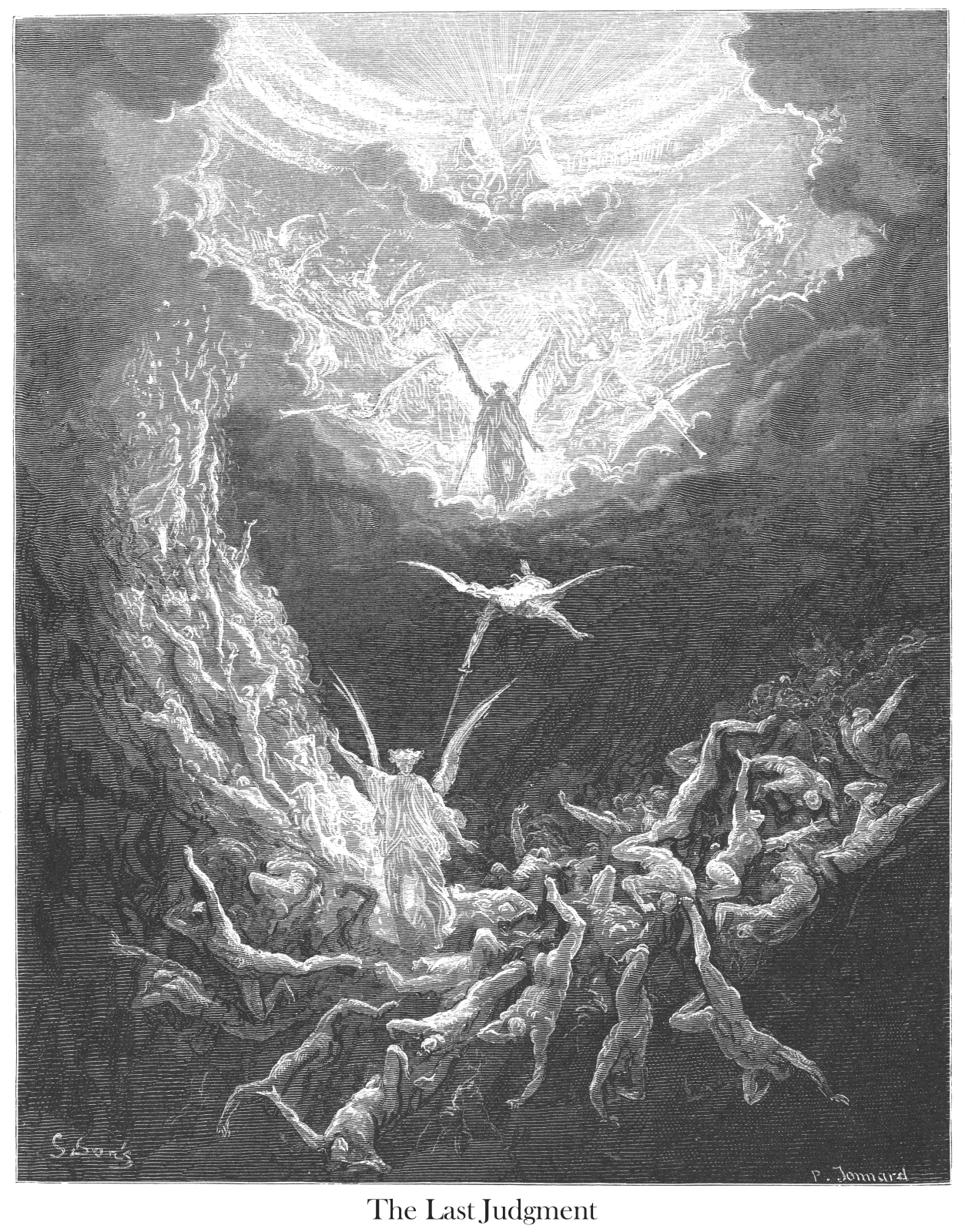
At the bottom of the engraving, a body pitches forward, headfirst; very close by, others collide, bend, or stretch out their arms. Their trajectories are difficult to distinguish in the tangle. Above them, a winged figure crosses the dark space, while another, standing among the bodies, stretches out its arms. Here, judgment takes the form of a movement that scatters the crowd.
On the left, however, a long line of figures rises in a narrow shaft of light. Raised arms mark the ascent all the way to the clouds. It gives the entire scene a direction: the eye leaves the bodies plunging in the foreground and rises toward the light, where a figure sits high above, surrounded by rays and heavenly crowds. Between this distant summit and the dead, the angels occupy several levels of space. The distance is immense; no stable ground connects the bottom with the top.
The Revelation of John places the dead, great and small, standing before the throne. Books are opened, as well as another book, the book of life; each is judged according to his deeds. The engraving retains the throne and the immense assembly, but the books cannot be discerned. In the lower part, the appearance before the written record gives way to a tumult of bodies moving in divergent directions. The immediate context also evokes the disappearance of heaven and earth before the One who sits: Doré’s dark space, with no sure earthly horizon, gives form to this loss of bearings.
The ascending line and the falling bodies make perceptible a separation that the verse devoted to the books does not yet spell out. The text emphasizes each person’s deeds; the engraving makes this appearance before judgment felt on the scale of a multitude, without allowing the content of the judgment to be read on the bodies.