Gustave Doré · Acts 21:34-35
Paul Is Rescued from the Crowd
Acts 21:34-35 · World English Bible (Catholic)
34Some shouted one thing and some another, among the crowd. When he couldn’t find out the truth because of the noise, he commanded him to be brought into the barracks.
35When he came to the stairs, he was carried by the soldiers because of the violence of the crowd;
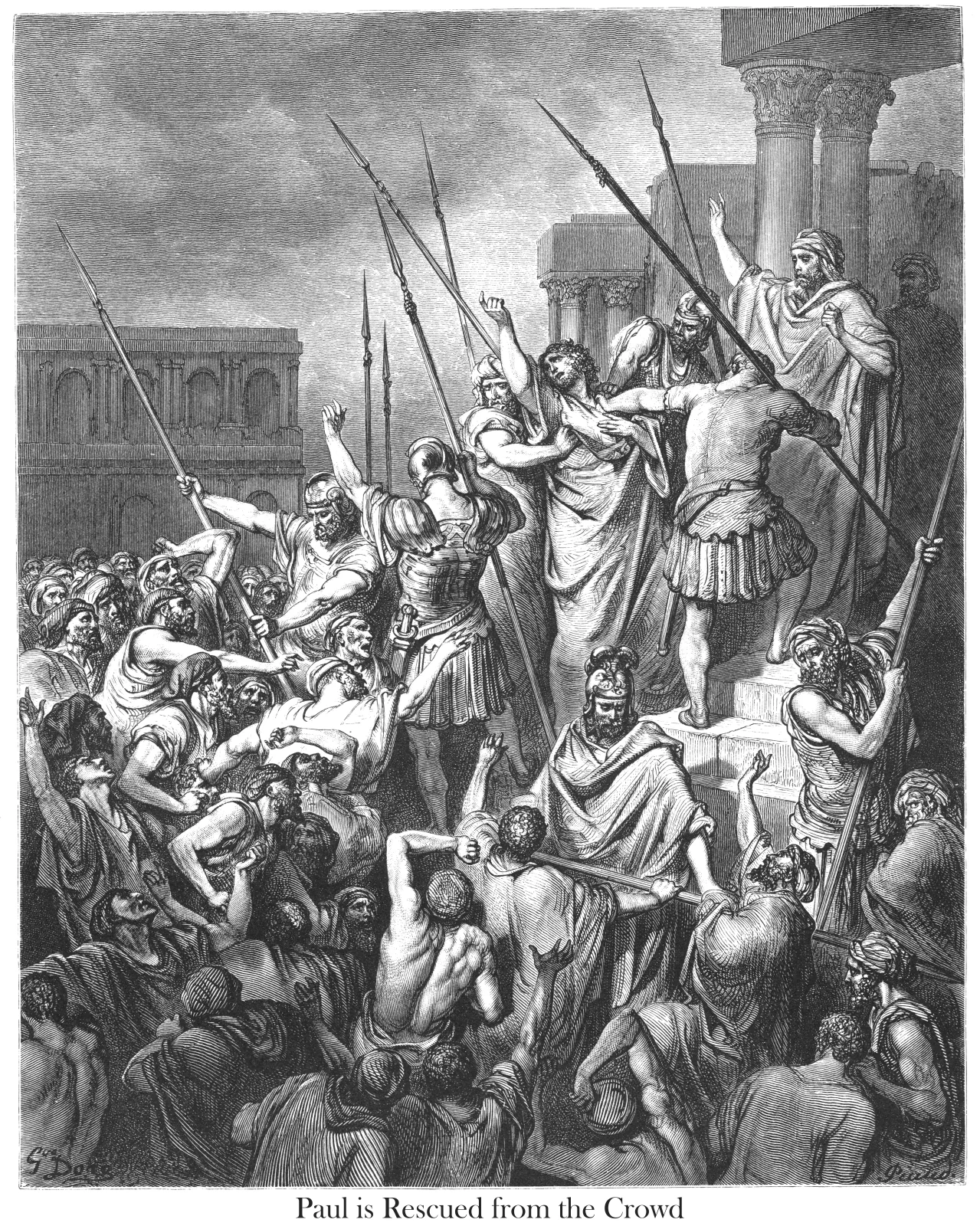
Above the heads, an arm is raised. It belongs to Paul, whose leaning body is held by the men around him. His open hand answers the arms stretched out from the crowd, but a line of soldiers and spears separates them. On the steps, Paul is at once kept from those pursuing him and held among those taking him away.
The engraving gives ample space to the surge coming from below. Hands reach to grasp the group; faces turn towards it, mouths open. A soldier, seen from behind, blocks access to the steps, while another uses his spear to hold back the attackers. The long weapons extend this defence into the sky: their diagonals cross the distance between the multitude and the figures placed higher up. Yet there is nothing triumphant about this ascent. Paul does not tower over the crowd by his own movement; his body depends on the arms supporting him.
Acts explains this position by the violence of the multitude: on the steps, the soldiers have to carry Paul. The text also recounts the confusion of the shouting. The tribune can learn nothing with certainty and orders his prisoner to be taken into the fortress. In the engraving, this disorder takes shape in the tangle of gestures; the contradictory words themselves remain beyond reach. The context further specifies that Paul was bound with two chains. These are not clearly distinguishable in the image, where the men’s grip around him draws the eye more strongly.
This compelled support gives the scene its tension. The authority protecting Paul from the crowd is also the authority that has seized him. His raised arm remains visible amid the spears, without the gesture making clear what he is saying. At this point, the possibility of speech seems suspended between the tumult and the prisoner being taken into custody.