Gustave Doré · Acts 27:43-44
Paul Is Shipwrecked
Acts 27:43-44 · World English Bible (Catholic)
43But the centurion, desiring to save Paul, stopped them from their purpose, and commanded that those who could swim should throw themselves overboard first to go toward the land;
44and the rest should follow, some on planks and some on other things from the ship. So they all escaped safely to the land.
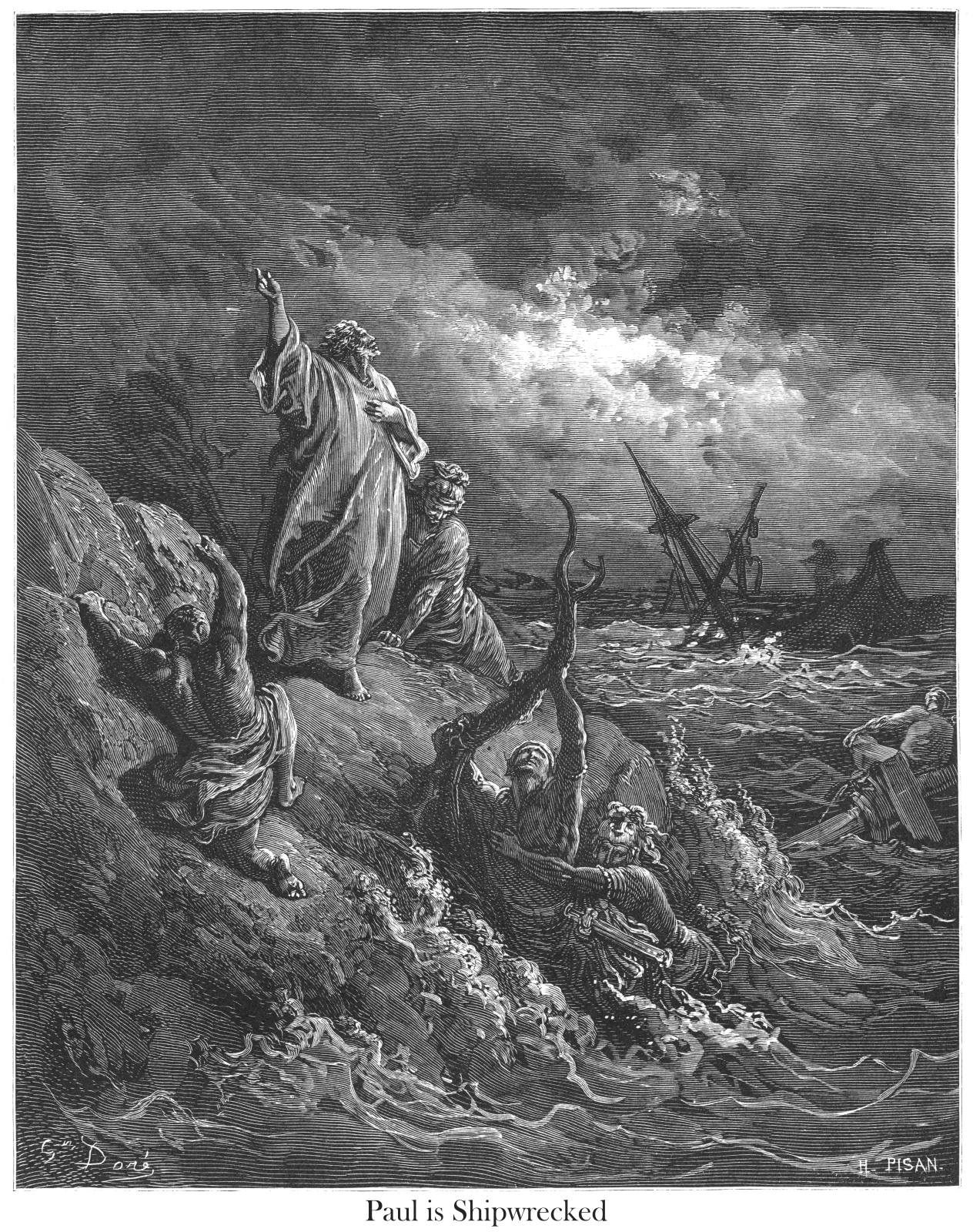
With one foot planted on the rock, Paul raises a hand toward the sky. Around him, the other shipwreck survivors have not yet found this foothold: one climbs on the left, clinging to the stone; two men are caught in the waves in the foreground, while on the right a figure floats among the wreckage. The shore has been reached, but it does not offer immediate refuge everywhere.
Paul’s figure dominates the group without being set apart from the catastrophe. His light robe follows the slope of the rock; behind him, a man hauls himself up onto the same surface. Farther off, the ship’s broken masts still rise above the sea. Between this wreck and the land, the water occupies almost the entire width of the engraving. The distance measures the journey already made or still to be made.
In the foreground, a man grips a forked branch rising above the waves. Another, carrying a sword, clings close by. This wood is no boat: it is a precarious handhold, set against the force of the wave breaking over the bodies. On the right, planks still bear a shipwreck survivor. These fragments give concrete form to the makeshift means mentioned in Acts.
The text also recounts a decision that no gesture here allows us to identify with certainty: the centurion prevented the soldiers from killing the prisoners because he wanted to save Paul. He then ordered the men to make for land, by swimming or on the wreckage. Whereas the verses ultimately declare that all reached the shore safe and sound, the engraving holds on to the moment when several are still struggling to get there.
Paul’s raised hand thus stands apart from the hands searching for a hold. The account links his rescue to the decision of one man; the engraving places this figure, already standing, amid bodies still in danger. His gesture can be read as an address to heaven, without erasing the fragile means of aid the others need.