Gustave Doré · Luke 24:26-27
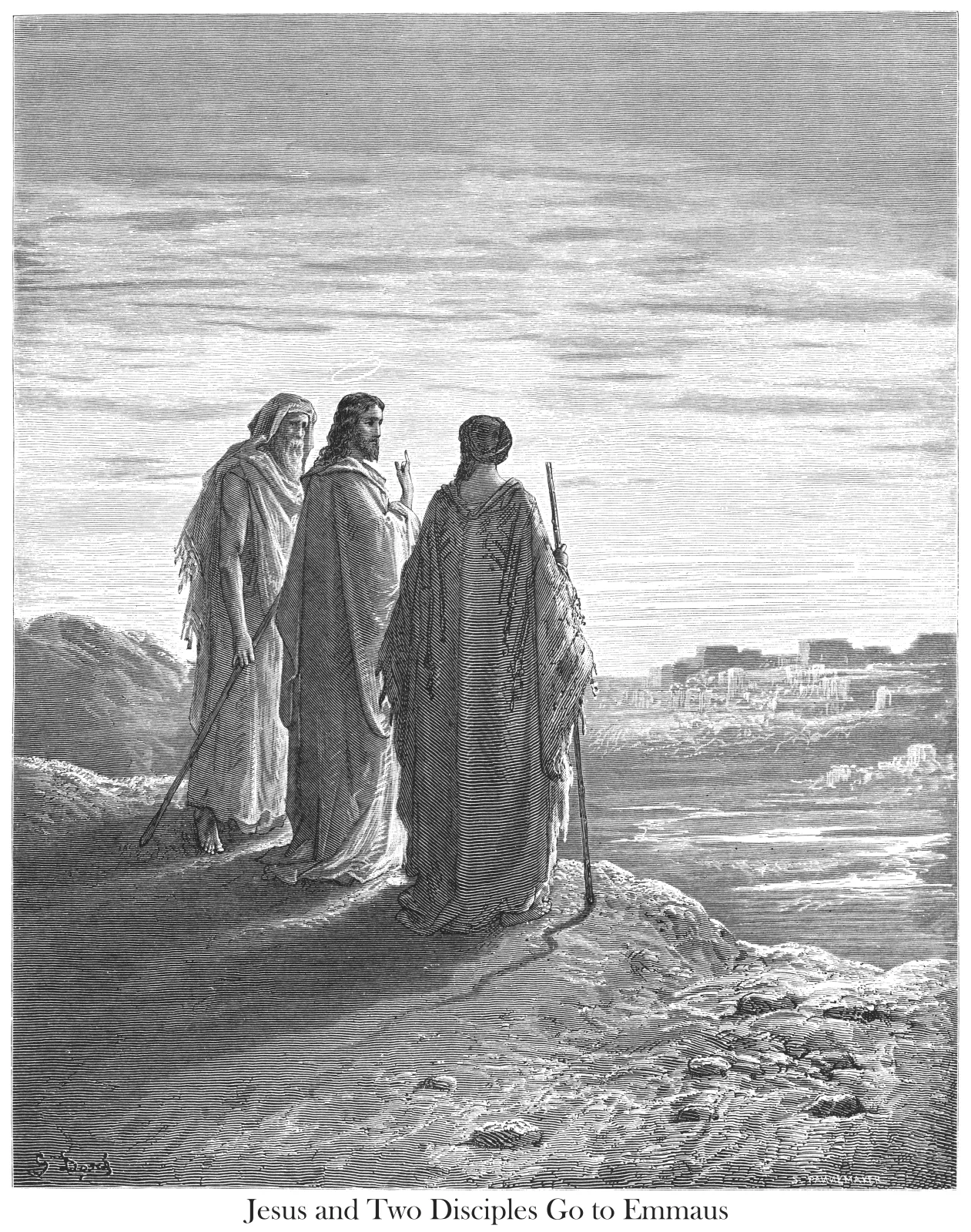
Jesus and Two Disciples Go to Emmaus
Luke 24:26-27 · World English Bible (Catholic)
26Didn’t the Christ have to suffer these things and to enter into his glory?”
27Beginning from Moses and from all the prophets, he explained to them in all the Scriptures the things concerning himself.
Jesus’s hand rises to the level of his face. An extended finger accompanies the words he addresses to his companion on the right. The latter is seen from behind, his head turned toward him; on the left, the other disciple stands very close, slightly behind. The two staffs identify them as travellers, but their gathered bodies give the group the appearance of a pause.
A fine halo inscribes a pale oval above Jesus’s head. This discreet sign distinguishes the speaker without separating him from his companions: his cloak joins theirs in a single dark mass. On the right, the ground slopes down toward an expanse in which the light is reflected; buildings occupy the horizon. The group remains at the edge of this broad space, as if held there by the conversation.
In Luke, Jesus explains to the two men what concerns him in the Scriptures, beginning with Moses and the prophets. He has just asked them whether the Christ must not suffer before entering into his glory. No book appears in the engraving. The gesture of the hand gives visible form to this explanation, whose stages the text does not detail. Nor are suffering and glory depicted as two distinct episodes: they remain the subject of an exchange on the road.
The halo makes Jesus identifiable in the image, while his place among the travellers preserves the intimacy of the conversation. His words concern himself, but they pass through the Scriptures. The raised finger thus draws attention less to a destination than to this work of understanding, even as the journey continues.