Gustave Doré · Luke 23:44-45
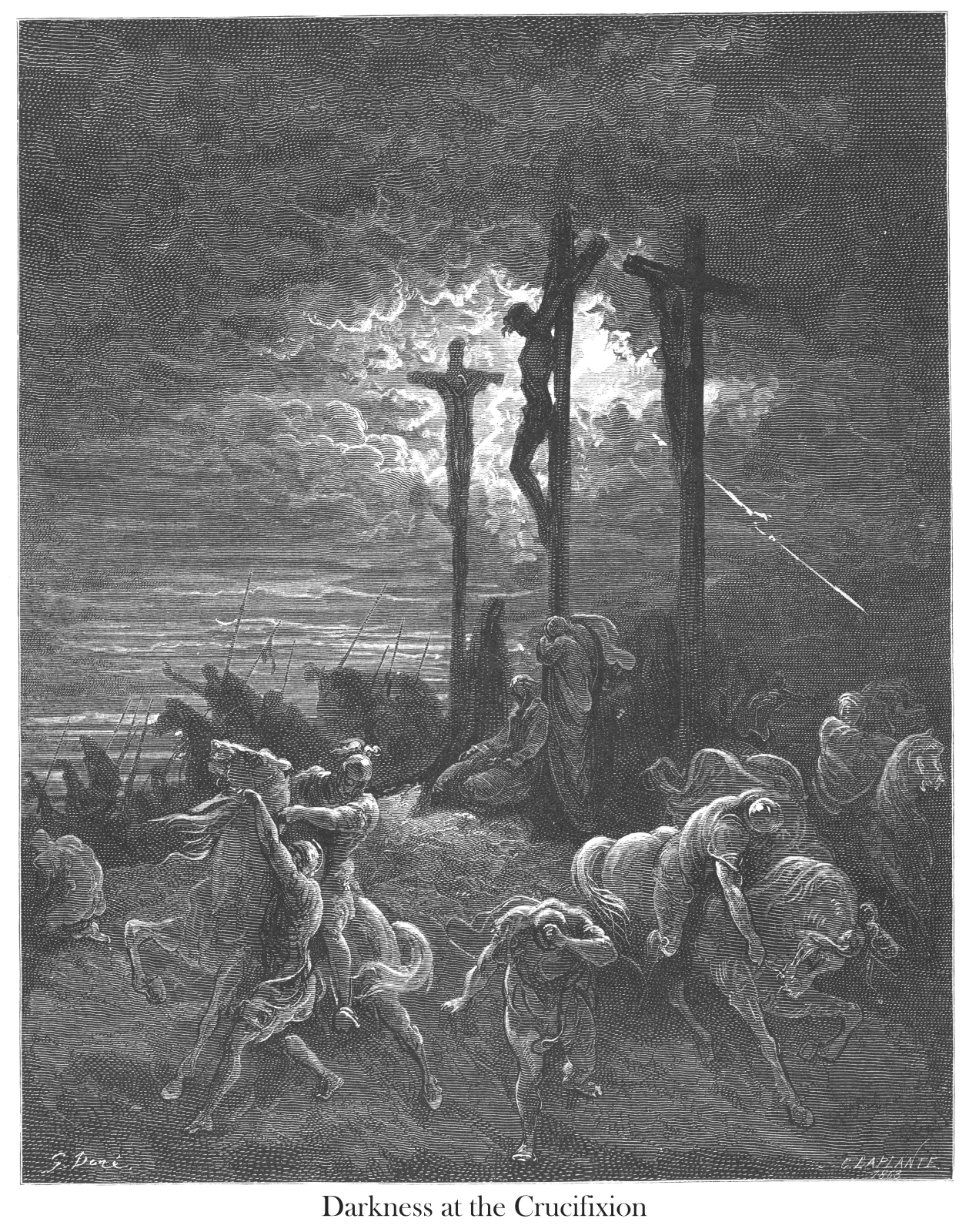
Darkness at the Crucifixion
Luke 23:44-45 · World English Bible (Catholic)
44It was now about the sixth hour, and darkness came over the whole land until the ninth hour.
45The sun was darkened, and the veil of the temple was torn in two.
In the foreground, a man advances bent over, his arm raised in front of his face. Behind him, the horses rear or lower their heads; the riders lean over their mounts. These bodies draw the eye toward the edges of the engraving, away from the crosses rising at the center. At the foot of Jesus’ cross, however, figures remain, huddled in their grief.
The central cross dominates the slope, but Christ’s body is difficult to distinguish from its dark wood. His silhouette stands out against a bright opening in the clouds. This remnant of light does not dispel the darkness: it makes its density palpable around the three crucified men. Below, the line of the horizon and the slanting spears lead toward a crowd receding into the darkness.
Luke places the event in the middle of the day: from the sixth to the ninth hour, darkness covers the whole earth. The sun is darkened, and the veil of the Temple is torn down the middle. The engraving retains the tumultuous sky without showing the veil. It gives, by contrast, particular scope to the reactions of men and beasts, about which the two verses are silent. The three-hour duration becomes here a scene of disorder and dispersal.
The torn veil belongs to a place other than Golgotha; its absence leaves the eye before the crosses. In Luke, however, the two signs are brought close together: the darkening reaches the whole earth, while the tearing affects the space of the Temple. The engraving allows us to contemplate this proximity without resolving it. Around Jesus, what seemed stable comes undone, and those who remain at the foot of the cross are almost lost in the expanse of the sky.