Gustave Doré · Luke 23:34-35
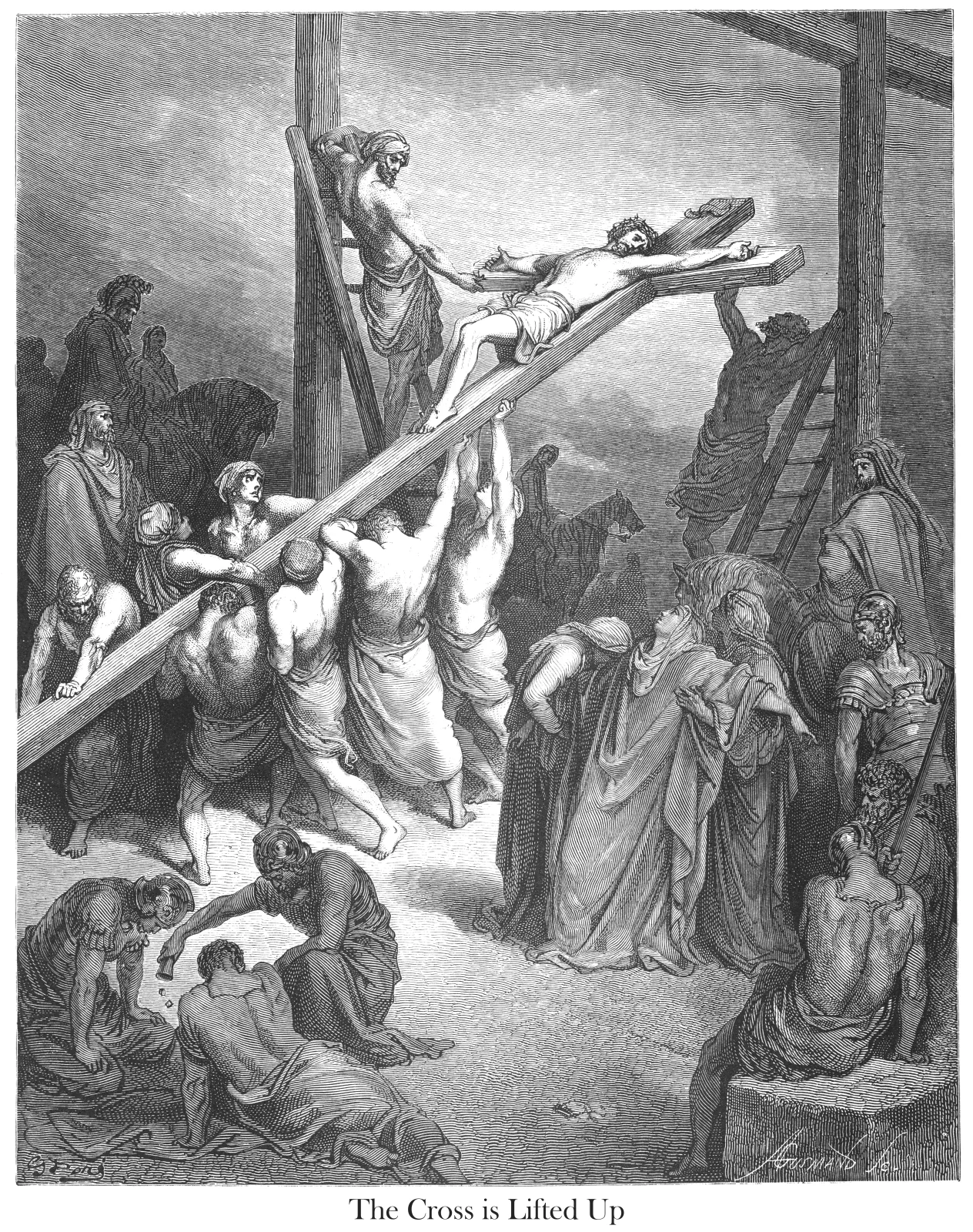
The Raising of the Cross
Luke 23:34-35 · World English Bible (Catholic)
34Jesus said, “Father, forgive them, for they don’t know what they are doing.” Dividing his garments among them, they cast lots.
35The people stood watching. The rulers with them also scoffed at him, saying, “He saved others. Let him save himself, if this is the Christ of God, his chosen one!”
The cross runs diagonally across the engraving. It has not yet been raised upright: men lift it with arms outstretched, while others, positioned higher up, guide its ascent. Jesus’ body follows the slope of the wood. His outstretched arms form a second line with it, almost horizontal, above the crowd.
The men’s effort gives weight to the cross. Beneath the beam, backs bend and legs search for footing; on the right, a man on a ladder supports the end of the crossbeam. The torment appears here as a collective operation, its balance still precarious. Jesus is already fixed to the wood, but his elevation is still under way.
In the foreground, however, other gestures hold the gaze. Soldiers are bent over small dice; one of them lets them fall near the clothes scattered on the ground. A few steps from the moving cross, they are occupied with dividing the garments. Their game draws the gaze back to the ground, far from the body exposed above. On the right, a woman throws her head back toward Jesus, supported by her companions: the proximity of the torment does not bring the figures together in a shared attitude.
Luke links the crucifixion with Jesus’ prayer for those who do not know what they are doing, and then with the division of his clothes and the mockery of the rulers. The engraving makes the casting of lots visible, but the words of forgiveness and derision cannot be heard in it. It gives particular prominence, by contrast, to the moment when the cross is raised, a gesture the passage does not describe in detail.
This setting in motion places the prayer for forgiveness alongside work to which several hands contribute. Without identifying each of the men as one of those Jesus addresses, one can read in their effort a troubling proximity to his words: the body they raise is the very one that, in Luke, asks forgiveness for those responsible for it.