Gustave Doré · Luke 23:26-32
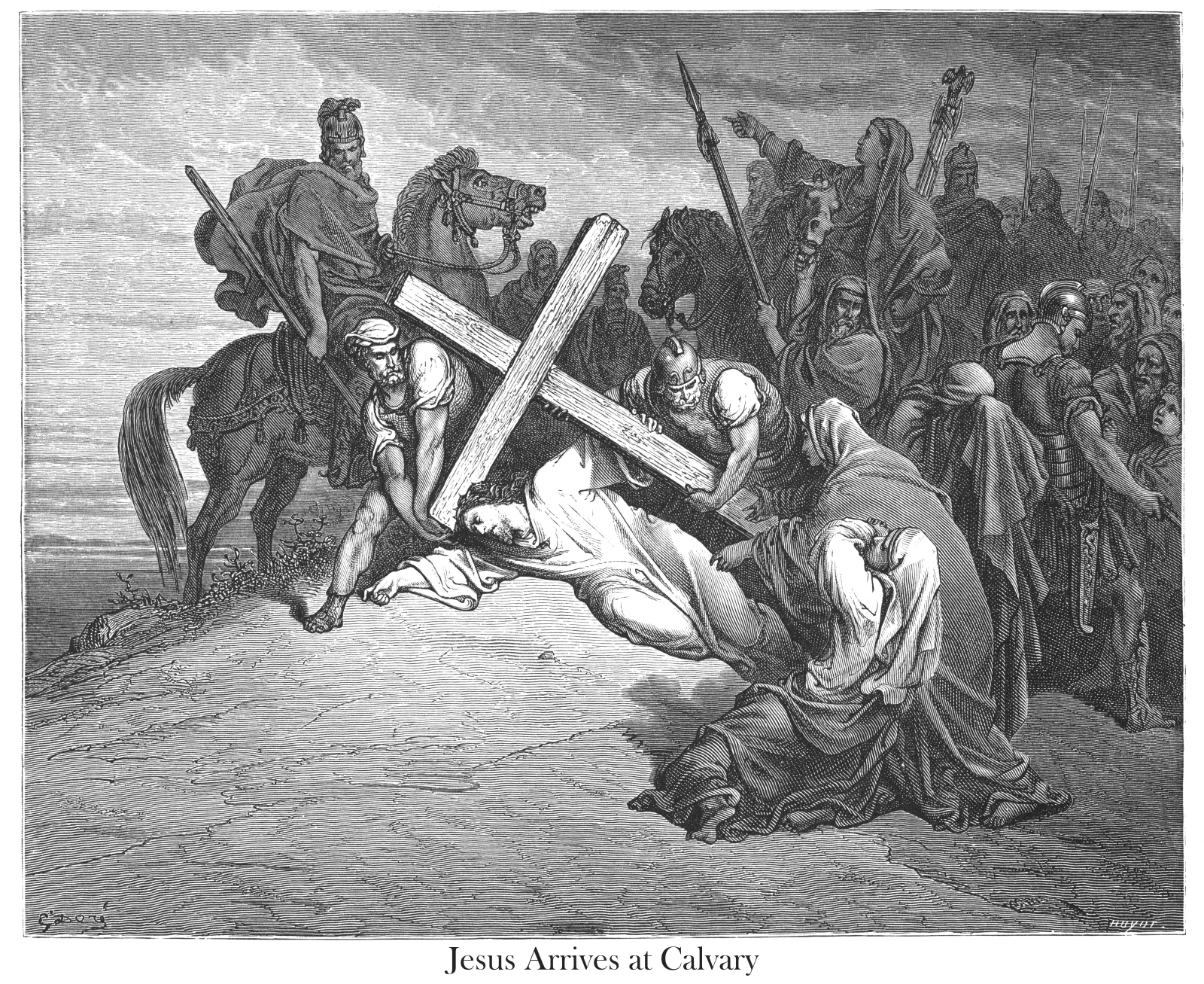
Jesus Arrives at Calvary
Luke 23:26-32 · World English Bible (Catholic)
26When they led him away, they grabbed one Simon of Cyrene, coming from the country, and laid the cross on him to carry it after Jesus.
27A great multitude of the people followed him, including women who also mourned and lamented him.
28But Jesus, turning to them, said, “Daughters of Jerusalem, don’t weep for me, but weep for yourselves and for your children.
29For behold, the days are coming in which they will say, ‘Blessed are the barren, the wombs that never bore, and the breasts that never nursed.’
30Then they will begin to tell the mountains, ‘Fall on us!’ and tell the hills, ‘Cover us.’
31For if they do these things in the green tree, what will be done in the dry?”
32There were also others, two criminals, led with him to be put to death.
Jesus’ hand rests on the ground, at the end of an outstretched arm. His body sags beneath the cross, whose two pale beams bar the center of the engraving. On the left, a man bends over near him; on the other side, a soldier grips the wood. The weight has become visible, even though several hands surround the cross.
Around this point of collapse, the procession draws closer together. The horsemen tower over the figures on foot, and the spears rise toward the sky, while in the foreground a woman, her face buried in her hands, curls in on herself. Very close to Jesus, another woman reaches out toward him. Their proximity gives a measure of the distance created by the crowd: the body on the ground remains within reach, yet is caught up in the movement of armed men and horses.
Luke recounts that Simon of Cyrene is made to carry the cross behind Jesus. Men help support it here, though Simon cannot be identified with certainty among them. The fall, by contrast, is not mentioned in the verses provided. It brings the journey to the place of execution to an abrupt halt. The title places this halt at the arrival at Calvary, where the quoted passage still shows the condemned being led along the road.
The women also occupy an important place in Luke: they lament, and Jesus turns to them to speak of the coming days of distress, for them and for their children. In the engraving, his face is inclined toward the ground; no words can be discerned. Yet the gesture of the woman hiding her face holds something of their grief. Read alongside Jesus’ warning, this gesture takes on a wider significance: the condemned man’s present suffering meets the suffering that threatens the inhabitants of Jerusalem.