Gustave Doré · Luke 10:34-35
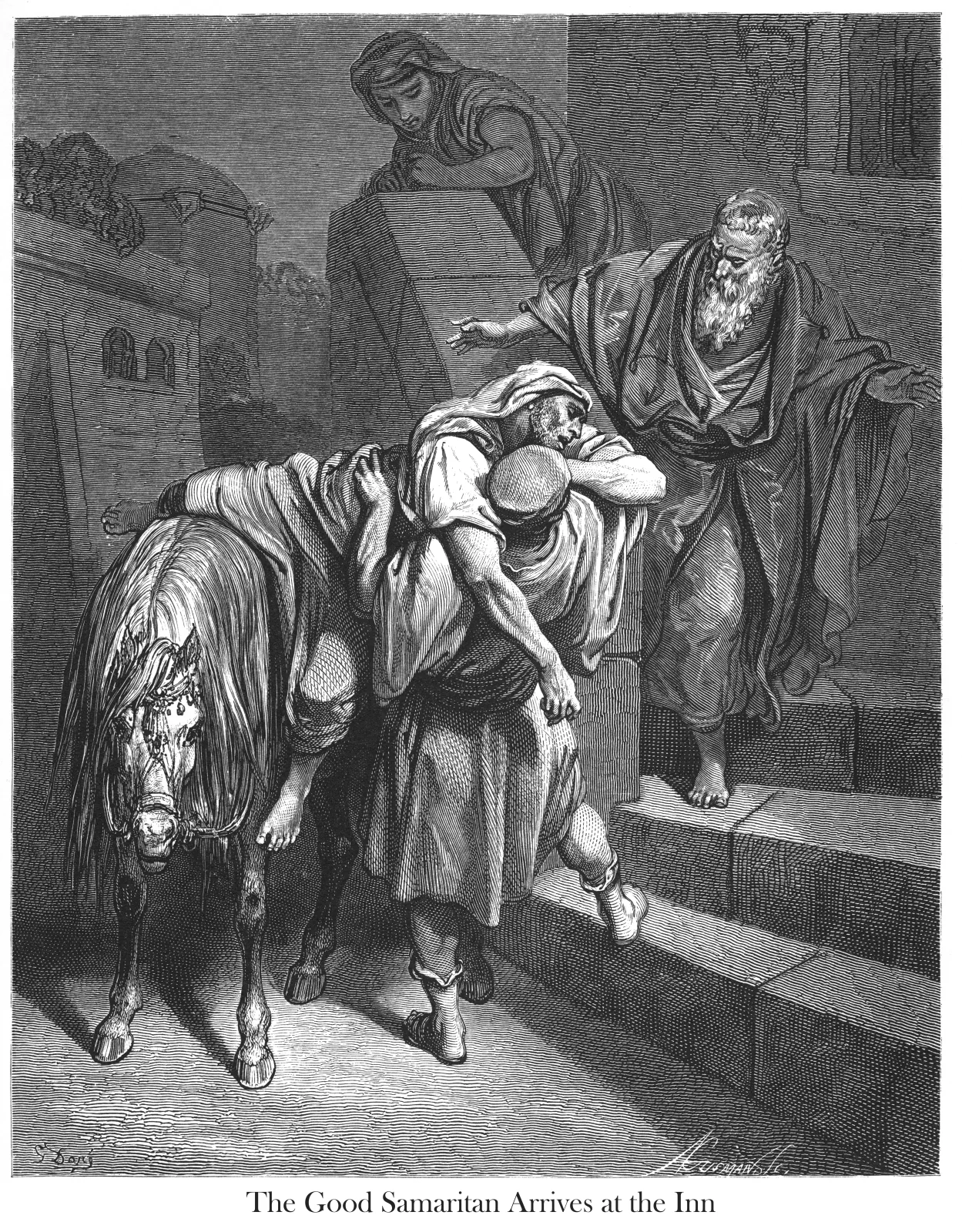
The Good Samaritan Arrives at the Inn
Luke 10:34-35 · World English Bible (Catholic)
34came to him, and bound up his wounds, pouring on oil and wine. He set him on his own animal, brought him to an inn, and took care of him.
35On the next day, when he departed, he took out two denarii, gave them to the host, and said to him, ‘Take care of him. Whatever you spend beyond that, I will repay you when I return.’
A foot steps onto the first stair. Under the wounded man’s weight, the Samaritan bends forward; behind him, the mount stands very close, head lowered. The man he carries has an arm and a leg hanging down. His body runs almost horizontally across the composition, from the animal’s haunch to his rescuer’s shoulder. To reach the door, he must still pass from the mount onto a man’s back, then cross this raised threshold.
At the top of the steps, a bearded old man stretches out his arms toward the arrivals. Higher still, a woman leans over a parapet to look. These two figures give visible form to the arrival at the inn: even before care can continue inside, the wounded man enters the field of view. The old man’s outstretched hand does not yet touch him; the effort of carrying him still belongs to the Samaritan.
In Luke, a few words lead from the road to the inn. The Samaritan has dressed the wounds with oil and wine, then placed the wounded man on his own mount. Only the next day does he entrust his guest to the innkeeper’s care, give him two denarii, and promise to pay any additional expense on his return. Doré dwells on a moment the text does not detail: the passage from the mount to the entrance. The first-aid gestures and the payment are not visible.
This movement gives particular weight to the question Jesus asks next: which of these proved neighbour to the man who fell among the robbers? Here, nearness takes the form of a burden being carried. The open arms at the threshold also suggest that care may continue with the help of another, without the wounded man ceasing to be its centre.