Gustave Doré · Luke 10:34-35
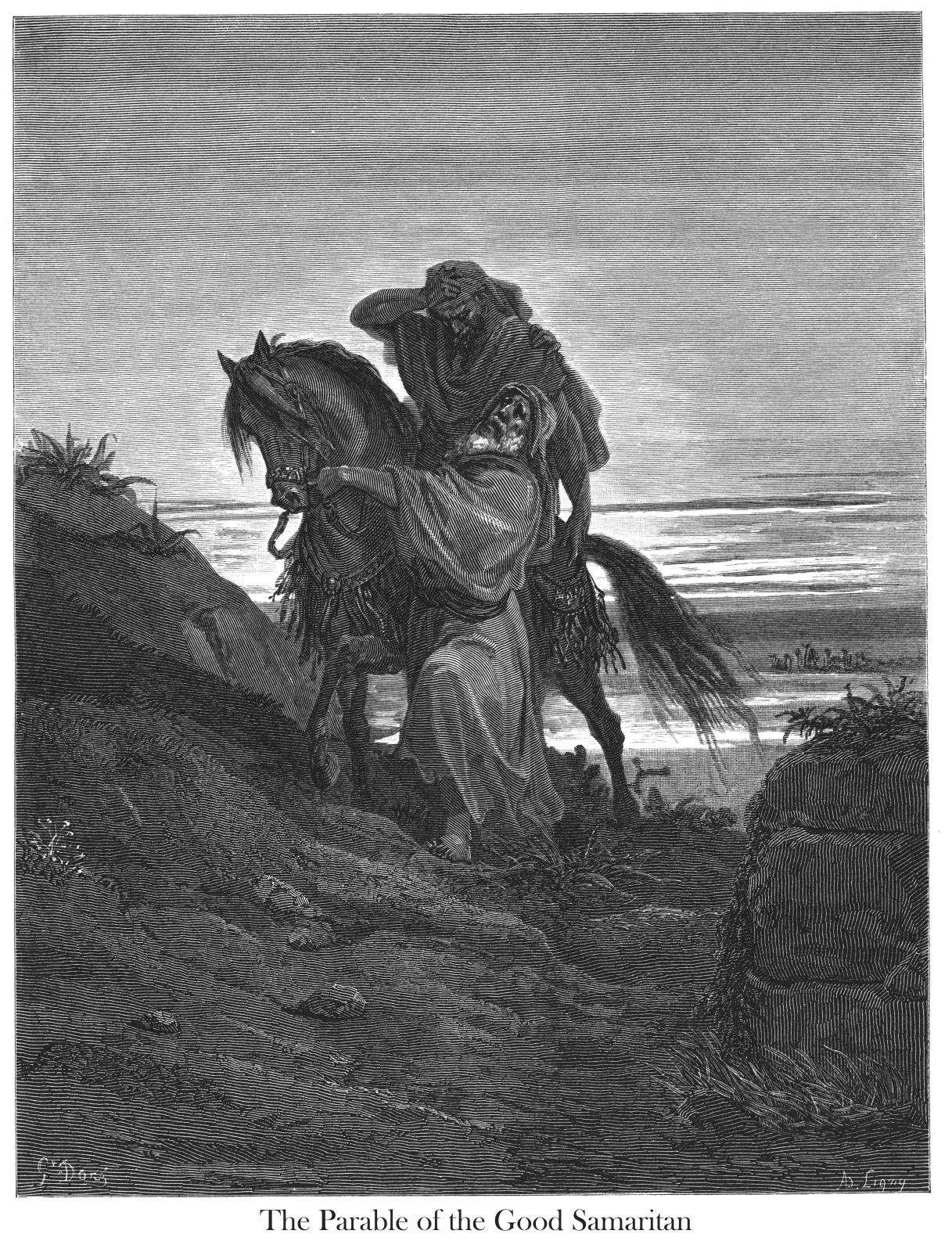
The Parable of the Good Samaritan
Luke 10:34-35 · World English Bible (Catholic)
34came to him, and bound up his wounds, pouring on oil and wine. He set him on his own animal, brought him to an inn, and took care of him.
35On the next day, when he departed, he took out two denarii, gave them to the host, and said to him, ‘Take care of him. Whatever you spend beyond that, I will repay you when I return.’
A hand holds the reins close to the horse’s mouth. It belongs to the man walking in front of the mount, his body turned toward the person it carries. The wounded man, positioned higher up, is bent over; one hand covers his forehead, and his other arm hangs alongside his leg. The Samaritan raises his face toward him while guiding the animal. Their bodies are close, but their gestures remain distinct: one moves forward, while the other seems absorbed in his pain.
The road climbs through dark, stony terrain. The horse lowers its head toward the slope, while the wounded man’s figure stands out against the almost empty sky. To the right, the landscape stretches to the horizon; no inn interrupts the journey. This broad expanse makes it possible to gauge the small group’s vulnerability and the distance it may still have to travel.
In Luke, the journey is only one moment in a series of acts of care. The Samaritan has bound the man’s wounds with oil and wine before placing him on his mount. He then takes him to the inn, where he cares for him. The next day, he gives two denarii to the innkeeper and promises to repay any additional expense. The engraving captures the passage from one place to another: the bandages and the payment are not visible, and here the help consists in guiding the horse and attending to the wounded man.
The detail of the upturned gaze gives this journey its weight. The Samaritan is not merely carrying the man toward shelter; he remains turned toward him as they travel. The question Jesus asks afterward—who proved to be the neighbor of the man who fell into the hands of robbers—finds concrete form in this closeness: two travelers move forward together, in unequal positions, bound by a care that must continue beyond the road.