Gustave Doré · Mark 12:42-43
The Widow's Mite
Mark 12:42-43 · World English Bible (Catholic)
42A poor widow came and she cast in two small brass coins, which equal a quadrans coin.
43He called his disciples to himself and said to them, “Most certainly I tell you, this poor widow gave more than all those who are giving into the treasury,
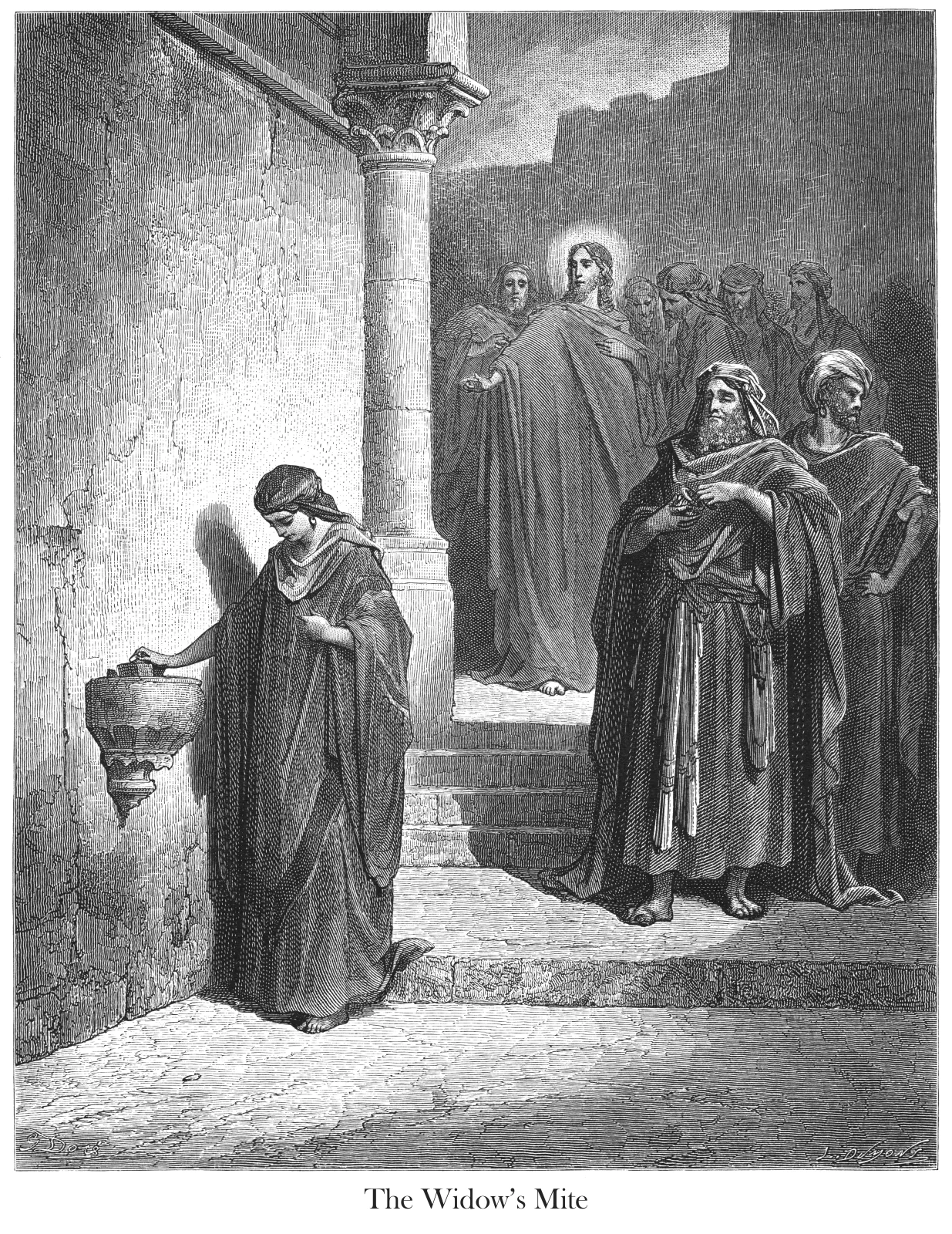
The widow’s hand barely reaches the top of the chest fixed to the wall. Her face is lowered; with her other hand, she holds her garment against herself. The gesture occupies a small place in the engraving, apart from the group gathered on the steps. Yet the brightness of the wall and the space left around the woman make it hard to miss.
Behind the column, Jesus stands among his disciples. His arm, extended to the left, continues the direction of the offering. Between him and the widow, the column marks a separation without interrupting this connection: Jesus’ gesture leads the eye toward what is happening on the other side. In the foreground, a man in ample robes holds an object in his hands, while a second figure turns away. Their imposing silhouettes occupy part of the passage. The widow, by contrast, is alone before the chest.
In Mark, Jesus is seated as he watches the offerings. Several rich people give much; the woman puts in two small coins. Then Jesus calls his disciples and declares that she has given more than all the others. The engraving brings these moments together: while her hand is still near the chest, Jesus is already pointing the woman out to the group around him. His words thus take the form of a visible gesture.
The coins are too small for their number to be determined with certainty in the image. The text, however, specifies their value and, above all, gives the reason for Jesus’ judgment: the others have given out of their surplus, while the widow has given all she had to live on. Nothing in the appearance of the deposit alone makes it possible to measure this share. Jesus’ outstretched arm therefore does more than point out a discreet gesture: it directs attention to an offering whose greatness must be recognized by something other than its amount.