Gustave Doré · Matthew 21:7-8
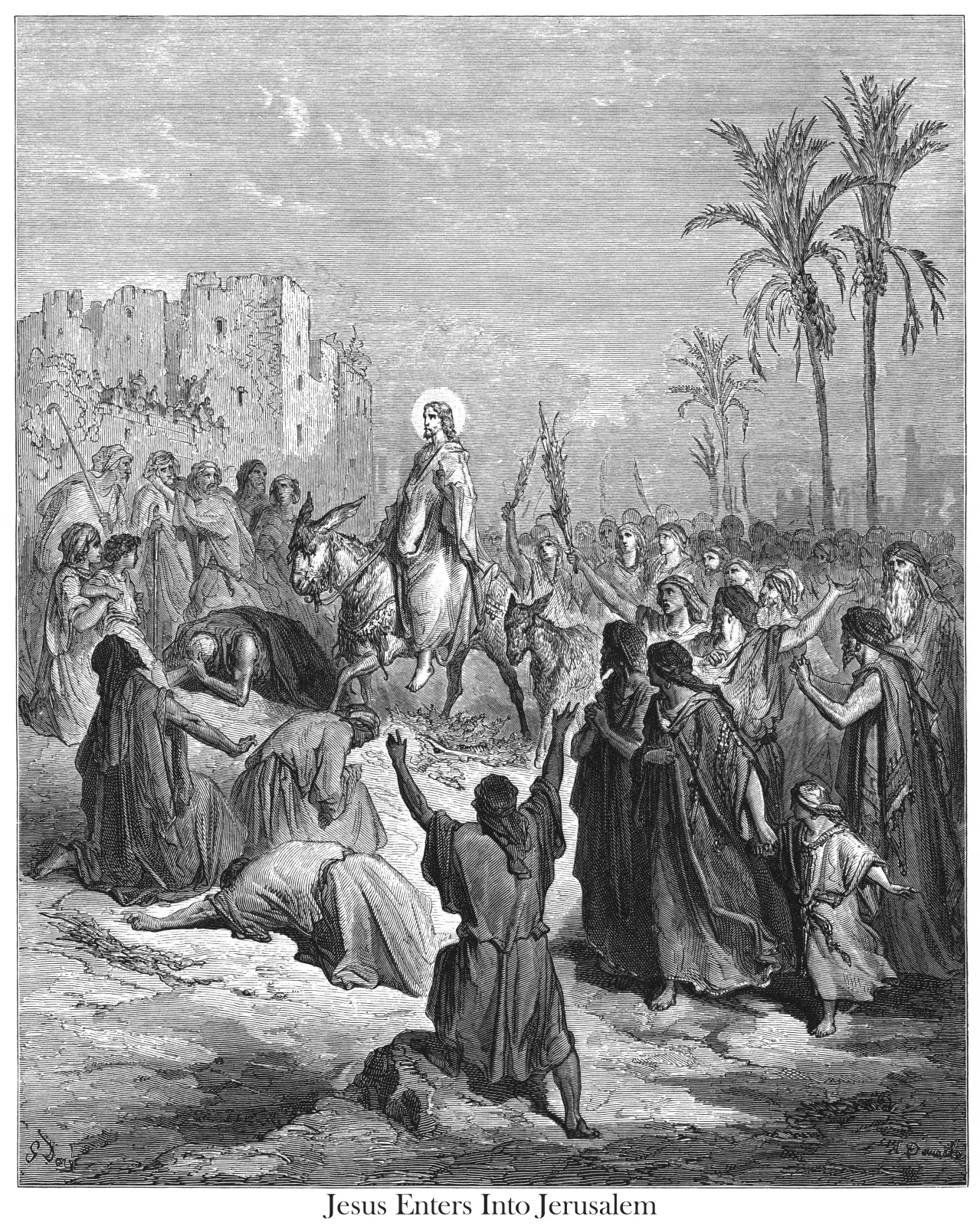
Jesus Enters into Jerusalem
Matthew 21:7-8 · World English Bible (Catholic)
7and brought the donkey and the colt and laid their clothes on them; and he sat on them.
8A very great multitude spread their clothes on the road. Others cut branches from the trees and spread them on the road.
In the foreground, a man seen from behind raises both arms toward Jesus. In front of him, others bow down right onto the road. Their bodies occupy the very passage along which the mount advances: the welcome is not simply offered at the sides of the procession; it reaches the ground.
Jesus sits above this crowd, but his mount has its head lowered. A second donkey walks beside him, smaller, its silhouette standing out beneath the branches held aloft. Matthew mentions the she-ass and the colt brought by the disciples; the engraving gives both of them a place in the procession. The presence of the small animal, almost caught up in the crowd, draws the eye from the haloed figure back to the road crowded with bodies and foliage.
The branches are not all strewn on the ground, as in the verses cited: several are raised above the heads, while others lie beneath the feet. This shift makes visible the eagerness of those accompanying Jesus. On the right, gestures multiply; on the left, near the city walls, faces watch his approach. The ramparts give the movement a destination, without yet enclosing it within a gate.
The text also speaks of cloaks laid on the animals and on the road. Here, the eye chiefly distinguishes the garments worn by the bowed figures and the branches scattered on the ground; the act of laying down the cloaks is not clearly singled out. The engraving gives greater prominence to the postures of welcome. In the immediate context, the crowd acclaims the Son of David: these words cannot be read in the image, but the outstretched arms and bowed bodies suggest their silent presence. The dignity accorded to Jesus may thus be sought in this closeness to the two donkeys and to those pressing along his path.