Gustave Doré · Matthew 17:14-15
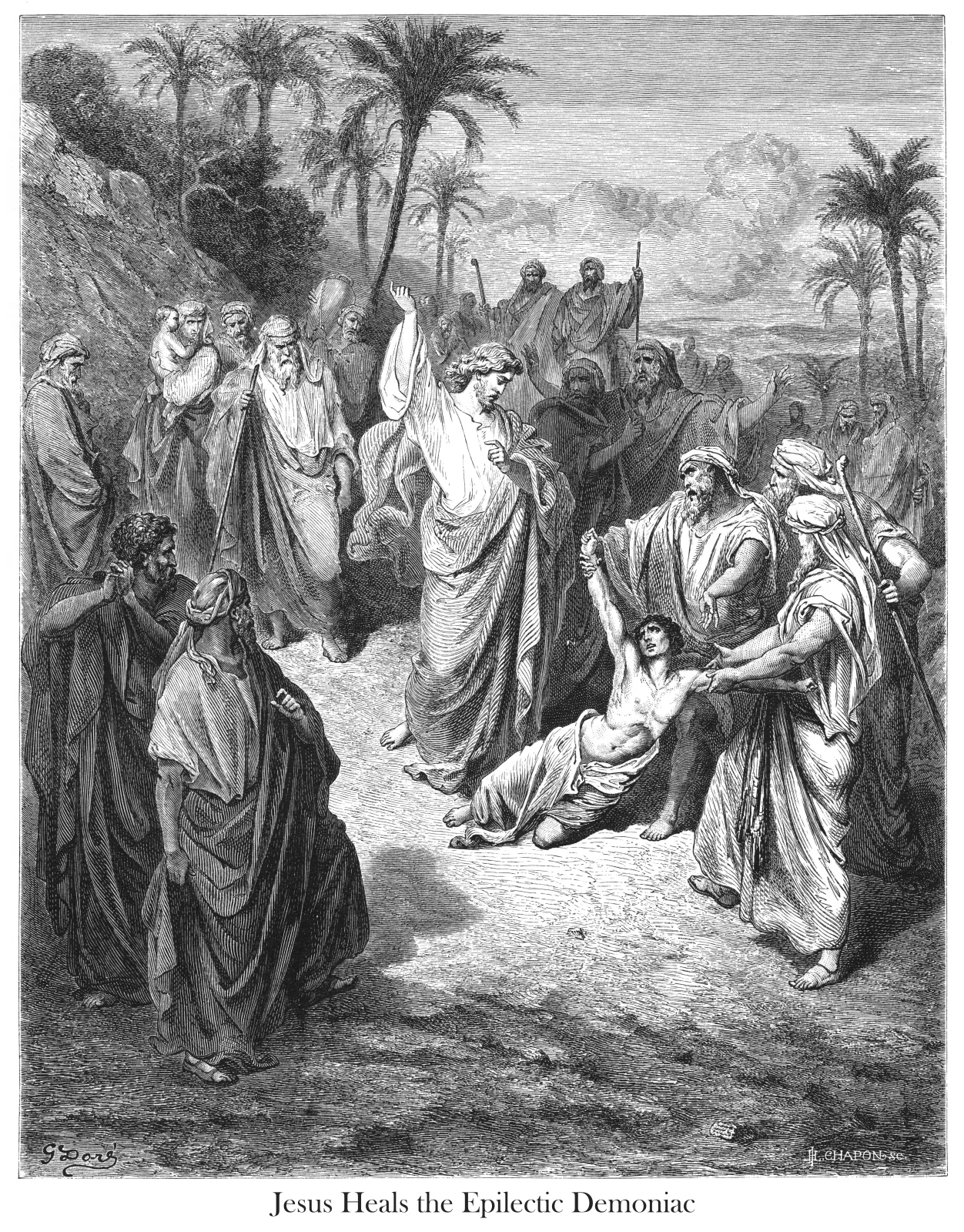
Jesus Heals the Epileptic Demoniac
Matthew 17:14-15 · World English Bible (Catholic)
14When they came to the multitude, a man came to him, kneeling down to him and saying,
15“Lord, have mercy on my son, for he is epileptic and suffers grievously; for he often falls into the fire, and often into the water.
The young man is almost on the ground. His torso pitches backward, his head turning upward toward Jesus, while two men hold his arms. The man on the left supports him by his raised hand; on the right, the other grasps his outstretched arm. Between these grips, the body seems both supported and restrained.
Jesus stands very close to him, without touching him. His gaze falls on the sick man, but his raised arm carries the gesture much higher, above the crowd. The vertical line of this arm answers that of the arm being lifted beside the young man. One belongs to a steady figure, the other to a body that can no longer stand on its own. Around them, the onlookers watch, speak, or reach out their hands; their movements converge on this narrow space where no one has yet let go of the sick man.
In Matthew, it is the father who speaks first. Kneeling before Jesus, he describes his son’s falls into the fire and into the water and recounts the disciples’ failure. His plea makes known a repeated suffering, without yet placing the crisis itself before the reader’s eyes. Here there is no fire, no stretch of water: the fall described by the father takes the form of a body toppled onto the ground, surrounded by hands holding it. It would nevertheless be imprudent to identify any one of these men with certainty as the father.
The catalogue title announces the healing; the verses provided stop at the plea and Jesus’ command to bring the child. Christ’s raised hand thus gives the engraving a significance that extends beyond the moment of supplication alone, without allowing us to say that the young man has already been healed. In this interval, the father’s words, “have pity,” find a visible echo: the one who suffers is brought before Jesus by others, even as their hold on him reveals the limits of their help.