Gustave Doré · 2 Samuel 18:33
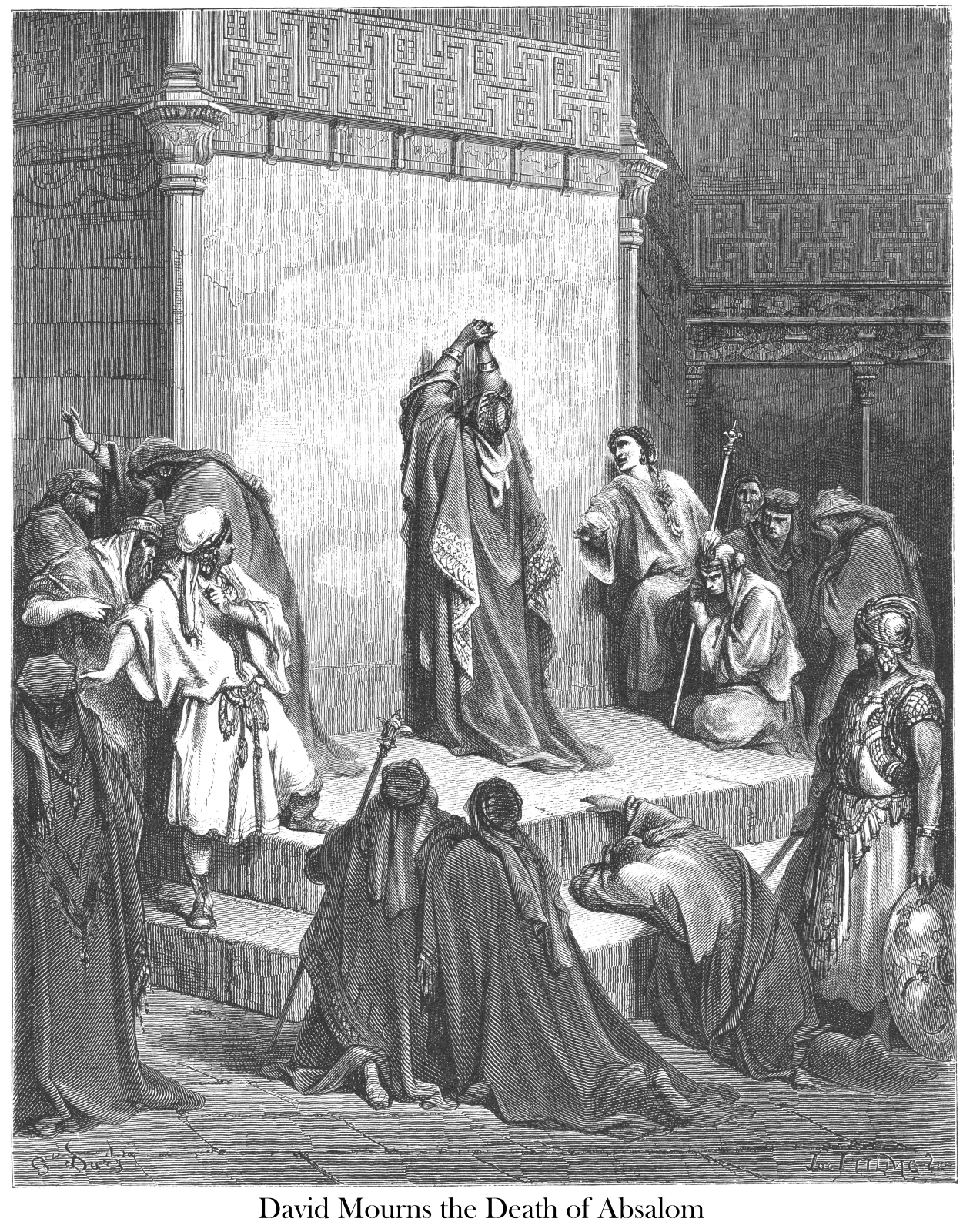
David Mourns the Death of Absalom
2 Samuel 18:33 · World English Bible (Catholic)
33The king was much moved, and went up to the room over the gate and wept. As he went, he said, “My son Absalom! My son, my son Absalom! I wish I had died instead of you, Absalom, my son, my son!”
David’s hands meet above his head. His body remains upright, but his upturned face is partly hidden by his arms. On the dais, the king stands out against a large light-colored wall; around him, figures bend forward, cover their faces, or fall to their knees. The space separating David from those close to him makes his gesture all the more visible. He towers over the assembly without seeming to address it.
In the foreground, a figure is slumped on the steps, his head hidden in his arms. On the right, an armed man stands beside his shield. The soldier’s presence brings the world of battle into this place of lament, while the body bent over the steps conveys the extent of the grief spreading through the royal entourage. The distance between these two figures is small; their postures do not meet.
The Book of Samuel gives voice to a lament that the engraving cannot utter. David repeats Absalom’s name and wishes that he had died in his place. He walks weeping into the room above the gate. Here, his gesture brings the movement of the text to a halt: the cry belongs to an immobile body, exposed to view. The room cannot be identified with certainty, but the platform and the assembly give the grief a public scale.
The lines following the verse illuminate this collective presence: victory is turned to mourning for all the people, who learn of the king’s distress. The engraving thus brings the father’s lament close to its echoes around him, without depicting Absalom. He whose name fills David’s words remains absent; it is the living, even those on the steps, who bear the mark of his death. The king’s wish to die in his son’s place then raises a question to which the raised gesture offers no answer: how can victory be received when it is bound up with such a loss?