Gustave Doré · Numbers 22:23
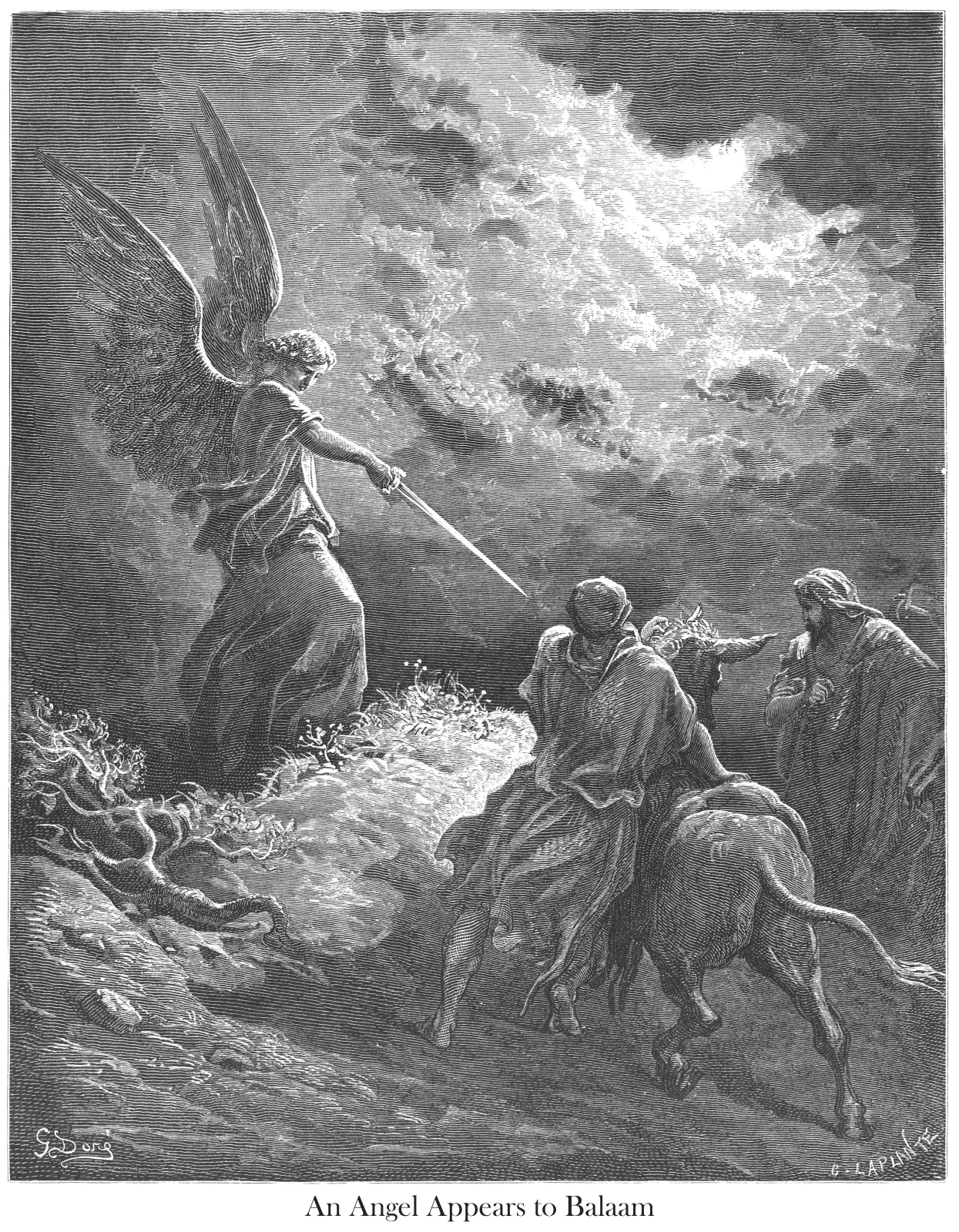
An Angel Appears to Balaam
Numbers 22:23 · World English Bible (Catholic)
23The donkey saw the LORD’s angel standing in the way, with his sword drawn in his hand; and the donkey turned out of the path, and went into the field. Balaam struck the donkey, to turn her into the path.
The point of the sword descends toward the group without reaching it. On the left, the angel spreads his wings and extends his arm; on the right, the donkey and its rider occupy the path. A dark interval remains between the blade and them. It is in this space that the journey is suspended.
The animal advances at an angle, its legs spread apart, while Balaam, seen from behind, turns his head to the left. The silhouette of the donkey does not form a stable figure with that of the rider: its slanting body and legs set in different directions give the movement a hesitant quality. The landscape itself offers little easy passage. A light-colored embankment, covered with grasses and branches, separates the angel from the group; above, a bright opening in the clouds overlooks the scene.
The Book of Numbers gives this moment a decisive detail: it is the donkey that sees the angel of Yahweh, standing on the path with his sword drawn in his hand. She turns aside into the fields; Balaam strikes her to bring her back to the road. The engraving makes the angel immediately visible, but the rider’s face remains hidden. The turn of his head is not enough to establish what he sees. As for the blow mentioned in the text, it is not clearly discernible here.
This uncertainty matters. The angel occupies an immense space in the engraving, whereas the narrative first attributes perception to the animal. The detour, which may seem like disobedience to Balaam, is a response to an obstacle that the donkey alone is said to witness. The sword lends the halt a gravity that the rider does not yet recognize in the passage cited. The scene thus reveals a disparity between the conduct a man seeks to impose and the threat to which his mount reacts.