Gustave Doré · Exodus 32:19
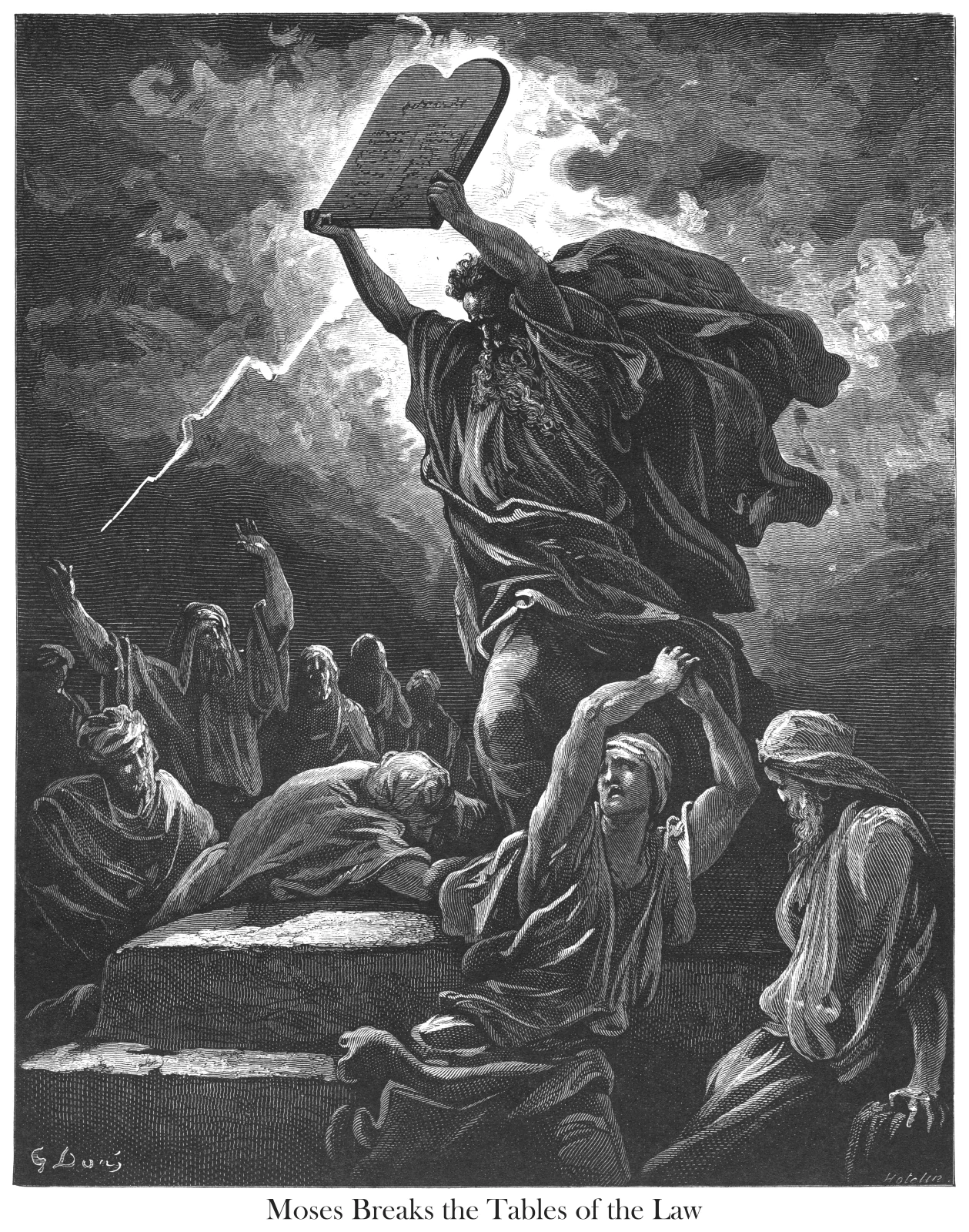
Moses Breaks the Tablets of the Law
Exodus 32:19 · World English Bible (Catholic)
19As soon as he came near to the camp, he saw the calf and the dancing. Then Moses’ anger grew hot, and he threw the tablets out of his hands, and broke them beneath the mountain.
The tablets are still in Moses’s hands. Raised above his head, they stand out against a bright opening in the clouds. Their outlines are intact, their inscriptions visible. A moment later, they are to be hurled to the ground; the engraving captures the gesture before it is complete.
Beneath Moses’s outstretched arms, his face bends toward the group gathered at his feet. His lifted cloak extends the violence of the movement, while in the foreground a man in turn raises his arms above his head. This gesture echoes Moses’s, but his hands are empty. Around him, bodies bend or turn away. The inscribed stone towers over these closely gathered figures, none of whom touches it.
In Exodus, Moses approaches the camp after hearing singing. He sees the calf and the dancing; his anger flares, and he breaks the tablets at the foot of the mountain. Doré retains the mountain and the gesture of breaking, but the calf does not appear in the frame. The cause of the anger must be sought in the text. Here, the tablets occupy the highest place and draw the eye before their fall can destroy them.
This choice lends the gesture a particular gravity: Moses raises what he is about to break. The Law remains legible as a material presence at the moment when its stone is under threat. The passage links this shattering to the sight of the calf; by leaving it out of the frame, the engraving concentrates attention on what is being broken before the people. The coming fracture can thus be read in light of the offense Moses names afterward: the tablets bear the words of a covenantal relationship between God and Israel that has just been wounded.