Gustave Doré · Genesis 41:25-26
Joseph Interprets Pharaoh's Dream
Genesis 41:25-26 · World English Bible (Catholic)
25Joseph said to Pharaoh, “The dream of Pharaoh is one. What God is about to do he has declared to Pharaoh.
26The seven good cattle are seven years; and the seven good heads of grain are seven years. The dream is one.
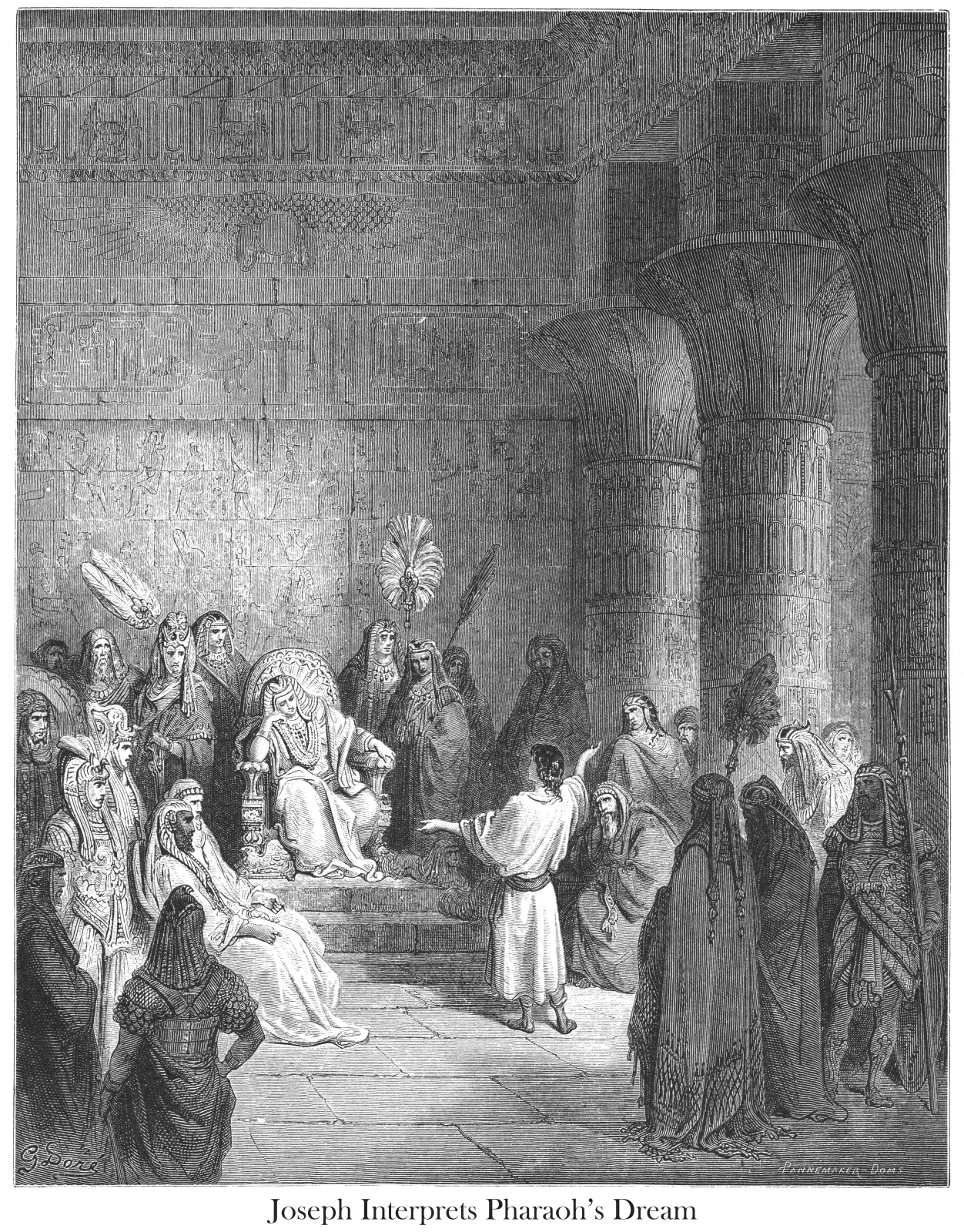
Standing in the middle of the hall, Joseph has his back to the viewer. With one arm extended toward the throne and the other raised, he gives his words a breadth that his averted face does not allow us to gauge. Before him, Pharaoh sits above, his head resting on one hand. The steps keep the two men apart; their gestures bridge the distance.
The court forms an irregular circle around Joseph. The figures are numerous, but an open space remains before the speaker. His light tunic stands out against the darker garments and the great columns covered in motifs. The palace occupies a large part of the engraving: above the figures, its walls covered in signs and its capitals assert their mass. Yet the centre of attention lies lower down, in the exchange between the standing man and the sovereign leaning toward him.
Joseph is not recounting his own dream here. Pharaoh has just confided his to the scribes, without obtaining an explanation. Joseph tells him that the fine cows and the fine ears of grain signify the same years: in two forms, the dream is one. The lean cows and the empty ears of grain, in turn, will herald years of famine. None of these dreamed creatures or plants appears in the hall. The engraving leaves it to words to bring them back.
This choice gives weight to Pharaoh’s posture. The master of the place listens to a meaning he does not yet possess, while Joseph, positioned below him, speaks before the whole court. According to his own words, what is about to happen has been made known to the king by God. Joseph’s open gesture can then be read as that of an interpreter: he does not give the dream a body; he conveys its meaning.