Gustave Doré · Genesis 24:65-67
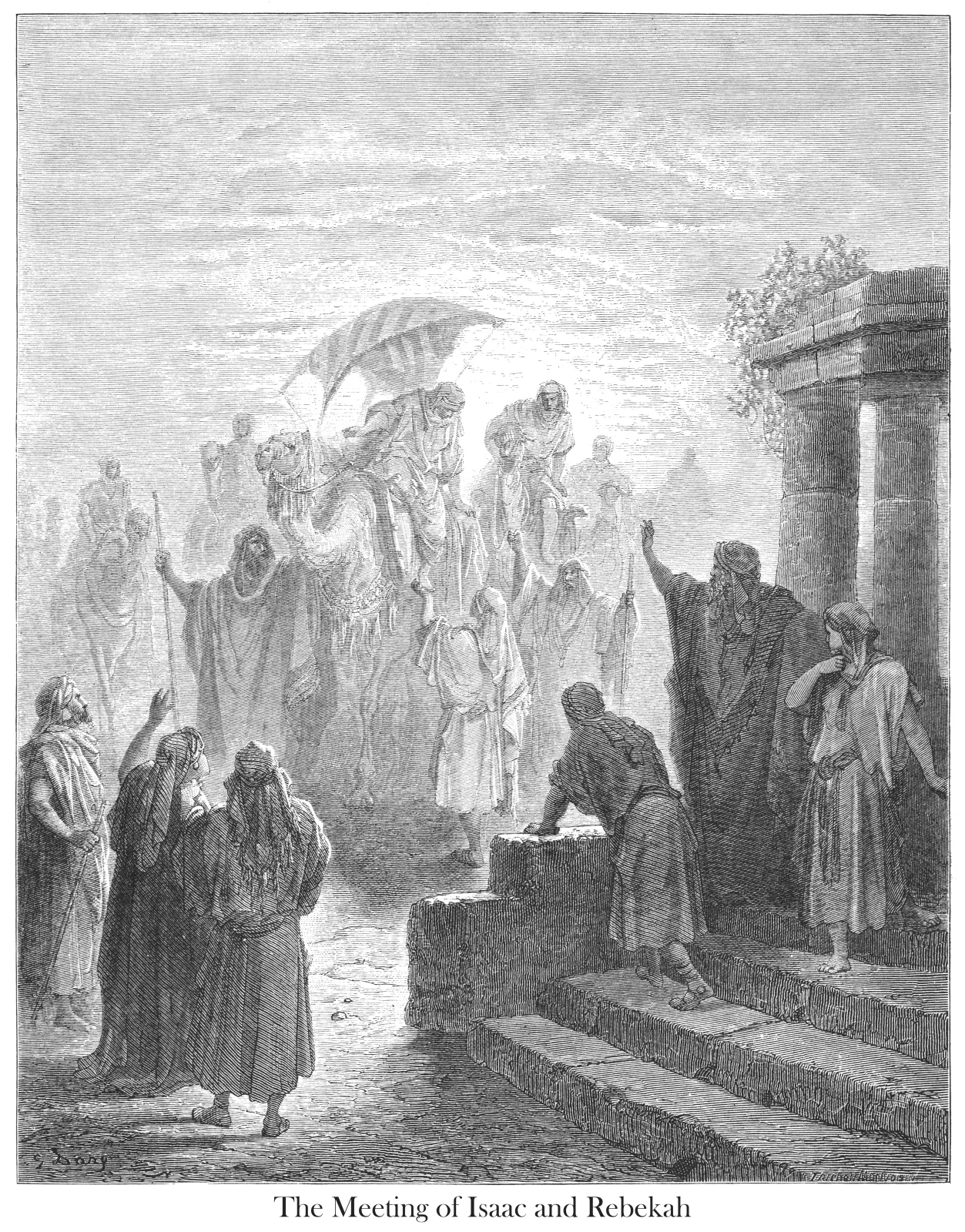
The Meeting of Isaac and Rebekah
Genesis 24:65-67 · World English Bible (Catholic)
65She said to the servant, “Who is the man who is walking in the field to meet us?” The servant said, “It is my master.” She took her veil, and covered herself.
66The servant told Isaac all the things that he had done.
67Isaac brought her into his mother Sarah’s tent, and took Rebekah, and she became his wife. He loved her. So Isaac was comforted after his mother’s death.
At the center, a figure leans down from the camel beneath a broad fabric canopy. Below, someone raises their arms toward her. On the right, on the steps of a building, a man reaches out toward the caravan. The space between this gesture and the mount remains open: the meeting announced by the title is still unfolding at a distance.
The eye moves from one group to another. Behind the laden camel, other travelers barely emerge in the light of the background; in the foreground, figures seen from behind turn toward the arrival. The man on the steps is surrounded too. What might have been an encounter between two people takes on the scale of a welcome witnessed by many. Yet no contact has yet brought the two sides of the engraving together.
Genesis first places the encounter in the fields. Rebekah sees Isaac, gets down from her camel, and asks the servant who the man is. When she learns that he is her master, she covers herself with a veil. In the engraving, the descent and the gestures of welcome hold the attention; the steps and stone building give the arrival a setting that the verses do not specify. The identity of each figure in the crowd, however, remains uncertain.
The text continues beyond the moment shown: the servant recounts his journey, then Isaac leads Rebekah into Sarah’s tent. She becomes his wife; he loves her and finds comfort after his mother’s death. The tent and the mourning remain outside the frame. Their mention gives particular significance to the distance that still separates those arriving from those welcoming them: the union to come will take place within a story already marked by an absence. In the engraving, they must first cross the space between the caravan and the steps.